Kidney Offer Acceptance Patterns During Transition From Pediatric to Adult Care: Refusal of Higher Quality Donor Kidneys Among Young Adult Candidates

Authors
Affiliations
Abstract
Introduction: Candidate refusal of deceased donor kidney offers (OPTN refusal code 728 “patient declined organ offer”) may reflect unique risk perceptions and decision-making behaviors during the transition from pediatric to adult transplant care. We sought to determine whether transition-of-care aged kidney transplant candidates differ from older adults in the quality of donor kidneys declined.
Methods: We performed a retrospective cohort study using OPTN kidney allocation data from December 2021 through December 2025. Candidates with at least one documented refusal code 728 were stratified by age (18-25, 26-40, and > 40 years). Characteristics of refused kidneys and post-refusal outcomes were compared across age groups. Transition-of-care aged candidates were defined as those in the 18-25 years age group. Kidney quality was defined by Kidney Donor Profile Index (KDPI), with high quality kidneys defined as those with KDPI ≤ 20 and marginal kidneys defined as those with KDPI ≥ 85.
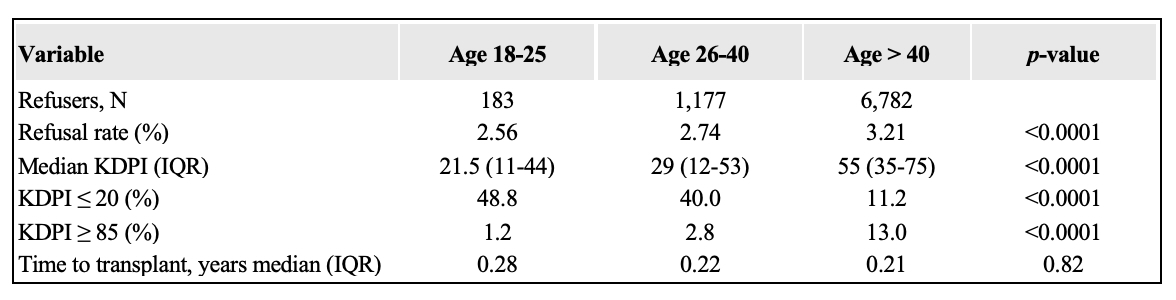
Results: Patient-level refusals were similar across age groups (2.56%, 2.74%, and 3.21% for ages 18-25, 26-40, and > 40 years, respectively) (Table 1). However, the quality of refused kidneys differed markedly by age. Transition-of-care aged candidates refused significantly higher quality kidneys, with a median refused-kidney KDPI of 21.5 (IQR 11-44), compared with 29.0 (IQR 12-53) among candidates aged 26-40 years, and 55.0 (IQR 35-75) among candidates > 40 years (p < 0.0001). Nearly one-half of kidneys refused by candidates aged 18-25 years were high-quality organs (KDPI ≤ 20; 48.8%) compared with 40.0% and 11.2% in the older age groups (p < 0.0001). Conversely, refusal of marginal kidneys (KDPI ≥ 85) was uncommon among transition-of-care aged candidates (1.2%), but increased with age (2.8% among 26-40 years and 13.0% among > 40 years, respectively; p < 0.0001). The difference in high-quality kidney refusal demonstrated the largest age-related effect observed in the analysis (Cramér's V=0.31). Time to transplantation after refusal was similar across groups (median 0.28 vs. 0.22 vs. 0.21 years; p = 0.82).
Conclusion: Transition-of-care aged kidney transplant candidates do not refuse deceased donor kidney offers more frequently than older adults, but they disproportionately decline higher quality donor kidneys. Nearly half of all kidneys refused by candidates aged 18-25 years were high-quality organs. These findings suggest distinct organ acceptance patterns during transition to adult care and identify an opportunity for targeted education and shared decision-making surrounding deceased donor kidney offer acceptance.