
A Single Center Comparison of BK, CMV, and EBV Infections Among Highly Sensitized and Non-Sensitized Pediatric Kidney Transplant Recipients
Authors
Affiliations
Abstract
Background: Pediatric kidney transplant recipients are at risk for viral infections due to their tendency for being naïve to these viruses compared to their donors. Here, we performed an observational analysis of BK, CMV, and EBV infections among three distinct groups of pediatric kidney transplant recipients: highly sensitized, non-sensitized steroid-based, and non-sensitized early steroid-withdrawal.
Methods: A single center retrospective analysis of 111 pediatric patients <21 years old who received a kidney transplant between January 2012-December 2025. Patients received induction immunosuppression with either a lymphocyte depleting (LDA, ATG or alemtuzumab) or a non-lymphocyte depleting agent (NLDA, basiliximab or daclizumab) and maintained on mycophenolate mofetil, tacrolimus, with or without corticosteroids. The cohort was divided into three groups: highly sensitized (Group A), non-sensitized steroid-based (Group B), and non-sensitized steroid-withdrawal (Group C). The frequencies of, time to, and duration of BK, CMV, and EBV infections were evaluated. Secondary analysis included the incidence of multiple viral infections and recurrent infections among the groups.
Results: Median age at transplant was 15.5 years (IQR 11.9-18.5 years); 70 (63.1%) were male. Per center protocol, all patients in Group A and C (56.4%) received induction immunosuppression with LDA, compared to 43.6% in Group B. BK, CMV, and EBV occurred in 27.0%, 30.6%, and 32.4% of the whole cohort. There were no differences between donor/recipient (D/R) CMV serologies among Group A, B, and C (Table 1, P=0.48); however, there was a trend for higher EBV D+/R- in Group C (P=0.05). The incidence of, median time to, and duration of BK and CMV infections were similar among Group A, B, and C (Table 1). Furthermore, there were no differences in the frequency and length of EBV disease between the groups; however, median time to EBV was later in Group A compared to Group B and C (47.1 vs. 6.2 vs. 3.8 months, P <0.001, Table 1). PTLD occurred in one patient in Group A. Recurrent BK and CMV infections were similar between the groups; however, Group C had more EBV recurrence (Table 1, P=0.01). All patients with recurrence received LDA immunosuppression. 100% CMV recurrence were CMV D+/R- at the time of transplant, compared to 71.4% EBV D+/R- with EBV recurrence. More than one viral infection occurred in 23.3%, 25.6%, and 23.8% of subjects in Group A, B, and C, respectively (Table 1, P=0.97). Median follow-up period was 41.9 months (IQR 21.3-83.2 months).
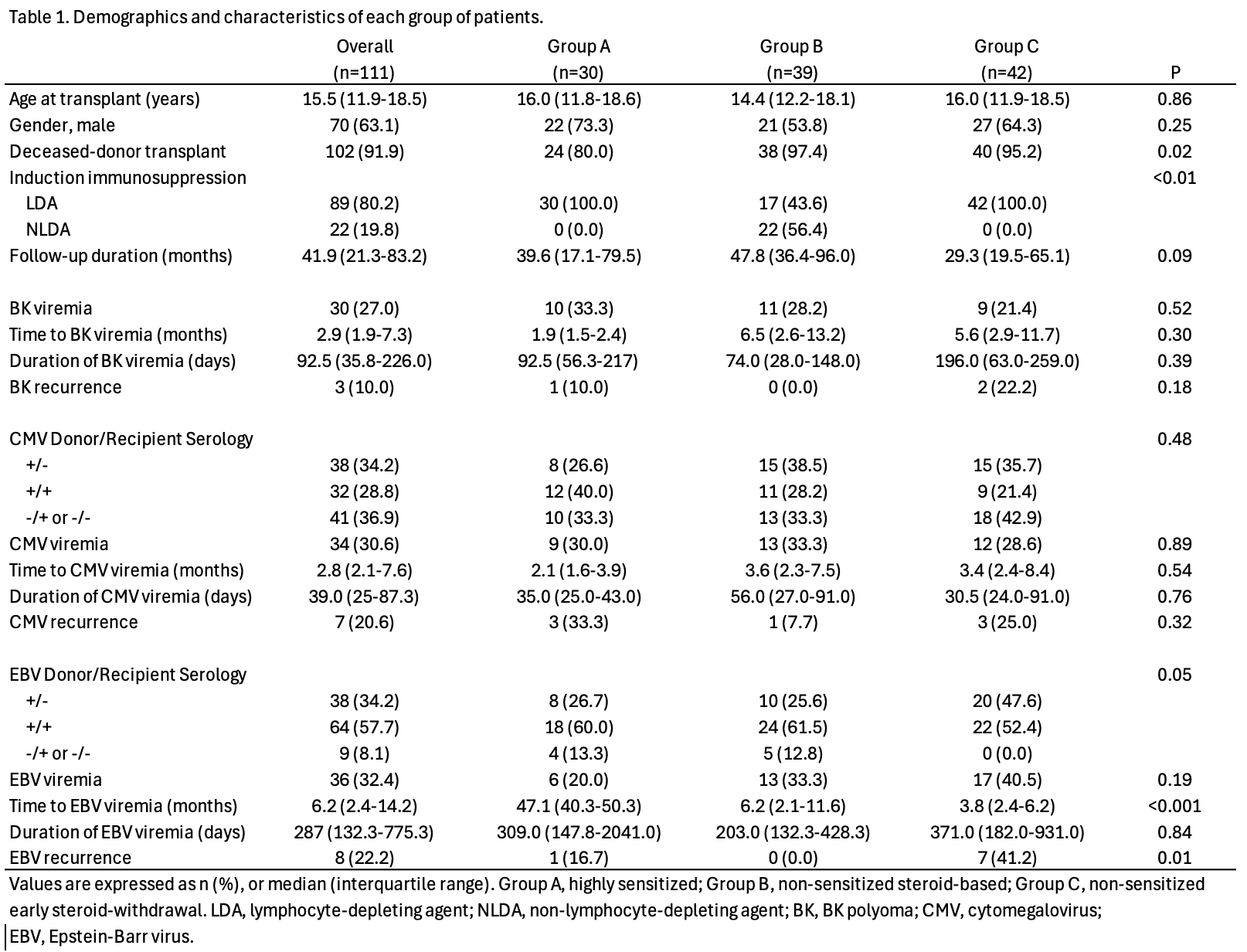
Conclusion: BK, CMV, and EBV infections each occurred in approximately 30% of this cohort of pediatric kidney transplant recipients. The incidence of, and duration of viremic episodes were similar between the three groups, despite increased immunosuppression via desensitization treatments in the highly sensitized patients. While BK and CMV infections commonly occurred in the first-year post-transplant and cleared in a few months, EBV infections took longer to clear, and the highly sensitized recipients developed EBV viremia years after transplant. Overall, viral infections were more likely to occur with LDA induction and CMV or EBV D+/R-. Approximately 24% of the cohort developed multiple viral infections, with no difference in incidence among the groups.