Longitudinal donor-derived cell-free DNA dynamics provide an early signal of subclinical rejection in pediatric liver transplantation
Authors
Affiliations
Abstract
Introduction: Donor-derived cell-free DNA (dd-cfDNA) is a non-invasive biomarker of allograft injury. Its longitudinal dynamics and association with biopsy-proven acute rejection (BPAR) in pediatric liver transplant recipients (PLTR) remain incompletely characterized, particularly in subclinical rejection. We evaluated whether trajectory-derived dd-cfDNA metrics were associated with subclinical BPAR (subBPAR) and if it could provide an early signal of graft injury during the first year post-transplant.
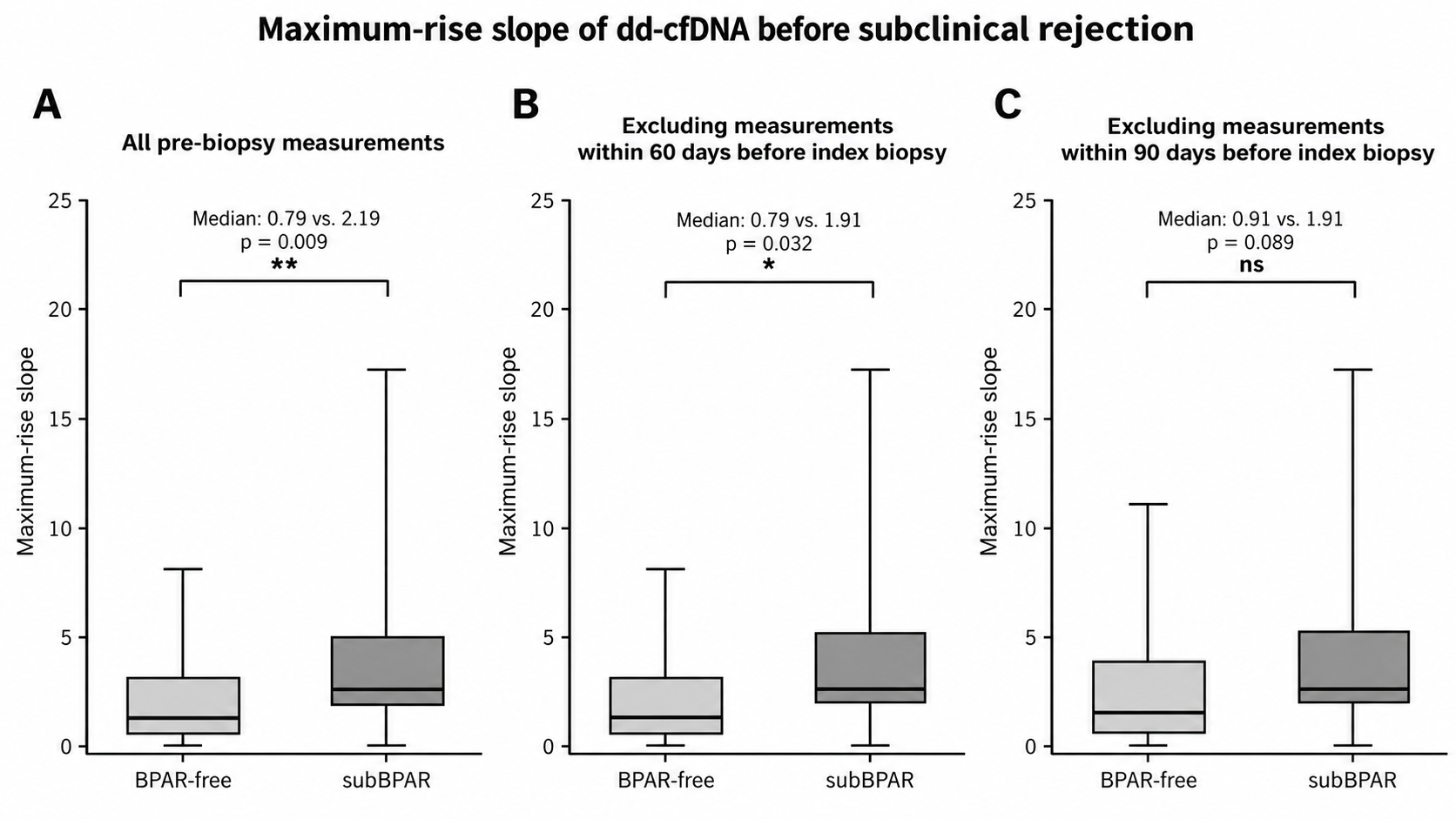
Methods: We conducted a prospective single-center longitudinal study of 76 PLTR during the first year post-transplant. Rejection was diagnosed according to Banff criteria. Subclinical BPAR (subBPAR) was defined as rejection detected on surveillance biopsy in clinically stable patients with normal liver function test; overt BPAR (overtBPAR) was diagnosed on for-cause biopsy in the setting of graft dysfunction. The index biopsy was defined as the first BPAR or, in BPAR-free patients, the last negative biopsy. Follow-up was censored at the last dd-cfDNA measurement obtained before the index biopsy; study inclusion required ≥3 pre-biopsy dd-cfDNA measurements. Several trajectory-derived metrics were explored, and maximum-rise slope (MRS) was selected for focused analysis based on its discriminatory performance and interpretability. MRS was calculated as the ratio of the largest positive increase in dd-cfDNA to the corresponding time interval. Group comparisons used the Wilcoxon-Mann-Whitney test and ROC analysis assessed discrimination. Temporal persistence of the MRS signal was recalculated after progressively excluding measurements obtained within 60 and 90 days before the index biopsy; ≥3 retained measurements were required at each cutoff.
Results: In the full pre-biopsy analysis, MRS was significantly higher in subBPAR (n=18) than in BPAR-free patients (n=28), with median values of 2.19 and 0.79, respectively (Mann-Whitney p=0.009). ROC analysis yielded an AUC of 0.73. The difference remained significant after excluding dd-cfDNA measurements obtained within 60 days before biopsy (median 1.91 vs 0.79; p=0.032; AUC=0.69), but attenuated when this exclusion interval was extended to 90 days (median 1.91 vs 0.91; p=0.089; AUC=0.65) (Figure.1).
Conclusion: MRS identified a dynamic dd-cfDNA early signal associated with subBPAR. This signal remained detectable after excluding measurements obtained within 60 days of biopsy but attenuated when the exclusion period was extended to 90 days. These findings support the use of longitudinal dd-cfDNA dynamics for early identification of subclinical graft injury in PLTR.