
Improving Tissue Adequacy for Diagnosis of Rejection Using Transbronchial Cryobiopsy in Pediatric Lung Transplant Recipients
Authors
Affiliations
Abstract
Background
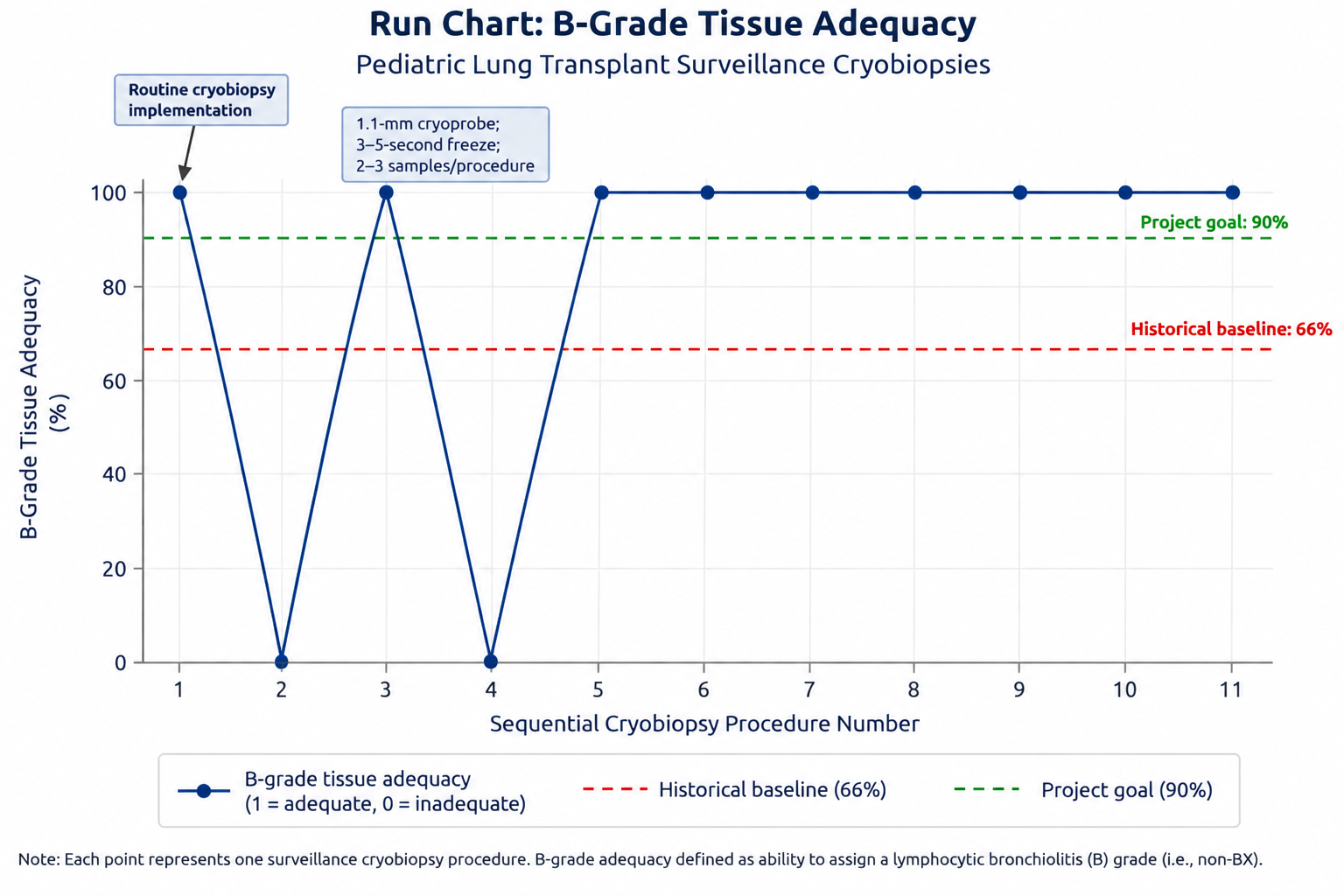
Adequate transbronchial biopsy tissue is essential for accurate histologic assessment of lung allograft rejection in pediatric lung transplant recipients. Conventional forceps biopsy may provide limited and artifact-prone tissue, particularly in younger children requiring smaller forceps. At our institution, only 66% of surveillance forceps biopsy procedures provided adequate tissue to assign a lymphocytic bronchiolitis (B) grade. We initiated a prospective quality-improvement project to implement routine transbronchial cryobiopsy for surveillance bronchoscopy.
Aim
To increase the proportion of surveillance transbronchial biopsy procedures adequate for B-grade assessment from 66% to at least 90% within the first 20 procedures following cryobiopsy implementation.
Methods
Routine transbronchial cryobiopsy was implemented using a 1.1-mm cryoprobe with 3 to 5-second freeze times. Two to three specimens were collected per procedure under endoscopic and fluoroscopic guidance. The primary outcome was the proportion of surveillance biopsy procedures with tissue adequate for B-grade assignment, defined as pathology reporting B0, B1R, or B2R rather than BX. Secondary outcomes included A-grade adequacy and acute rejection detection. Process measures included cryobiopsy adoption and fluoroscopy time. Balancing measures included bleeding, pneumothorax, and post-procedural escalation of care.
Results
Eleven surveillance cryobiopsy procedures have been completed. Tissue was adequate for B-grade assessment in 9 of 11 procedures (81.8%) and for A-grade assessment in 11 of 11 procedures (100%). Mean fluoroscopy time was 62.3 seconds, representing an approximately threefold decrease from the historical forceps-biopsy fluoroscopy time of 150–180 seconds. Nine procedures were associated with very mild Nashville grade 1 bleeding. Two procedures had grade 2 bleeding requiring intervention. No pneumothoraces, chest tube placements, or post-procedure escalations in care occurred.
Conclusions
Early implementation of transbronchial cryobiopsy in pediatric lung transplant surveillance bronchoscopy has improved B-grade tissue adequacy relative to the historical 66% forceps-biopsy baseline, although the preliminary rate of 81.8% has not yet reached the project target of 90%. A-grade adequacy was achieved in all procedures. Cryobiopsy was implemented without pneumothorax or post-procedural clinical deterioration and with substantially reduced fluoroscopy time. Ongoing sequential monitoring, pathology feedback, and PDSA-guided refinement will evaluate achievement and sustainability of the ≥90% B-grade adequacy target while continuing to monitor procedural safety.