Era, Not Case-Mix, Explains Survival Gains After Pediatric Liver Transplantation: A 1,526-Patient Single-Team Cohort.

Authors
Affiliations
Abstract
Background: Pediatric liver transplantation has changed substantially over three decades, yet how much of the improvement in outcome reflects recipient selection, donor and graft strategy, or operative technique is rarely quantified within a single, continuously operating transplant team. We analyzed 1,526 consecutive primary transplants performed by one team over 35 years to disentangle these contributions.
Methods: Retrospective cohort of all 1,526 primary liver transplants in recipients under 18 years performed between September 1991 and June 2026, divided into tertiles of case volume: P1 1991-2011 (n=500), P2 2011-2018 (n=500), P3 2018-2026 (n=526). Patient and graft survival were estimated by Kaplan-Meier and compared by log-rank; complications by chi-square with Cochran-Armitage tests for trend. Covariates were incomplete in 43% of cases, concentrated in P1, so multiple imputation by chained equations was used (m=20, including outcome and Nelson-Aalen hazard) with estimates pooled by Rubin's rules. Multivariable Cox models adjusted for recipient case-mix, donor and graft factors, and operative variables.
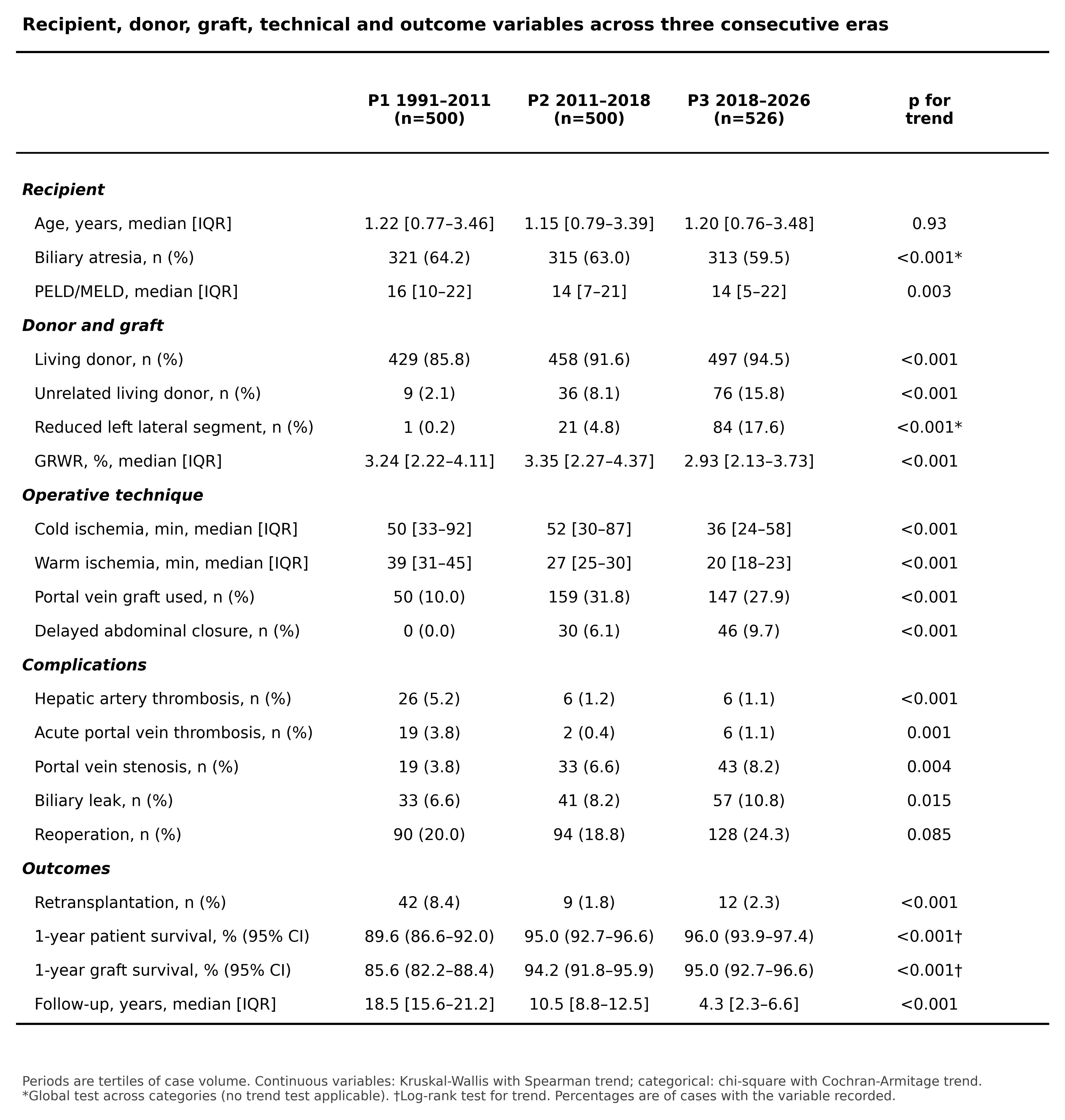
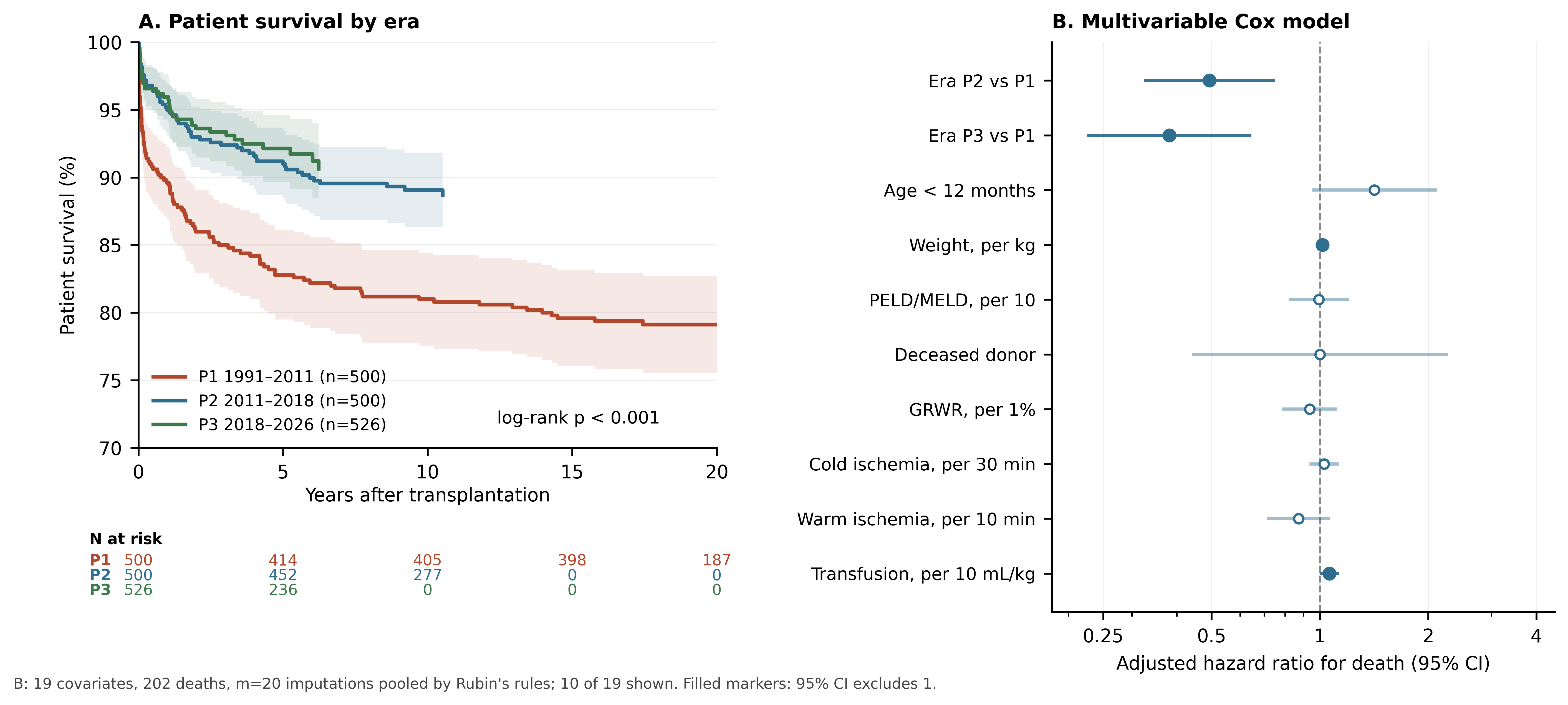
Results: Median follow-up was 9.0 years (maximum 33.4). Recipient profile was stable across periods: median age 1.2 years, 41% under 12 months, biliary atresia 64.2%, 63.0% and 59.5% (p=0.93 for age). Living donors increased from 85.8% to 94.5% and unrelated living donors from 2.1% to 15.8%; reduced left lateral segment grafts rose from 0.2% to 17.6%, GRWR fell from 3.24% to 2.93%, warm ischemia from 39 to 20 min and cold ischemia from 50 to 36 min (all p<0.001). One-year patient survival improved from 89.6% to 96.0% and graft survival from 85.6% to 95.0% (log-rank p<0.001); retransplantation fell from 8.4% to 2.3%. Hepatic artery thrombosis fell from 5.2% to 1.1% and acute portal vein thrombosis from 3.8% to 1.1% (both p<0.001), whereas portal vein stenosis rose from 3.8% to 8.2% (p=0.004) and biliary leak from 6.6% to 10.8% (p=0.015) (Figuere 1). Biliary stricture was unchanged among patients with ≥3 years of follow-up (17.4%, 17.5%, 17.0%). The adjusted hazard of death for P3 versus P1 was 0.38 (95% CI 0.23-0.64) and for graft failure 0.36 (0.23-0.58); adjustment strengthened rather than attenuated the era effect. Intraoperative transfusion was the only operative variable independently associated with death (HR 1.06 per 10 mL/kg, p=0.019) (Figuere 2). Model discrimination was modest (Harrell's C 0.65).
Conclusion. Over 35 years, patient and graft survival improved markedly and arterial and early portal thromboses became rare, while portal vein stenosis and biliary leak increased alongside wider use of reduced grafts and lower GRWR. The survival gain persisted, and grew, after adjustment for recipient case-mix and every recorded donor, graft and technical variable, indicating that cumulative program experience and perioperative care account for much of it. Surgical databases that aim to explain era effects should capture these domains prospectively.