Project Hope: A peer support and resource network for adolescent and young adult solid organ transplant recipients
Authors
Affiliations
Abstract
Pediatric solid organ transplantation presents distinct challenges that evolve from childhood through adolescence and into young adulthood. Addressing the complex mental and emotional needs of these patients remains an ongoing concern, often linked with clinical outcomes. Peer support has been associated with improved psychosocial outcomes in other chronic populations but represents an underutilized resource in pediatric transplantation. Drawing on their lived experiences, a group of young adult transplant recipients established Project Hope to provide and evaluate peer support and educational resources specific to pediatric, adolescent, and young adult (AYA) transplantation. Project Hope aims to address the unmet need for peer support resources for pediatric, adolescent, and young adult transplant recipients and promote emotional, behavioral, and conceptual understanding of the transplant experience
Project Hope uses a chapter-based approach to establish center-specific, peer-led support. Each chapter is developed in collaboration with a transplant center advisor (e.g., a Child Life Specialist), who oversees meetings and guides both mentors and mentees. This model aims to provide three core pillars for each mentorship group.
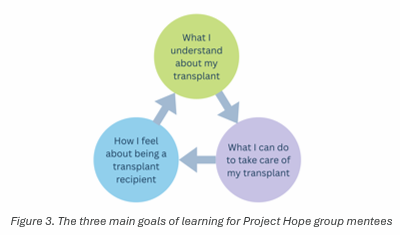
In this model, pediatric transplant recipients participate in group-based mentorship led by older adolescent and young adult (AYA) patients, fostering age-relevant support, shared understanding, and community, with eight core education modules guiding mentorship chapters through crucial concepts about solid organ transplant.
In 2025, the pediatric Child Life program at MedStar Georgetown University Hospital in Washington, D.C., collaborated with Project Hope to found the first ongoing pilot chapter aimed at providing proof of concept for peer mentorship in pediatric liver and intestinal transplantation. The pediatric transplant child life specialist serves as the institutional advisor, organizing participants and adapting programmatic modules. Groups were primarily described by age (Mentorship group: pediatric recipients age 16-26; Mentee group: recipients age 9-15)
To date, 25+ pediatric and AYA transplant recipients have participated in regular group meetings (weekly/biweekly), completed education modules/activities, and/or attended in-person events.
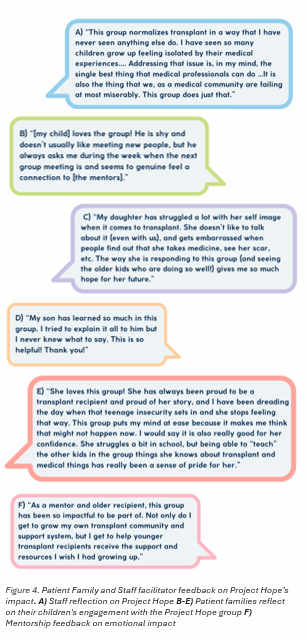
Group mentees, parents, hospital staff, and group mentors have provided feedback, which has been used to evaluate the interplay between cognitive, behavioral, and psychosocial understanding of transplant for pediatric recipients. Over 30 mentorship sessions have occurred since the program launched. The group settings have enabled a broader range of experiences to be shared, community formation, and shared health habit-building among mentors and mentees. Mentors, families, and staff have noted increased mentee engagement and a greater ability to speak about their own transplant journeys.