De Novo Human Leukocyte Antigen Allosensitization in Pediatric Patients with HeartMate 3 Ventricular Assist Devices
Authors
Affiliations
Abstract
Increased allosensitization is associated with longer transplant wait list times and higher waitlist mortality, and among post-transplant recipients a higher risk of antibody-mediated rejection (AMR). Ventricular assist devices (VADs) are associated with increased rates of allosensitization, however the risk of sensitization varies by device.
Single-center adult studies have suggested that the HeartMate 3 (HM3) VAD may confer a lower risk of allosensitization compared with earlier-generation VADs. The impact of HM3 support on HLA sensitization in pediatric patients remains unknown. In this study we examined de novo HLA antibody development after HM3 implantation in pediatric patients at our institution.
This was a review of all pediatric patients who underwent HM3 implantation at our center between 2019-2025. Medical records were retrospectively reviewed for patient history and clinical details. Clinical and demographic variables were described using standard summary statistics.
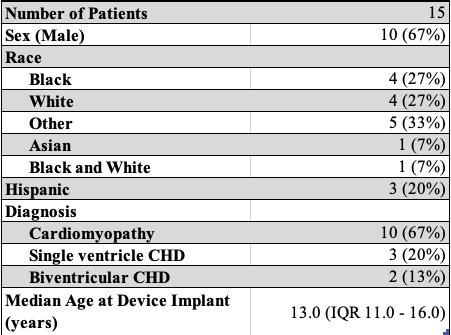
Between 2019-2025, 15 pediatric patients underwent HM3 implantation and had HLA PRA lab testing at our center. The median age at device implant was 13 years (IQR 11–16 years) (Table 1). 13 patients underwent heart transplant, with a median of 199 days on device prior to transplant (IQR 93–264 days). Of the 2 patients who did not undergo transplant, 1 underwent HM3 explant for recovery and 1 died.
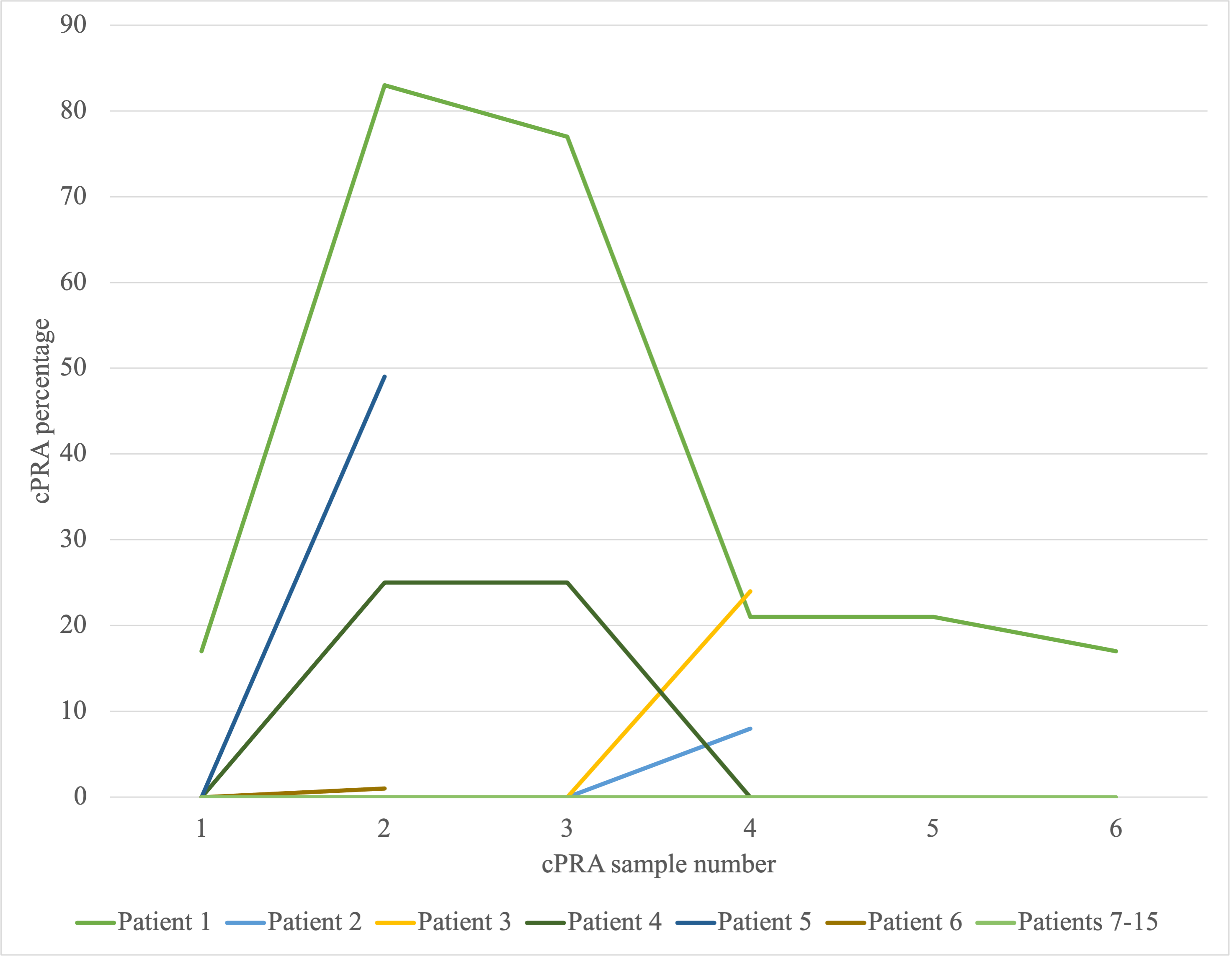
Pre-implant cPRA was 0% in 13 patients (87%). One patient’s cPRA was 17%, and the other patient had nonspecific/inconclusive results in the antibody identification assay. 6 patients (40%) developed HLA antibodies on VAD support; 4 (27%) had a maximum cPRA >/=10% and 2 (13%) had a cPRA <10%. Among the 6 patients who developed HLA antibodies on VAD, 5 developed antibodies to HLA Class I and 1 developed antibodies to Class II. 4 developed persistent antibodies and 2 developed antibodies that later returned to pre-implant baseline (Figure 1), and all de novo antibodies detected were relatively low titer (</=1:64). Of the 13 patients who underwent transplant, 2 had a positive flow crossmatch associated with HLA DSA. 8 patients had positive DSAs in the first 3 months post-transplant, though only 2 patients required treatment for AMR, and both of those patients remained unsensitized following VAD and a negative pre-transplant crossmatch. 14 patients (93%) have survived to date; median time since transplant/VAD explant is 3.0 years (IQR 2.5 - 5.1 years).
While allosensitization among pediatric patients on HM3 VAD support was frequent (27% with cPRA >10%; 13% with cPRA 1-10%), the majority of de novo HLA antibodies were low titer Class I HLA antibodies, and some antibodies were only transient. No patients underwent pre-transplant desensitization and post-transplant AMR requiring treatment was uncommon. Larger multicenter studies are needed to evaluate the impact of HM3 on de novo HLA antibody formation and long-term post-transplant outcomes.