Divergent Renal Trajectories After Pediatric Liver Transplantation: Who Recovers and Who Declines?
Authors
Affiliations
Abstract
Introduction:
Renal dysfunction is an important long-term complication after pediatric liver transplantation (LT), yet kidney function does not follow a uniform course after transplantation. Identifying children who demonstrate renal recovery and those at risk for progressive decline may allow earlier surveillance and kidney-preserving interventions.
Methods:
A retrospective single-center cohort of pediatric LT recipients (<18 years) transplanted between 2001 and 2026 was evaluated. Simultaneous liver-kidney transplant and retransplant recipients were excluded. Estimated glomerular filtration rate (eGFR) was calculated using the Bedside Schwartz equation before LT, throughout the first post-transplant year, and annually for up to 10 years. Recipients were stratified by pretransplant eGFR (≥90, 60–89, 30–59, and <30 mL/min/1.73m²) and age at LT. Renal trajectories, hospital length of stay, and patient survival were evaluated.
Results:
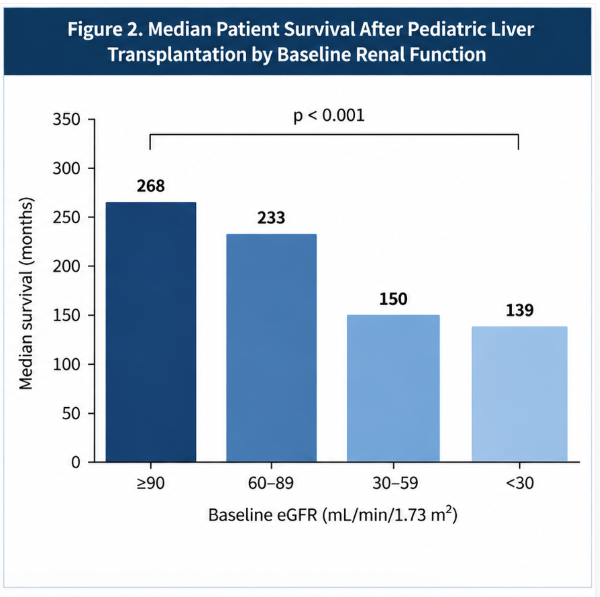
Among 165 pediatric LT recipients, median age was 4.7 years, and median pretransplant eGFR was 123 mL/min/1.73m². At one year, median eGFR change differed markedly by baseline renal function: −12, +15, +60, and +72 mL/min/1.73m² for eGFR ≥90, 60–89, 30–59, and <30, respectively (p<0.001). This pattern remained evident at five years (−28, +18, +44, and +65; p<0.001) (Figure 1). Age also showed distinct patterns: recipients <2 years had median eGFR changes of +35 at one year and +19 at five years, whereas recipients aged 2–10 and 11–17 years showed declines at both time points (p<0.001). Baseline renal dysfunction was also associated with shorter median patient survival (268, 233, 150, and 139 months across worsening eGFR strata; p<0.001) (Figure2) and longer hospitalization (13, 17, 21, and 20 days; p<0.01).
Conclusion:
Pediatric LT recipients demonstrate markedly different renal trajectories according to pretransplant kidney function and age. Recipients with severe baseline renal dysfunction showed substantial improvement among those followed longitudinally, whereas recipients with preserved baseline eGFR and older children showed sustained decline. Importantly, worse pretransplant renal function was also associated with shorter survival and longer hospitalization. These findings highlight the dynamic nature of renal risk after pediatric LT and support individualized, long-term kidney surveillance across the spectrum of baseline renal function.
Figure 1. Median change in eGFR at one and five years after pediatric liver transplantation according to pretransplant renal function.
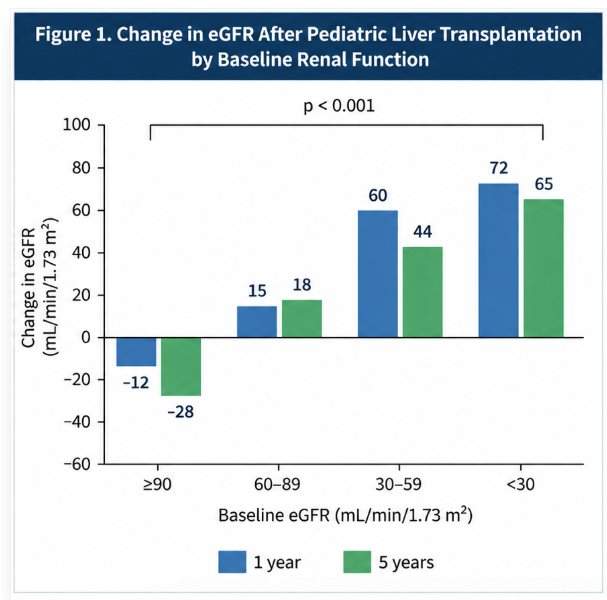
Figure 2. Median patient survival after pediatric liver transplantation according to pretransplant renal function.