
Perioperative course and early glycemic escalation during pediatric liver transplantation for maple syrup urine disease
Authors
Affiliations
Abstract
INTRODUCTION
Liver transplantation (LT) stabilizes branched-chain amino-acid homeostasis in maple syrup urine disease (MSUD), but fasting and surgical stress create a catabolic hazard [1,2]. Continuous dextrose is recommended, although intraoperative glycemic trajectories and insulin exposure remain poorly characterized [3]. We characterized perioperative management and outcomes and tested whether glucose near 90 minutes predicted later glycemic burden.
METHODS
This single-center retrospective cohort included MSUD LT from September 2015 through February 2025. Recipients aged >18 years were excluded. Timed glucose and insulin observations were aligned to surgical start. The early landmark was glucose closest to 90 minutes within a 60–120-minute window; later burden was time-weighted mean glucose after 120 minutes. Associations were assessed using Spearman correlation and HC3 regression adjusted for baseline glucose and log2(age).
RESULTS
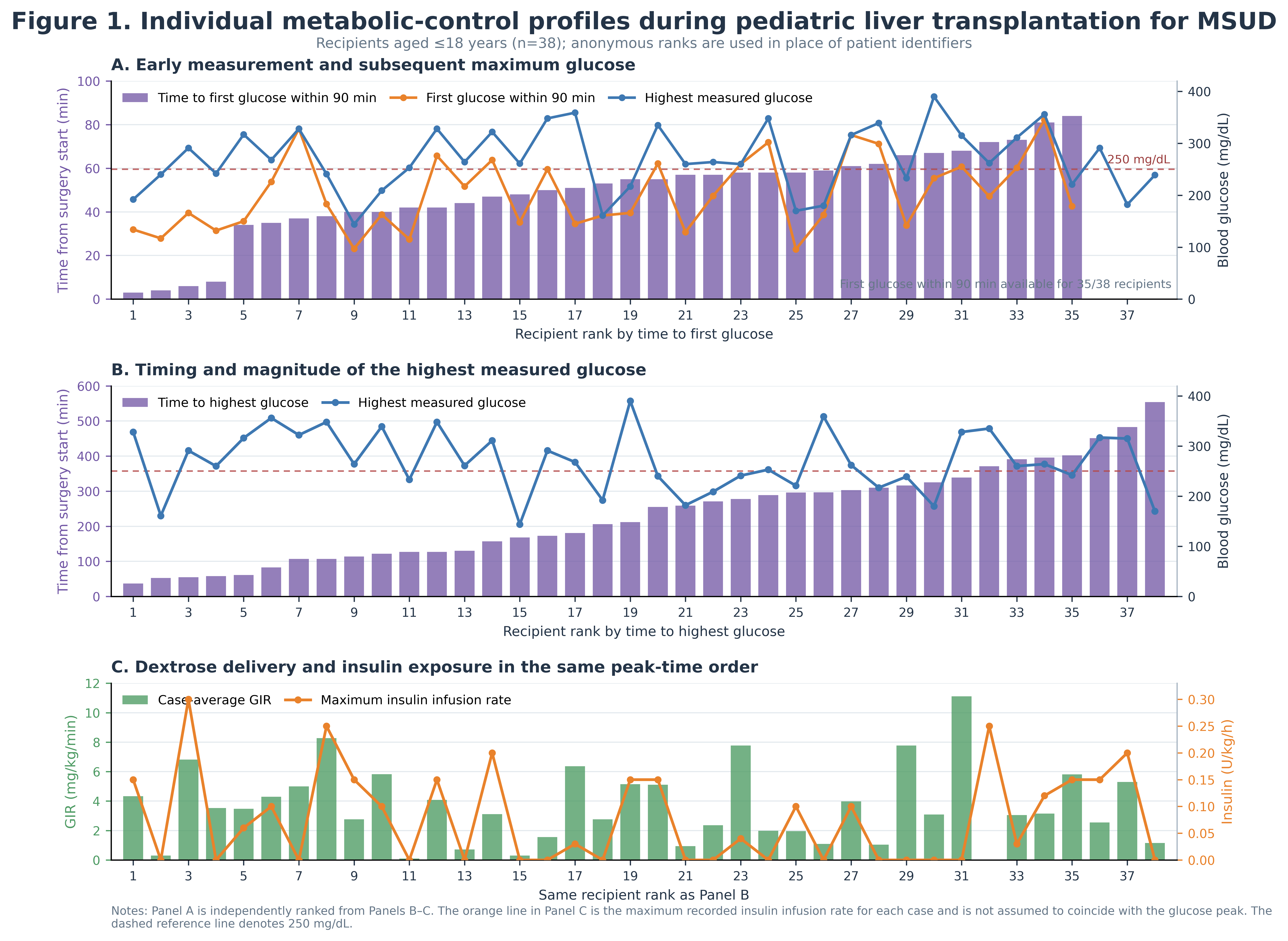
Of 59 MSUD recipients, 21 were excluded for age >18 years, leaving 38. Thirty-four received volatile anesthesia; four received total intravenous anesthesia because of family history of malignant hyperthermia. Table 1 summarizes perioperative characteristics; Figure 1 shows individual glycemic profiles. Median glucose infusion rate was 3.13 [1.66–5.14] mg/kg/min. First glucose within 90 minutes was 183 [147–258] mg/dL at 53 [40–60] minutes (n=35); peak glucose was 263 [235–321] mg/dL at 234 [123–315] minutes. Twenty-four (63%) reached ≥250 mg/dL. Positive insulin infusion was recorded in 21 (55%); maximum rate among treated recipients was 0.15 [0.10–0.15] U/kg/h (range 0.03–0.30). Glucose near 90 minutes correlated with later time-weighted glucose (rho=0.51, p=0.003); in 29 complete cases, each 10-mg/dL higher early value predicted 4.1 mg/dL higher later glucose (95% CI 1.5–6.7, p=0.002). Thirty-seven (97%) were alive at last recorded status.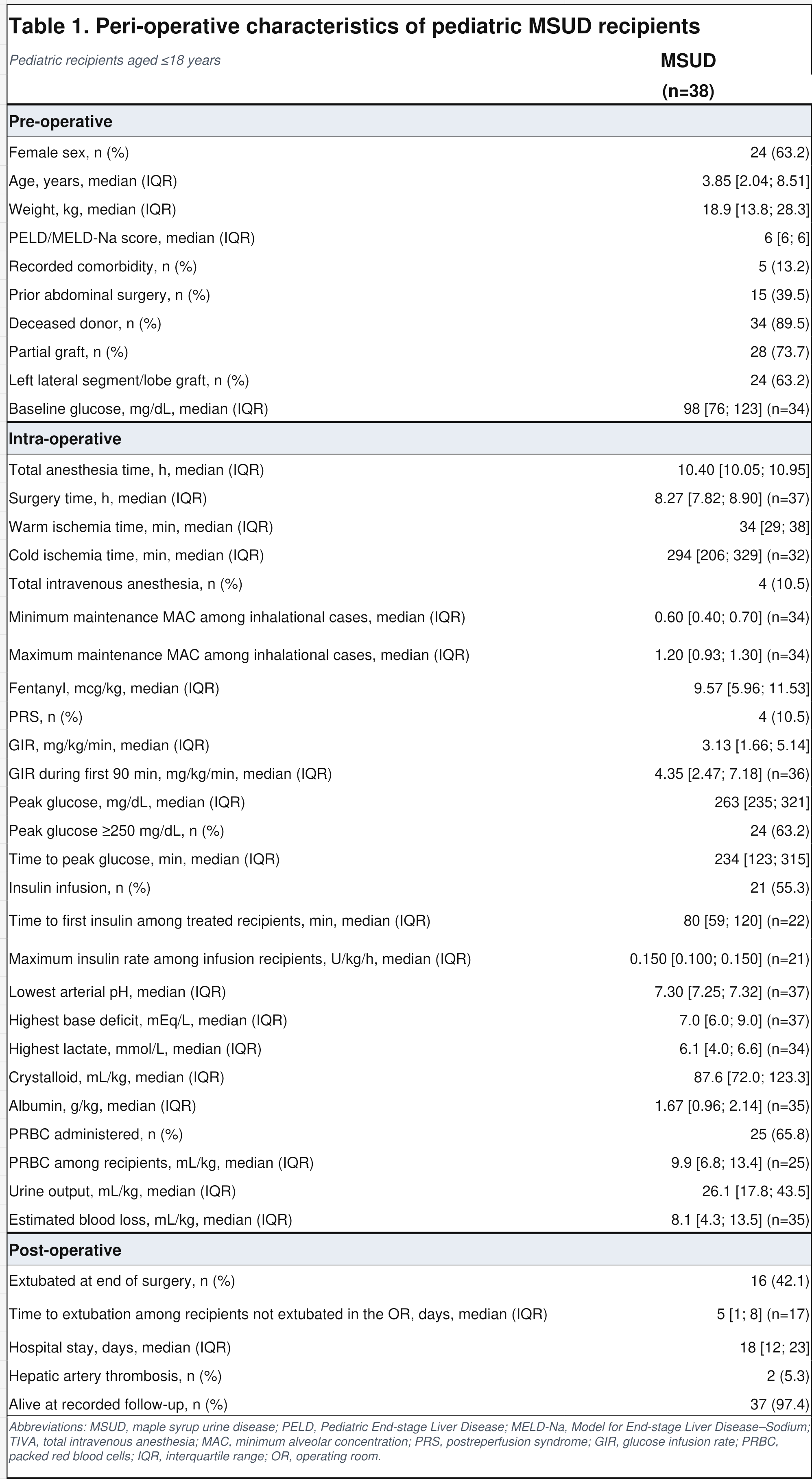
CONCLUSION
Marked hyperglycemia was common despite intentional dextrose administration. The association between glucose by 90 minutes and subsequent exposure is consistent with an amplifying counter-regulatory stress response [4], and a recent MSUD transplant case demonstrated that metabolic decompensation can occur despite dextrose, insulin, and lipid therapy [5]. These retrospective data do not establish a 250-mg/dL threshold or show that anesthetic depth caused the pattern because MAC and opioid exposure were not time-synchronized to induction and incision. The first 90 minutes merit prospective study of protocolized metabolic management and whether anesthetic technique or supplemental regional anesthesia attenuates the early stress response.
REFERENCES
1. Strauss KA, et al. Am J Transplant. 2006;6:557–564. 2. Mazariegos GV, et al. J Pediatr. 2012;160:116–121.e1. 3. Stuart G, Griffiths S. OrphanAnesthesia. 2015. 4. Dungan KM, et al. Lancet. 2009;373:1798–1807. 5. Saeyup P, et al. Pediatr Anesth. 2024;34:366–370.