
Kasai Portoenterostomy Before Liver Transplantation for Biliary Atresia: No Long-Term Survival Benefit, but a Critical 90-Day Mortality Window When Kasai Fails Before Age 1.

Authors
Affiliations
Abstract
Background: Whether a previous Kasai portoenterostomy helps or harms at the time of liver transplantation (LT) for biliary atresia (BA) remains unsettled, and our own earlier series of 347 children suggested a large survival benefit when the Kasai failed late.
Methods: We studied 949 children transplanted for BA by a single team between 1995 and 2026. Kasai status was known in 917: no previous Kasai (No-K, n=436), early failure (K-EF, transplanted before 12 months, n=239) and late failure (K-LF, n=242), classified by age at LT as in our previous report. Patient and graft survival were compared by Kaplan-Meier and Cox regression, adjusting for transplant era, PELD, graft-to-recipient weight ratio and donor type. Complications occurring after transplantation were kept out of the survival models. The original analytic strategy was also reapplied to the expanded cohort.
Results: Median follow-up was 10.6 years, with 109 deaths and 33 retransplants. Patient survival at 1, 5 and 10 years was 96.5%, 90.2% and 88.2% for No-K; 91.6%, 86.6% and 85.4% for K-EF; and 95.5%, 90.7% and 89.8% for K-LF (p=0.32). Graft survival was likewise similar: 93.6%, 86.8% and 84.8%; 90.8%, 85.8% and 84.5%; and 93.8%, 89.0% and 88.1% (p=0.58). The earlier protective effect was not reproduced, including when the original analytic strategy was reapplied. The risk of a failed Kasai proved real but short-lived (Figure 1). Mortality within 90 days was 7.3% after early failure, against 1.9% without a Kasai and 1.4% after late failure (p=0.0002), a fourfold excess (HR 4.10) that vanished entirely thereafter (HR 0.18). These infants were otherwise comparable to primary transplants in PELD, graft size and ascites. Any previous Kasai tripled to quadrupled the need for reoperation for bowel perforation (Figure 2).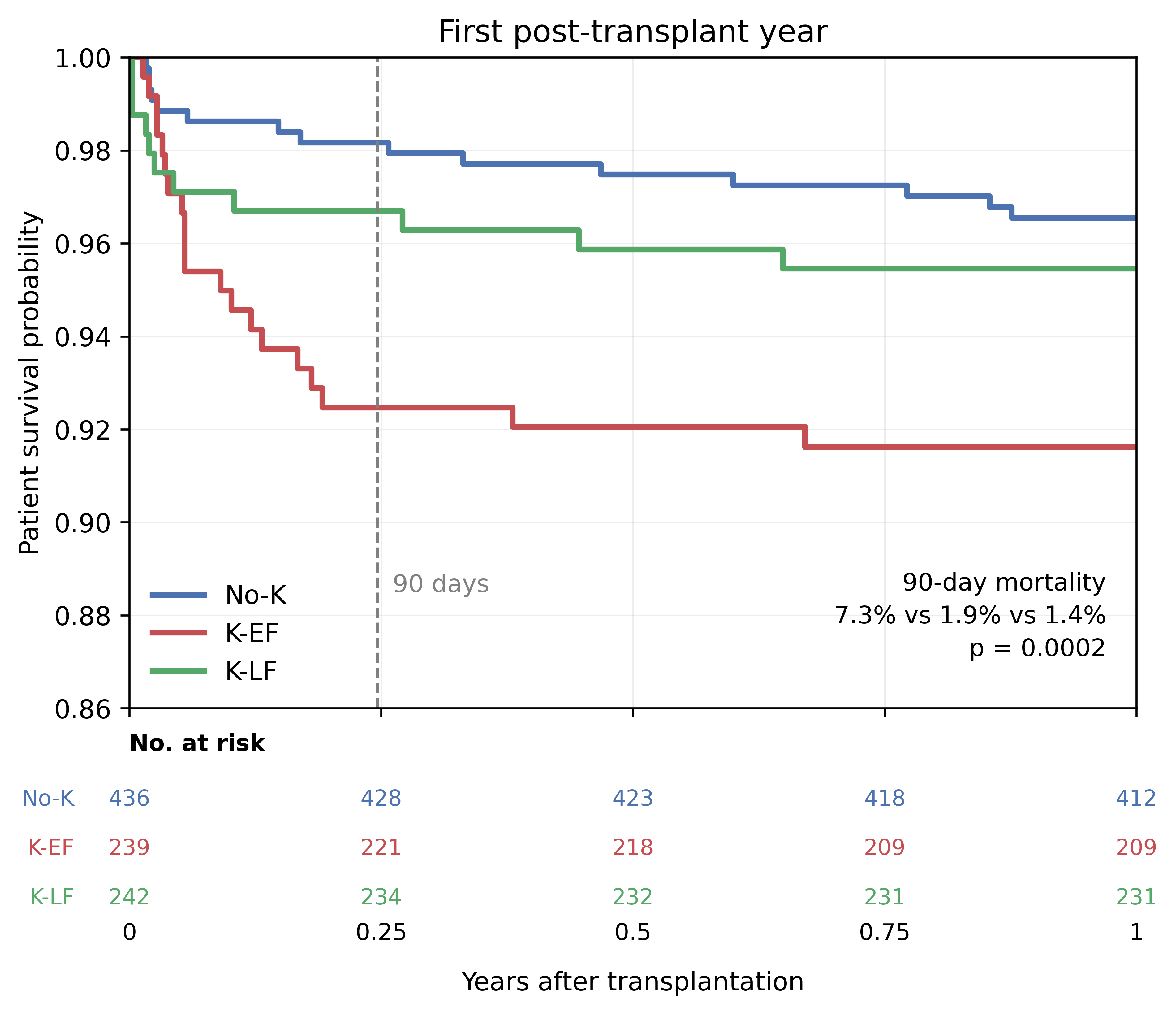
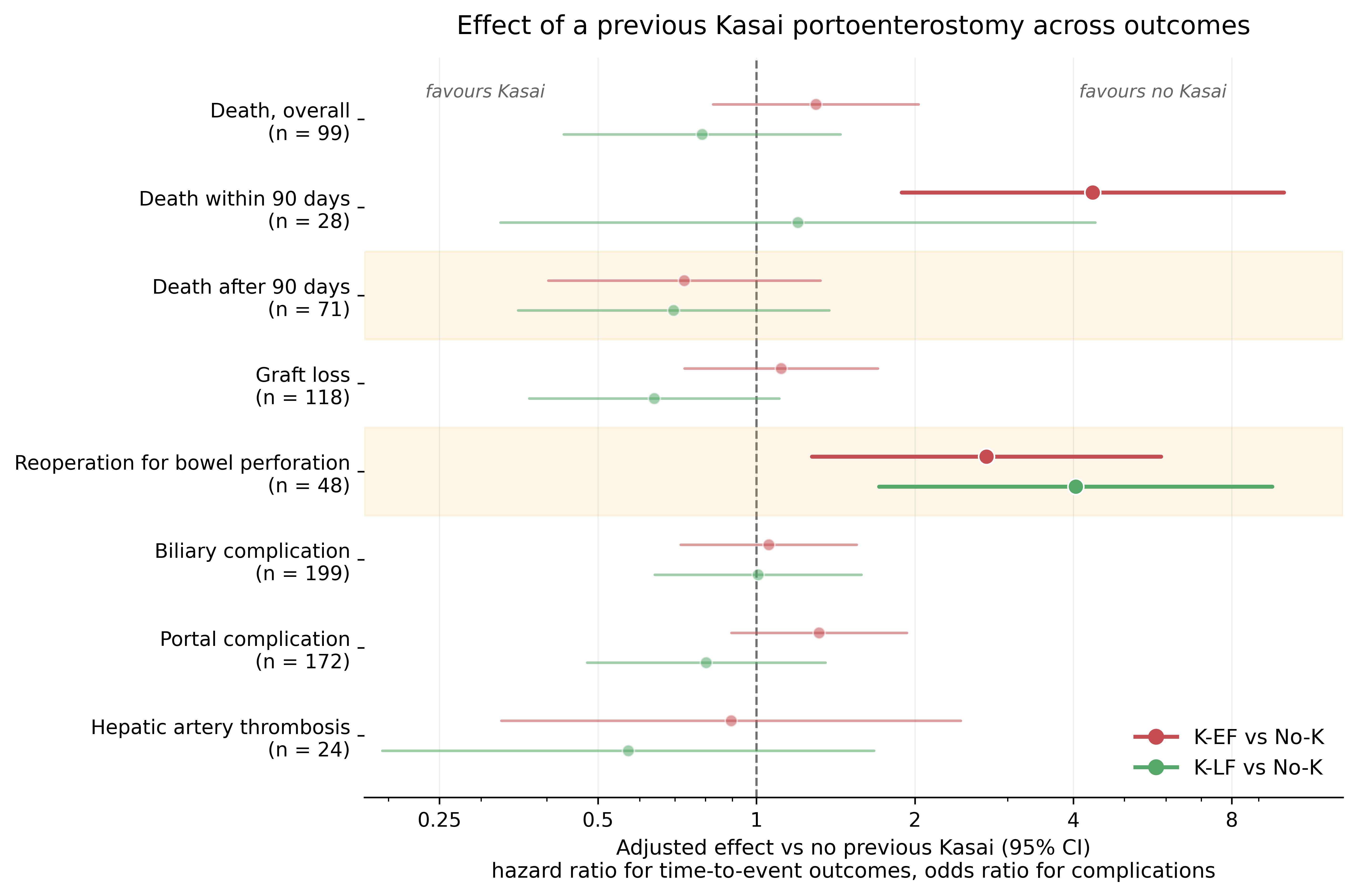
Conclusions: A previous Kasai does not influence long-term survival after LT for BA, and the protective effect we reported earlier was not confirmed. Early Kasai failure carries a fourfold mortality risk confined to the first 90 days, while any previous portoenterostomy triples to quadruples the risk of bowel perforation.