Does time from brain death to procurement predict pediatric organ transplantation rates?
Authors
Affiliations
Abstract
Introduction: Donor management aims to preserve organ function after brain death, but the impact of time to procurement on transplantation remains unclear. Using the Organ Retrieval and Collection of Health Information for Donation (ORCHID) dataset, tracking 6 OPOs from 2015-2021, this study examined the association between time from brain death to organ procurement and the likelihood of successful organ transplantation in pediatric donors.
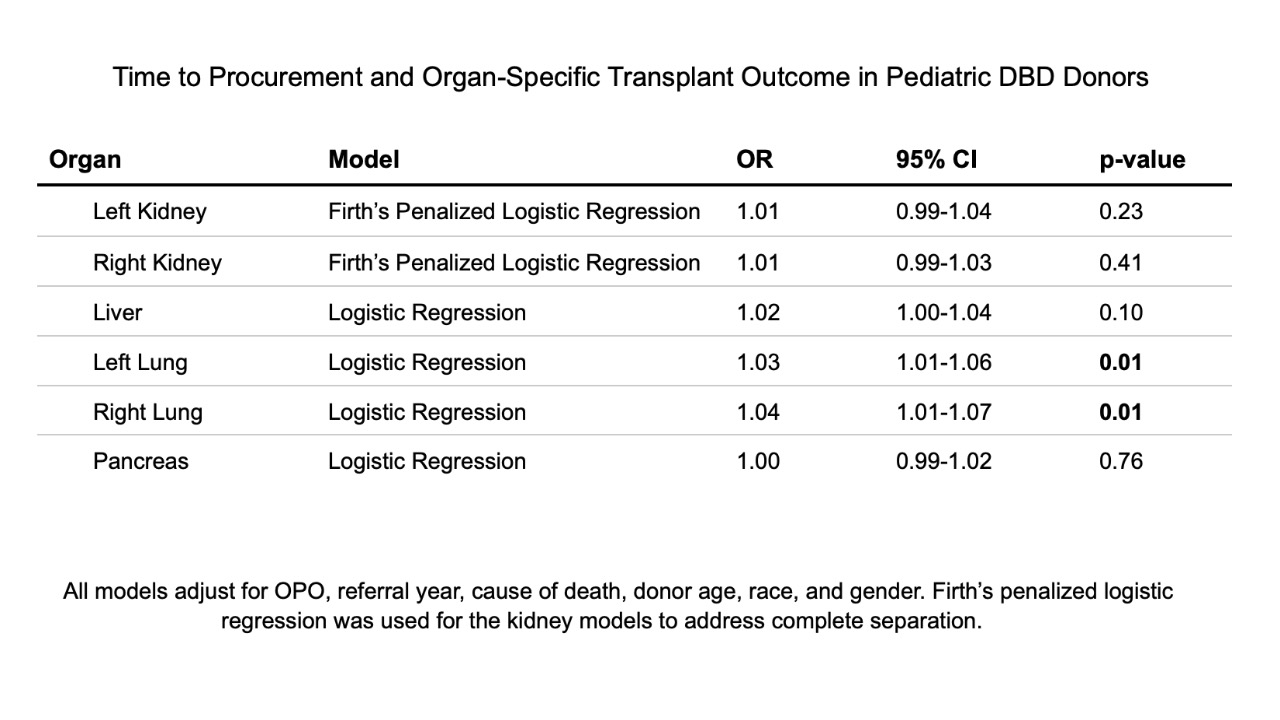
Methods: This study cohort comprised 594 pediatric (< 18 years old) DBD donors who reached procurement from the ORCHID dataset. Analysis was performed for each organ: left lung, right lung, left kidney, right kidney, liver, and pancreas, which were modeled separately. The exposure was the time between brain death declaration and procurement, defined as interval_hours. The outcome was transplanted vs. not transplanted, with organs recovered for research classified as not transplanted. Statistical models were adjusted for OPO, referral year, cause of death, donor age, race, and gender. Logistic regression was used for left and right lung, liver, and pancreas, with Firth’s penalized logistic regression for left and right kidney due to subgroups with zero non-transplanted cases.
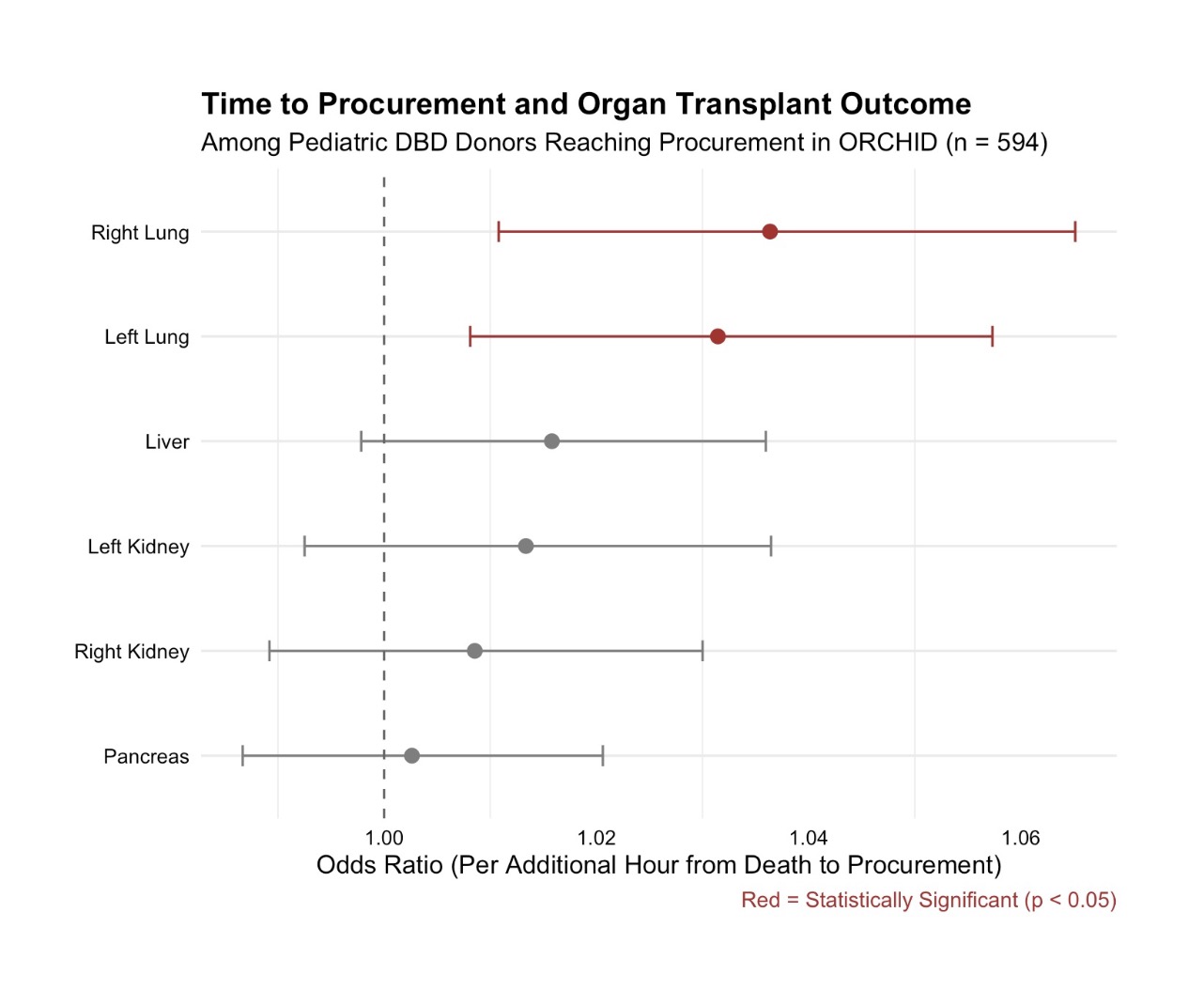
Results: Interval_hours was significantly associated with increased transplantation for left lung (aOR 1.03 per hour, 95% CI 1.01–1.06, p=0.01) and right lung (aOR 1.04 per hour, 95% CI 1.01–1.07, p<0.01), with no significant association for left kidney (aOR 1.01, 95% CI 0.99–1.04, p=0.23), right kidney (aOR 1.01, 95% CI 0.99–1.03, p=0.41), liver (aOR 1.02, 95% CI 1.00-1.04, p=0.10), and pancreas (aOR 1.00, 95% CI 0.99–1.02, p=0.76). Age was a significant covariate for all organs, with increased age predicting organ transplantation. Gender was significant in liver only, with males associated with increased transplantation (p=0.03); cause of death was similarly significant in liver only, with death from head trauma predicting transplantation (p=0.01). Referral year was significant in only pancreas, with increased odds for earlier years (p=0.01); other/unknown race was significant in right lung (p=0.03). OPO was not significant for any organ.
Conclusion: Each additional hour in the brain death to procurement interval predicted significantly greater odds of lung transplantation in pediatric DBD donors, a pattern not identified in liver, kidney, or pancreas. These findings are consistent with the lung’s unique physiologic vulnerability after brain death and responsiveness to active donor management. Together, these results suggest a potential advantage in allowing additional time for donor management before lung procurement, and support organ-specific management protocols in pediatric DBD donation. The ORCHID dataset lacked data on potential confounders such as biopsy and imaging findings, and may not reflect recent updates in donor management from 2022 onward.