Getting to the heart of measles prevention: Implementation of an MMR vaccine protocol for pediatric heart transplant recipients
Authors
Affiliations
Abstract
Background: The use of live attenuated virus vaccines has historically been contraindicated in heart transplant (HT) recipients. The measles outbreak in the United States in 2025 prompted our group to implement a quality initiative (QI) focused on identifying measles vaccination history and serologic status of our pediatric HT recipients, and to recommend vaccination for recipients who we perceived to be at low risk of MMR vaccine-related adverse events (AE).
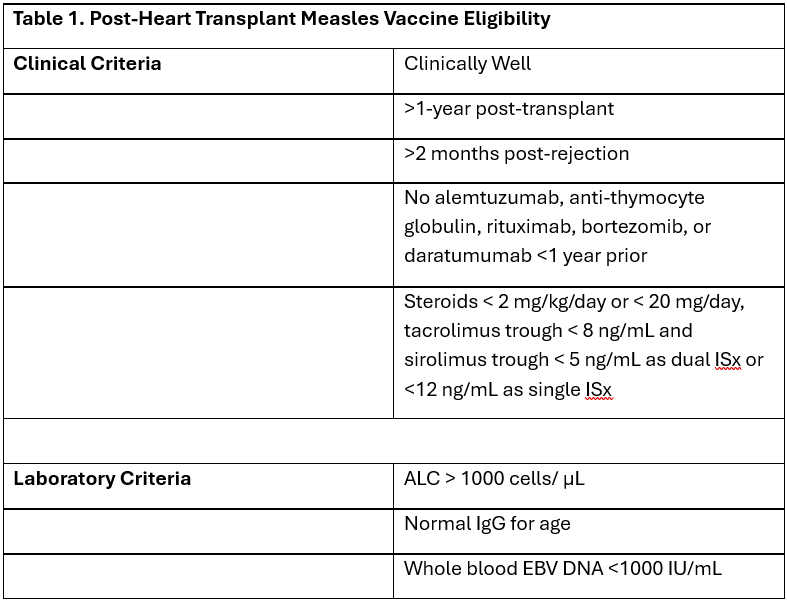
Methods: This single center QI study was launched in 7/2025 with data collection through 8/2026. Clinical and laboratory criteria for vaccination are summarized in Table 1. The transplant team discussed vaccination with patients who met clinical criteria and referred for screening bloodwork (CBC, IgG, EBV PCR) after which patients were advised to proceed/not proceed with MMR vaccination. Primary care providers of eligible patients were instructed to provide vaccine dose(s): patients with no pre-transplant vaccines were recommended 2 doses of MMR, and patients with 1 or 2 pre-transplant doses of MMR and negative measles serology were recommended 1 dose of MMR. Follow up serology was assessed 4-6 weeks after vaccination. Patients with 2 pre-transplant doses of MMR and positive measles serology were not recommended for vaccination.
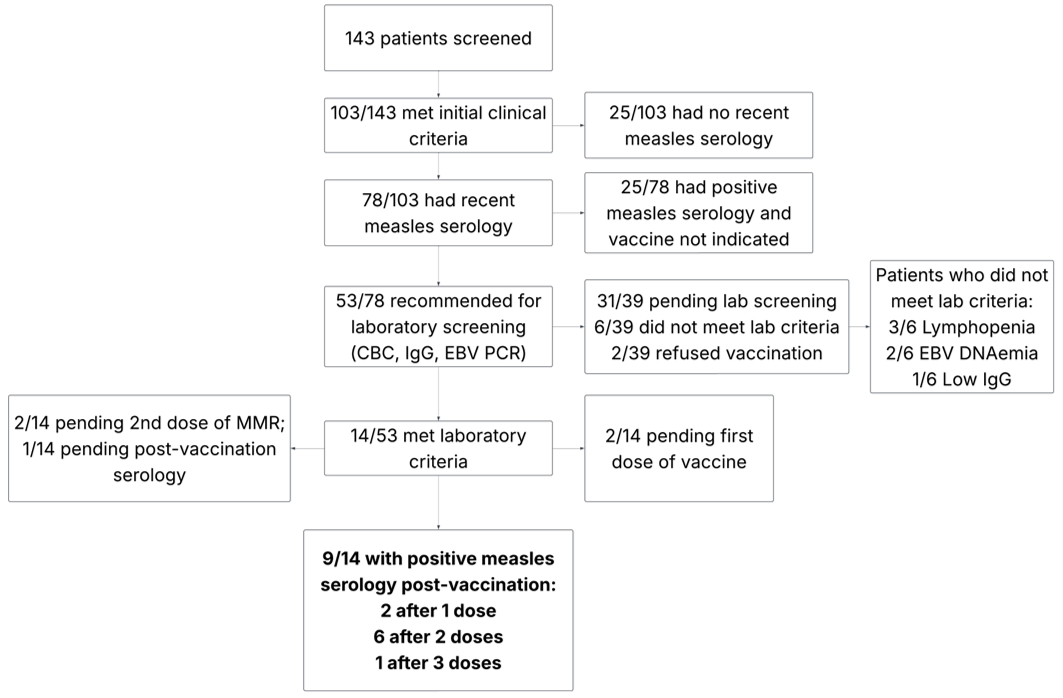
Results: A total of 143 HT recipients were screened. 40 (28%) patients did not meet initial clinical criteria for vaccination (Table 1). 78/103 (76%) patients had pre-HT measles serologies available for review; 25 (32%) had positive measles serology and were not recommended for vaccination and 53 (68%) who were pre-HT measles seronegative or confirmed not vaccinated were recommended to undergo laboratory assessment to guide post HT MMR vaccination. Of these, 33 have not yet received laboratory screening, 6 were excluded based on laboratory criteria, 2 refused vaccination after discussion with provider prior to lab screening, and 12 met laboratory criteria and received >1 dose of MMR. All 9 patients who completed their recommended MMR doses seroconverted, though one patient required a third dose of MMR to achieve seroconversion. 2/12 require an additional vaccine and follow-up serologies, and 1/12 was pending final serologies (Figure 1). One patient reported a pruritic, erythematous patch on their lower back, separate from the vaccination site that presented several days after vaccination. This resolved with diphenhydramine. Diphenhydramine was given prior to the second MMR dose without recurrence. No other adverse events were identified.
Conclusion: Eligible pediatric HT recipients who completed post-transplant MMR vaccination were without complication and developed humoral immunity to measles. Adverse events were rare and mild. Although the study’s sample size is currently small, it builds on data from previous organ transplant experience to offer reassurance of safety and immunogenicity of MMR vaccine after HT.