Transplant Utilization and Survival Outcomes From Deceased Donors Under 6 Months of Age in the United States
Authors
Affiliations
Abstract
Introduction: Historical data from single center studies have suggested increased risk of graft loss in pediatric patients receiving liver transplants (LT) from deceased infant donors with decreasing donor age, particularly in grafts from donors less than 6 months old. This has led to low infant donor graft utilization, further straining the ongoing organ supply-demand mismatch. Using a United States national transplant database, we compared deceased donor graft utilization, and graft- and patient-survival outcomes between children transplanted with livers from donors less than 6 months (≤6mo) and 7-12 months (7-12mo) old. We hypothesize that there will be lower graft utilization rates among donors ≤6 months old, but similar graft- and patient-survival outcomes between cohorts.
Methods: We retrospectively reviewed children (age ≤18) undergoing LT within the SRTR database, from database inception in 1978 to 2026, comparing graft utilization and recipient outcomes between study cohorts. Kaplan-Meier with Log-Rank testing and Cox-Proportional Hazards Regression analyses were used to compare survival outcomes between cohorts. Statistical significance was defined as p≤0.05.
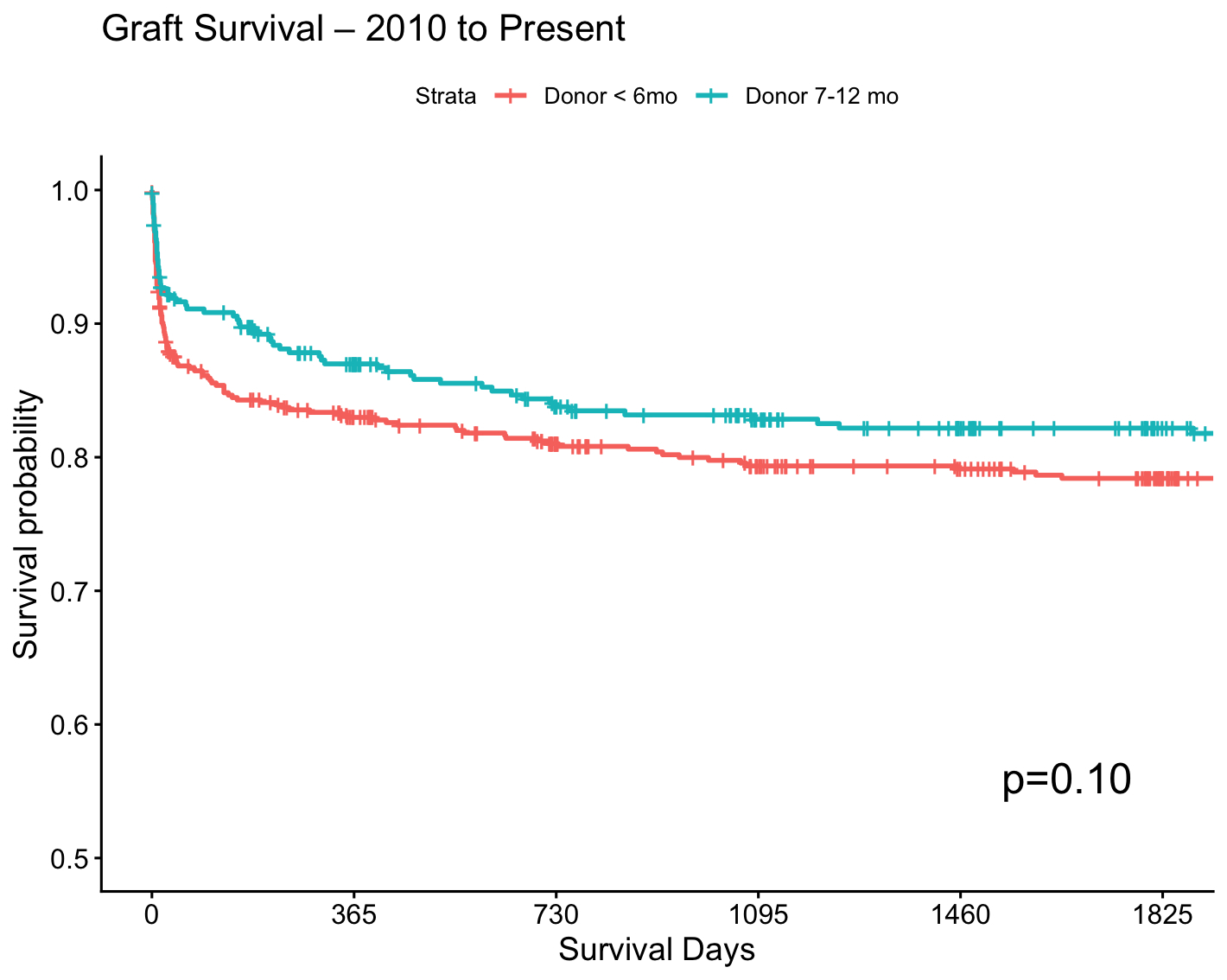
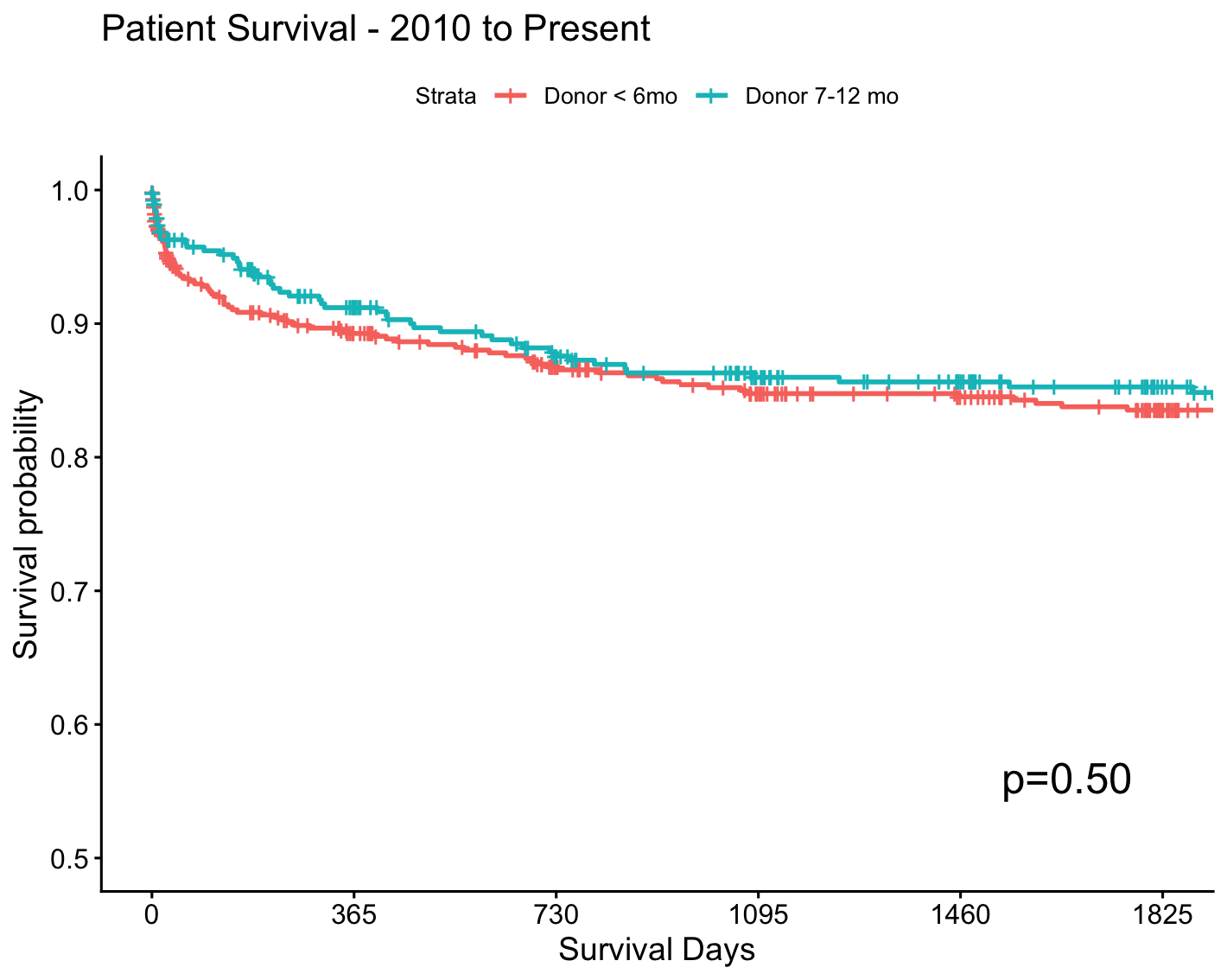
Results: In total, 3,087 donors age ≤6 months and 1,416 donors age 7-12 months were evaluated. Organ recovery rate was significantly higher in the 7-12 month cohort (≤6 mo: 66%, 7-12 mo: 78%), though utilization rates among recovered organs was similar (≤6 mo: 83%, 7-12 mo: 85%). There were 2,629 recipients (n= 1,686 recipients of donor ≤6 mo, n=943 recipients of donor 7-12 mo). The median donor age in the <6mo cohort was 3 mo (IQR: 2-5) and 9 mo (IQR: 8-11) in the 7-12mo cohort. Recipients of 7-12 month donors were older (median, ≤6mo: 10 mo, 7-12 mo: 13mo) and heavier (median, ≤6mo: 7.3kg, 7-12 mo: 8.8kg). 33.7% of ≤6mo transplants and 40.8% of 7-12mo transplants occurred between 2010 and present. On Cox-Proportional Hazards modeling, donor age was not independently predictive of graft loss (7-12 mo: aHR 0.89 (95% CI: 0.77-1.04)) or patient mortality (7-12mo: HR 0.90 (95% CI: 0.77-1.06)), however, era of transplant independently predicted graft loss (2010-present: aHR 0.47 (95% CI: 0.39-0.56)) and patient mortality (2010-present: aHR 0.44 (95% CI: 0.36-0.53)). Kaplan Meier analysis of transplants occurring from 2010-present demonstrated no significant differences in 5-year graft or patient survival between ≤6mo and 7-12 mo cohorts.
Conclusions: Among the SRTR database, there is a significantly lower rate of graft recovery for donors less than 6 months of age. However, donor age ≤ 6 months did not predict graft or patient survival, compared to 7-12 months. In the modern transplant era, donor age ≤6 months of age should not be viewed as portending increased risk compared to donors 7-12 months of age. Expanded graft utilization in donor less than 6 months of age may positively impact the organ supply-demand mismatch, without negatively affecting recipient outcomes.