
Sarcopenia as a prognostic factor in children listed for or undergoing liver transplantation a systematic review and meta analysis

Authors
Affiliations
Abstract
INTRODUCTION
Low skeletal muscle mass, or sarcopenia, predicts adverse outcomes in adults undergoing liver transplantation. However, pediatric evidence remains fragmented across single-center cohorts with inconsistent definitions and measurement modalities. We estimated the pooled prevalence of sarcopenia and quantified its association with mortality and post-transplant morbidity in children evaluated for or undergoing liver transplantation.
METHODS
We searched MEDLINE, Embase, Web of Science, and Cochrane Central through July 2026 without language restriction for cohort studies reporting low skeletal muscle mass as an exposure predicting clinical outcomes in children (aged 0–18 years) listed for or undergoing liver transplantation. We pooled risk ratios for dichotomous outcomes and standardized mean differences for continuous outcomes under random-effects models, quantified heterogeneity with I², and estimated prevalence on the logit scale. The protocol was registered in PROSPERO (CRD420261464181).
RESULTS
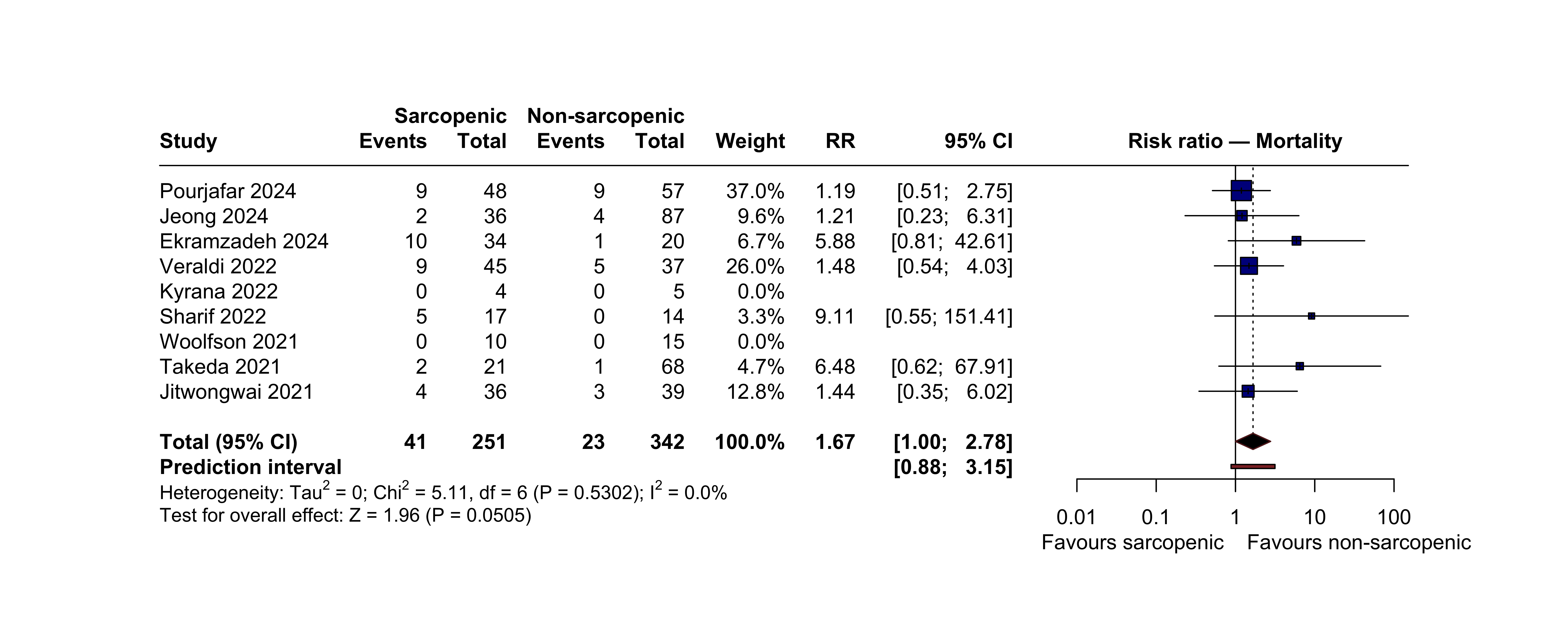
Twenty cohorts encompassing approximately 1,470 children met inclusion criteria. Pooled sarcopenia prevalence was 42% (95% confidence interval [CI] 34–51; I² = 85%). Sarcopenia was associated with higher mortality risk reaching the margin of significance (risk ratio 1.67, 95% CI 1.00–2.78; I² = 0%). Every post-transplant complication examined exceeded unity without attaining statistical significance: vascular complications (RR 1.68), graft loss (RR 1.46), infection (RR 1.21), and acute rejection (RR 1.20). Lower muscle mass correlated with longer hospital length of stay (r = −0.31, 95% CI −0.41 to −0.21). Intensive-care and total hospital length of stay both showed numerical trends toward prolongation in sarcopenic children.
CONCLUSION
Sarcopenia affects approximately two in five children awaiting or undergoing liver transplantation and may be associated with elevated mortality risk and longer length of stay. The findings align directionally with adult literature but remain underpowered for definitive conclusions. Prospective, multicentre studies employing a standardized pediatric definition are needed to confirm the mortality signal and to evaluate whether pre-transplant muscle optimization improves outcomes.