
Evolution of Use of Donation after Circulatory Death Livers in Pediatric Transplantation
Authors
Affiliations
Abstract
Introduction:
We have previously reported that donation after circulatory death (DCD) livers, despite having otherwise favorable donor characteristics, were rarely used in pediatric liver transplantation. With recent increased DCD utilization in adult practices and the emergence of advanced organ preservation techniques, we examined whether the use of DCD livers in pediatric liver transplantation has changed.
Methods:
Using the OPTN STAR file, we identified all pediatric patients (age <18 y) who underwent liver transplantation using a DCD liver between January 1, 1990, and July 1, 2026. Recipients transplanted within the time period of PRIOR report (1990-2017) were compared to the RECENT (2018-2026) cohort. Donor and recipient characteristics, patterns of DCD liver utilization, and post-transplant outcomes were examined.
Results:
Overall, 89 of 15,661 (0.57%) pediatric liver transplants were performed using DCD livers within the study period. A modest increase was noted in DCD use comparing PRIOR, where 57 of 11,773 (0.48%) were DCD livers, to RECENT, where 32 of 3,888 (0.82%) were DCD livers (p = 0.02). This increase in use of DCD livers in RECENT was most notable in the past two years, where DCD donors represented 3.72% of all deceased donors used in pediatric transplantation. 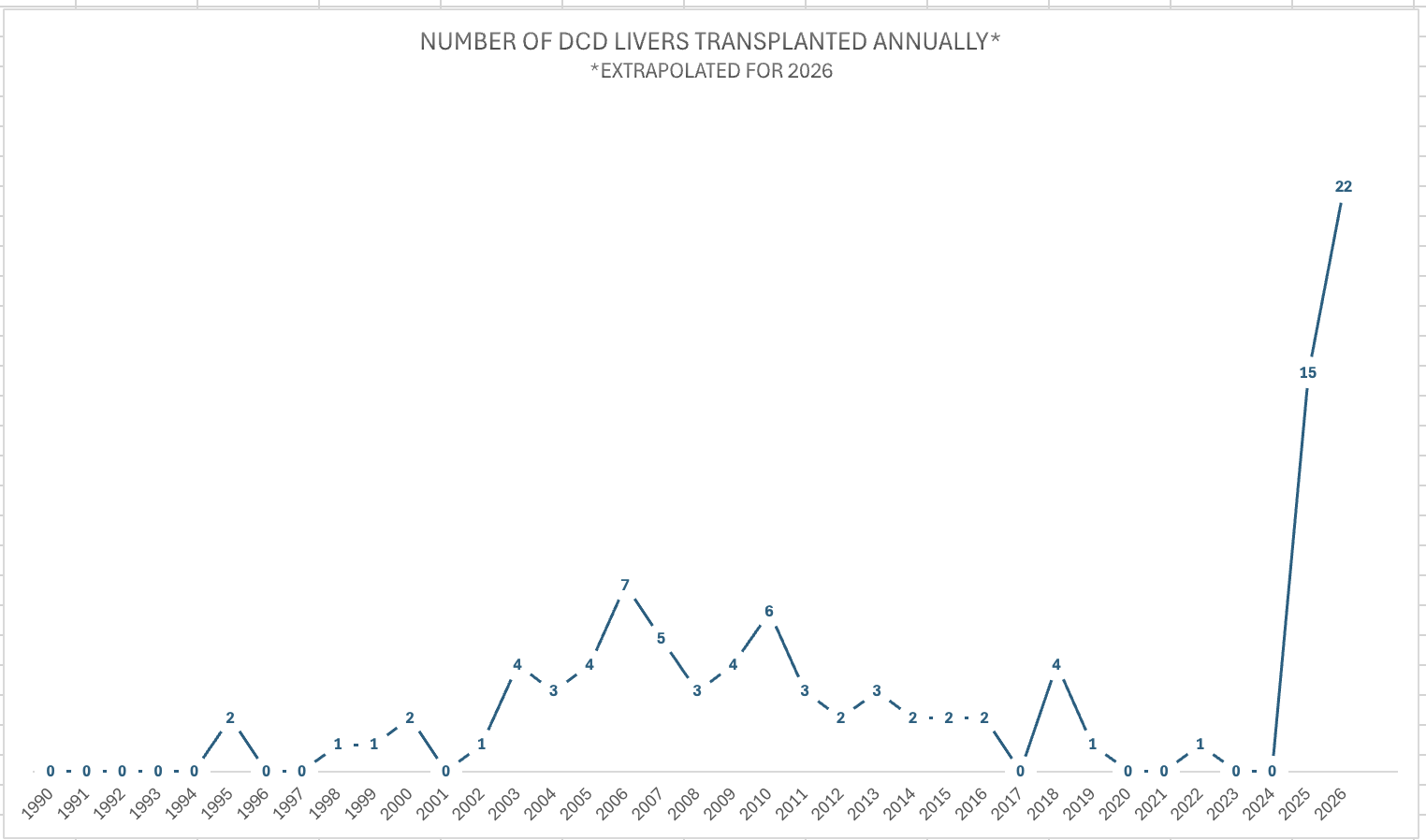
Donors in PRIOR and RECENT were similar in age (11.3 vs. 13.8 y, p = NS), body mass index (19.8 vs. 20.8, p = NS), and terminal transaminases (67 vs. 98 for SGPT, p = NS; 102 vs. 84 for SGOT, p = NS). Cold ischemia time (7.9 vs. 13.7 h, p = 0.00001) and warm ischemia time (24.1 vs. 49.3 min, p = 0.0060) were significantly longer in RECENT, but distance to the transplant center was similar in the groups (269 vs. 318 miles, p = NS). In RECENT, 24 of the 32 livers (75%) were preserved with normothermic machine perfusion and/or normothermic regional perfusion, while only 2 of the 57 livers (3.51%) in PRIOR underwent advanced preservation, representing a rapid shift in practice.
Recipients were of similar age (7.7 vs. 7.7 years, p = NS), had similar final MELD/PELD scores (22 vs. 20, p = NS) and percentage on life support at the time of transplant (35.1% vs. 32.3%, p = NS).
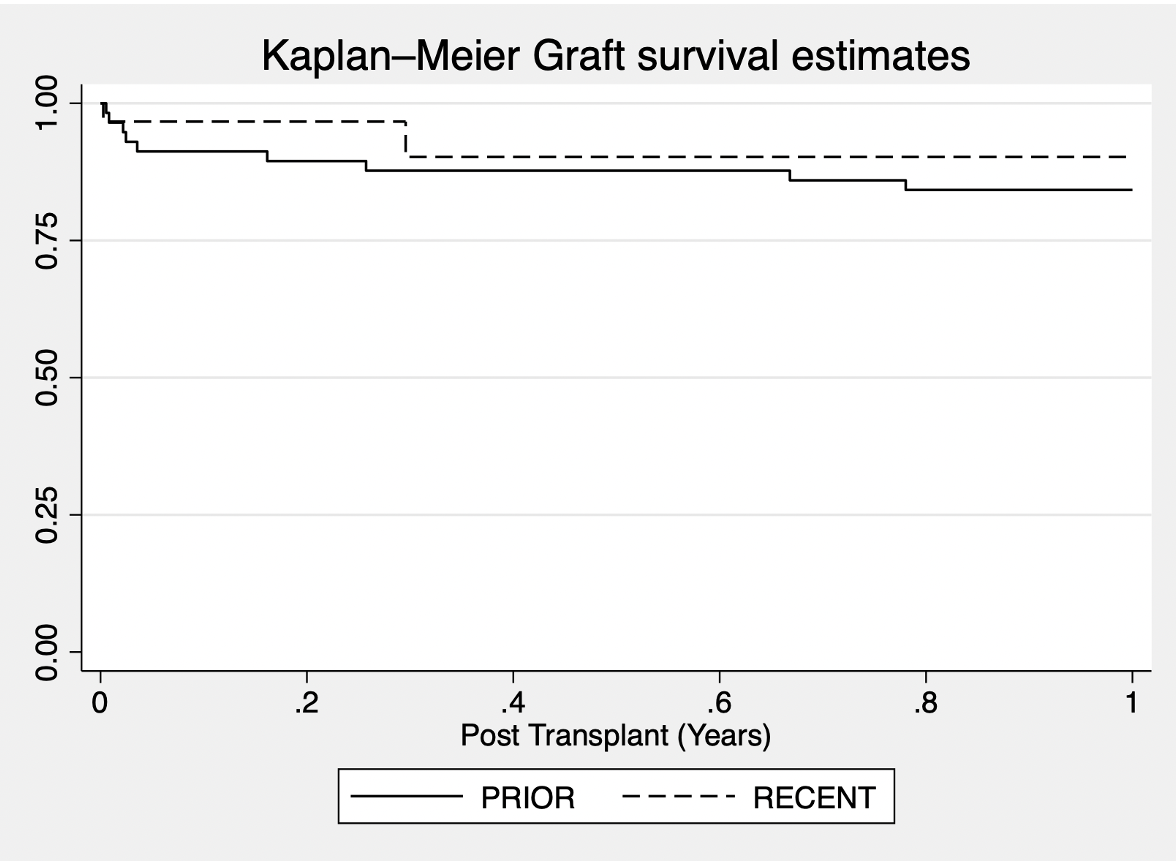
Allograft loss at 30 days (6% vs. 9%), 90 days (6% vs. 11%) and 1 year (9% vs. 16%) were consistently lower in RECENT compared to PRIOR, although not statistically significant. Kaplan Meier survival curves showed no difference at 1 year. Importantly, there was no difference in outcomes between DBD and DCD donors in the RECENT period (92% vs. 90%, p = NS), despite a significantly higher MELD/PELD in the DCD cohort (13 vs 20, p = 0.02).
Conclusion: Although experience remains limited, these findings of favorable outcomes and increasing utilization, especially in the setting of advanced organ preservation practices, provide encouragement that DCD livers can safely expand the donor pool in pediatric liver transplantation.