
One Act of Donation, Double the Hope: A Metabolic Chimera Creating a Domino Effect in Liver Transplantation
Authors
Affiliations
Abstract
Introduction
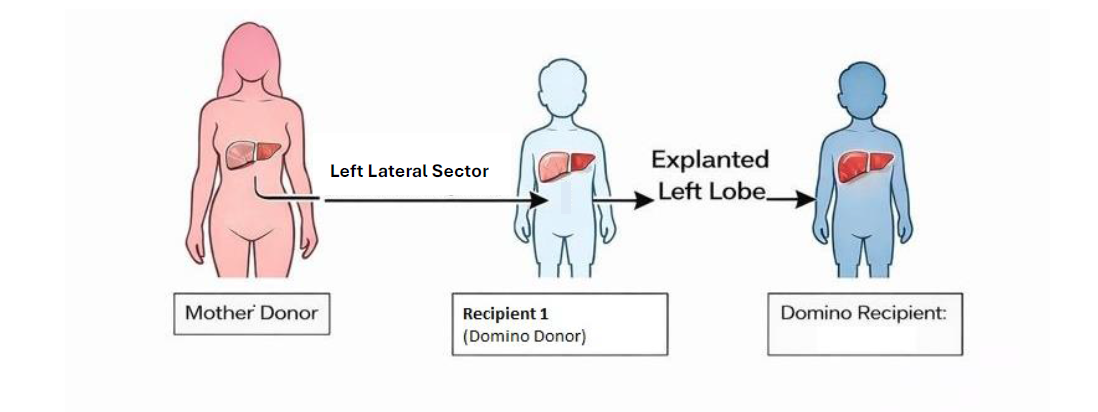
Domino liver transplantation expands graft availability by reutilizing structurally normal livers from selected patients with inherited metabolic disorders. Combining this with auxiliary partial orthotopic liver transplantation (APOLT) may preserve native hepatic function while minimizing living-donor requirements. We report, to our knowledge, the first domino APOLT using a graft from a child with Crigler–Najjar syndrome type I (CNS-I) to treat homozygous familial hypercholesterolemia (HoFH).
Methods
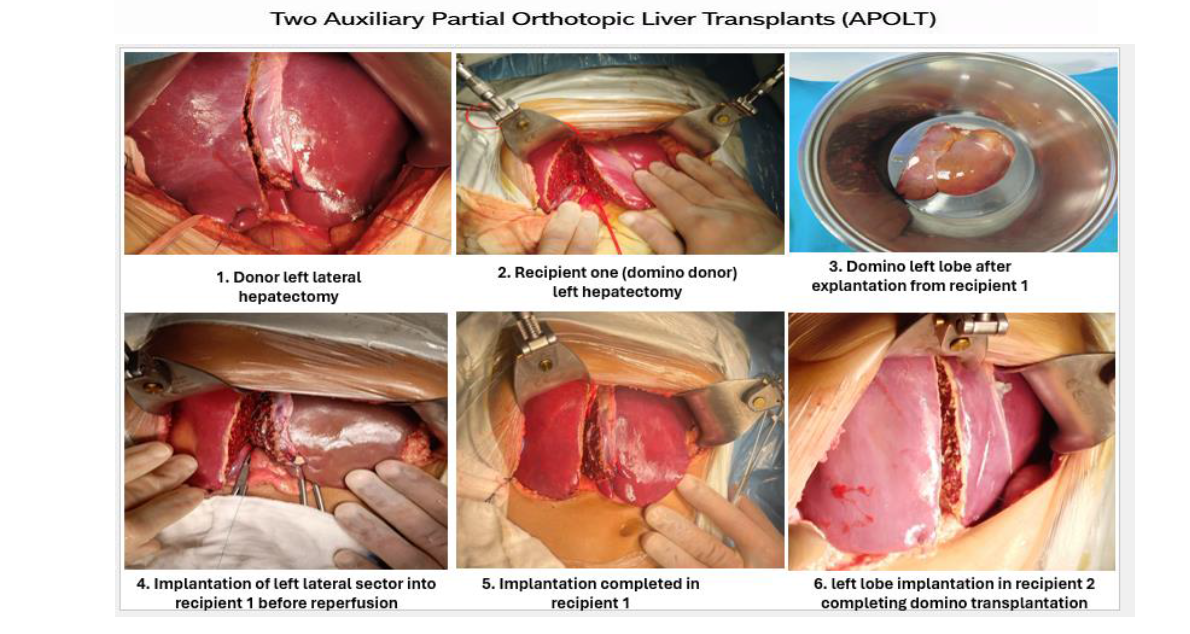
On 21 January 2026 at PKLI&RC, a 2-year-old boy with CNS-I underwent APOLT using a left lateral segment from his healthy paternal aunt. His structurally normal native left lobe, deficient in bilirubin conjugation, was subsequently explanted and used as a domino graft for a 5-year-old boy with genetically confirmed HoFH despite intensive lipid-lowering therapy. The HoFH recipient underwent left hepatectomy and APOLT using the 160-g CNS-I-derived graft (GRWR 0.89), retaining his native right liver with 50% right portal-vein modulation.
Results
Both APOLTs were successfully completed from a single living-donor operation with satisfactory graft perfusion. Donor hepatectomy lasted 7 h 20 min with 200-mL blood loss, no transfusion, and ClassIntra grade 0. The CNS-I recipient had an operative duration of 10 h 30 min, 120-mL blood loss, and ClassIntra grade I due to repeat arterial anastomosis; portal flows were 600 mL/min to the auxiliary graft and 160 mL/min to the native liver. The HoFH recipient had 300-mL blood loss, received 300-mL PRBC, and achieved graft portal flow of 345 mL/min. Postoperative recovery was uncomplicated without major surgical or radiological intervention. The donor transferred to the ward on POD1 and was discharged POD5. The CNS-I recipient transferred from ICU by POD5, had drain removal POD6, and was discharged POD8. In the HoFH recipient, invasive lines were removed by POD3, drain by POD5, and discharge occurred POD7. Bilirubin normalized in the CNS-I recipient. In the HoFH recipient, total cholesterol/LDL-C decreased from 1061/>800 mg/dL pretransplant to 384/336 mg/dL on POD1. At 6.5 months, he remained asymptomatic with a patent, normally perfused domino graft and sustained metabolic improvement on adjunct therapy (total cholesterol 301 mg/dL).
Conclusion
Domino APOLT enabled treatment of two complementary inherited metabolic disorders from one living-donor operation. CNS-I-to-HoFH graft reutilization demonstrates the potential of metabolic complementation to expand the pediatric living-donor pool while preserving native liver function. Long-term metabolic and cardiovascular follow-up remains essential.