
CHIMERA: The Chain of Life — Unlocking Hidden Potential by Turning Metabolic Diversity into Transplant Opportunity
Authors
Affiliations
Abstract
Introduction:
Children with non-cirrhotic monogenic metabolic liver diseases may have structurally normal livers lacking only a specific metabolic pathway. We developed CHIMERA (Combined Hepatic Integration through Metabolic Exchange and Recycled Allocation) to test whether complementary metabolic defects could be matched through domino auxiliary partial orthotopic liver transplantation (D-APOLT), enabling serial graft reutilization while reducing dependence on additional healthy living donors.
Methods:
CHIMERA was performed on 18–19 May 2026 at PKLI&RC Lahore as a prospectively coordinated transplant network integrating living-donor liver transplantation, D-APOLT, paired exchange, in-situ liver splitting, and serial graft reutilization. Matching incorporated metabolic complementarity, ABO compatibility, graft size, vascular/biliary anatomy, portal-flow dynamics, and downstream graft potential. Donor, operative, postoperative, and disease-specific metabolic outcomes were assessed through 3 months.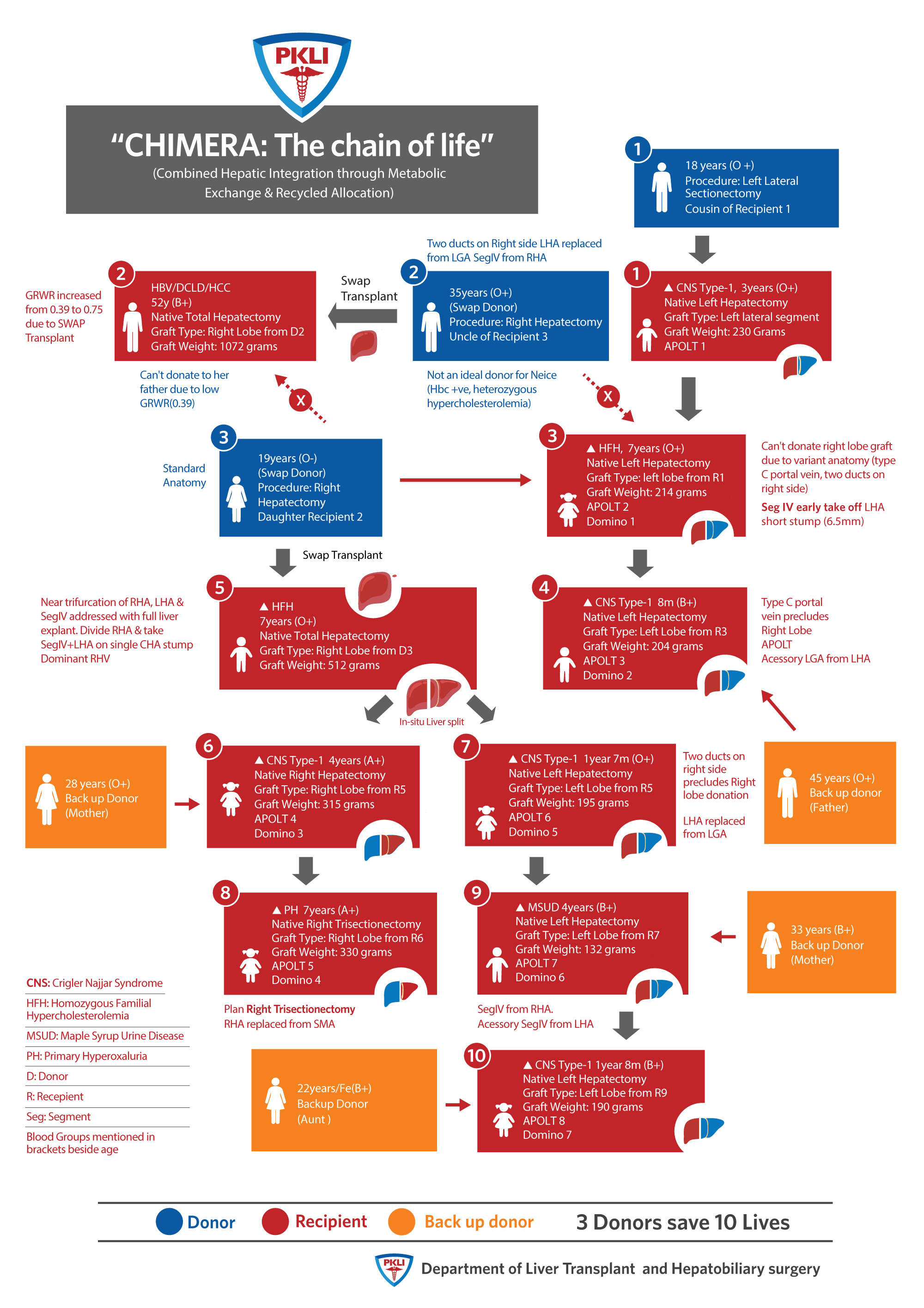
Results:
Three living donors enabled 10 transplants in 10 recipients (9 pediatric, 1 adult), including 8 APOLT and 7 D-APOLT procedures, with one swap-linked pathway and one planned in-situ split. The program was completed within 23 h 20 min. Diagnoses included Crigler–Najjar syndrome type I (CN1; n=5), homozygous familial hypercholesterolemia (HoFH; n=2), maple syrup urine disease (MSUD; n=1), primary hyperoxaluria type I (PH1; n=1), and HBV-related decompensated liver disease with HCC (n=1). Median ICU and post-transplant hospital stays were 4 and 9.5 days, respectively. Clavien–Dindo complications were grade I in 3, grade II in 6, and IIIb in 1 recipient; one required re-exploration for postoperative bleeding/hematoma. No vascular complications occurred. One recipient was readmitted for pyrexia and recovered conservatively. All recipients were alive at 3 months. Metabolic correction was demonstrated: CN1 bilirubin decreased from 20.4 to 0.72 mg/dL, normal in all 5; HoFH cholesterol decreased from 609 and 801 to 236 and 203 mg/dL (61.2% and 74.7% reductions); MSUD leucine decreased from 491 to 94 μmol/L by 1 month, with ammonia 66 μmol/L at 3 months and tolerance of an unrestricted diet; PH1 urinary oxalate decreased from 37 to 9mg/24h, with creatinine 0.56 mg/dL and eGFR 181 mL/min/1.73 m² at 3 months. No clinically significant phenotype from a reutilized domino graft was observed.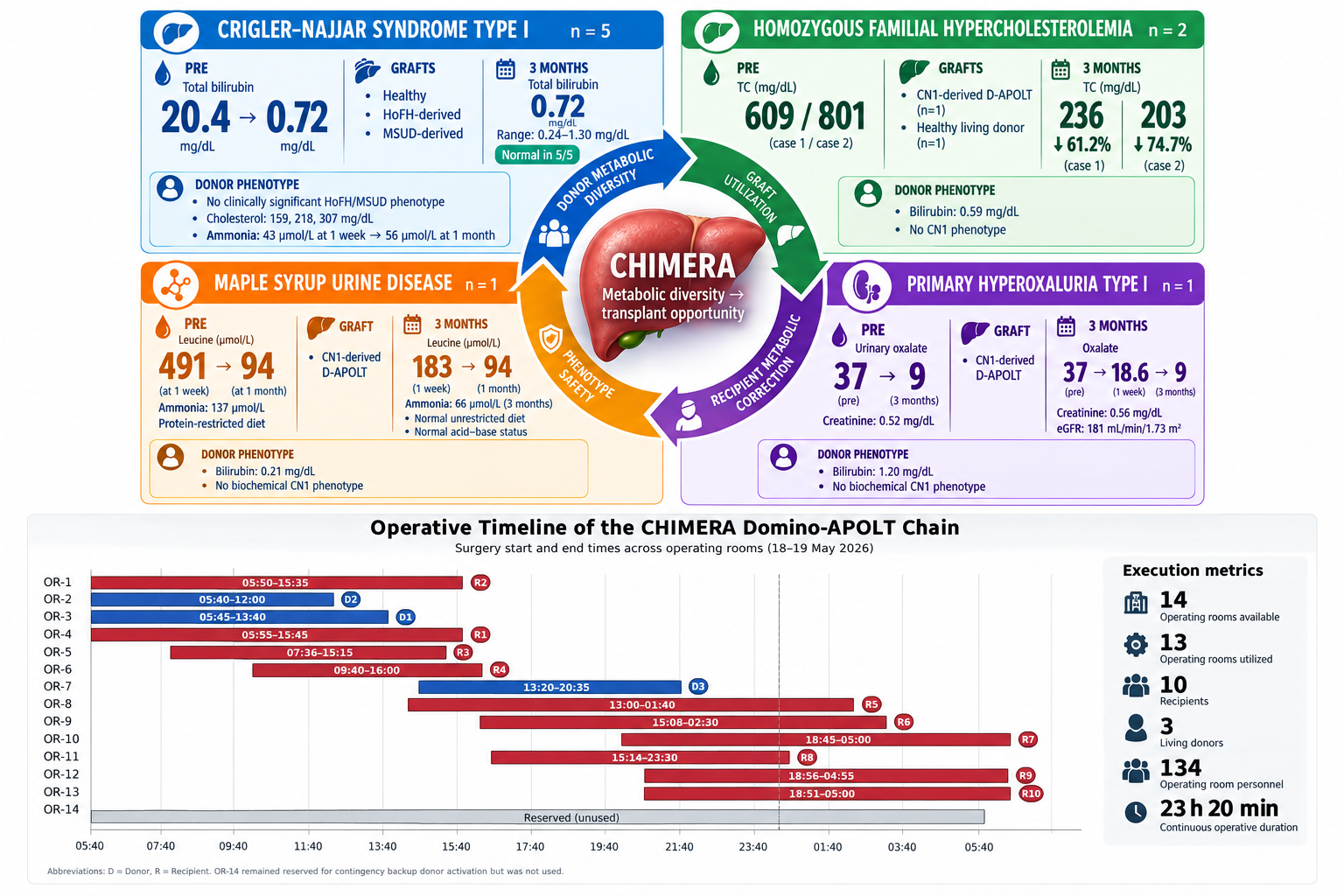
Conclusion:
CHIMERA demonstrates the potential to convert selected structurally preserved metabolic livers into a donor resource through complementary metabolic matching and serial graft reutilization. A national or regional referral network could bring rare complementary disorders together, expanding pediatric transplant access while reducing exposure of additional healthy living donors to hepatectomy. Longer follow-up is needed to establish the durability and broader applicability of metabolic graft exchange.