
Long-Term Outcomes in Pediatric Liver Transplant Recipients Induced with Antibody Therapy: Autoimmune Liver Disease vs. Non-Autoimmune Liver Disease
Authors
Affiliations
Abstract
Background: We previously demonstrated that IL-2 receptor antagonist induction in pediatric autoimmune liver disease (AILD; autoimmune hepatitis, primary sclerosing cholangitis, or autoimmune sclerosing cholangitis) significantly reduces early acute rejection without increasing infection risks or compromising long-term graft and patient survival compared to steroid-only induction. The impact of antibody induction strategies on outcomes in pediatric recipients with AILD remains incompletely defined. Post-transplant outcomes comparing pediatric AILD and non-AILD recipients under antibody induction (anti-thymoglobulin; ATG or basiliximab/daclizumab) have not been previously established. Evaluating these differences is critical given the higher rates of prior immunosuppression and the ongoing risk of recurrent disease following transplantation in AILD.
Methods: Using the Society of Liver Transplantation (SPLIT) database, this study evaluated baseline characteristics and clinical outcomes in primary pediatric liver transplant (LT) recipients who received antibody induction therapy with AILD (n=116) versus non-AILD diagnoses (n=1,970). Re-transplants were excluded. Differences in early clinical outcomes (acute rejection, culture-proven infection) were assessed with a mixed effects logistic regression and while 5-year patient and graft survival were assessed using mixed-effects multivariable regression models with proportional hazard regression frailty model. Both sets of models accounting for center variability as a random effect and adjusting for sex, age, race/ethnicity, bilirubin at LT, creatine at LT, INR at LT, donor age, graft type, deceased or living donor.
Results: Patients with AILD were significantly older at LT (mean age 13.0 vs. 5.0 years, p<0.001) and predominantly female (66.4% vs. 48.4%, p<0.001). AILD recipients had higher rates of inflammatory bowel disease (17.1% vs. 0.3%, p<0.001) and fewer prior abdominal surgeries (5.6% vs. 53.8%, p<0.001). Donor age was higher for AILD recipients (24.3 vs. 15.9 years, p<0.001). Graft procedure types differed significantly, with AILD patients receiving whole liver grafts more frequently (68.4% vs. 54.5%, p=0.013). Biliary duct-to-duct anastomosis was more common in AILD (47.4% vs. 27.8%), while Roux-en-Y was lower (51.7% vs. 67.1%, p<0.001). In adjusted multivariable models, there was no significant difference in acute rejection within Day 30 (aOR 0.91, 95% CI: 0.48–1.73, p=0.777) or Day 30–90 (aOR 1.51, 95% CI: 0.58–3.90, p=0.395). Culture-proven infection rates did not differ significantly at Day 30 (aOR 1.08, 95% CI: 0.63–1.84, p=0.790) or Day 30–90 (aOR 1.33, 95% CI: 0.63–2.81, p=0.451)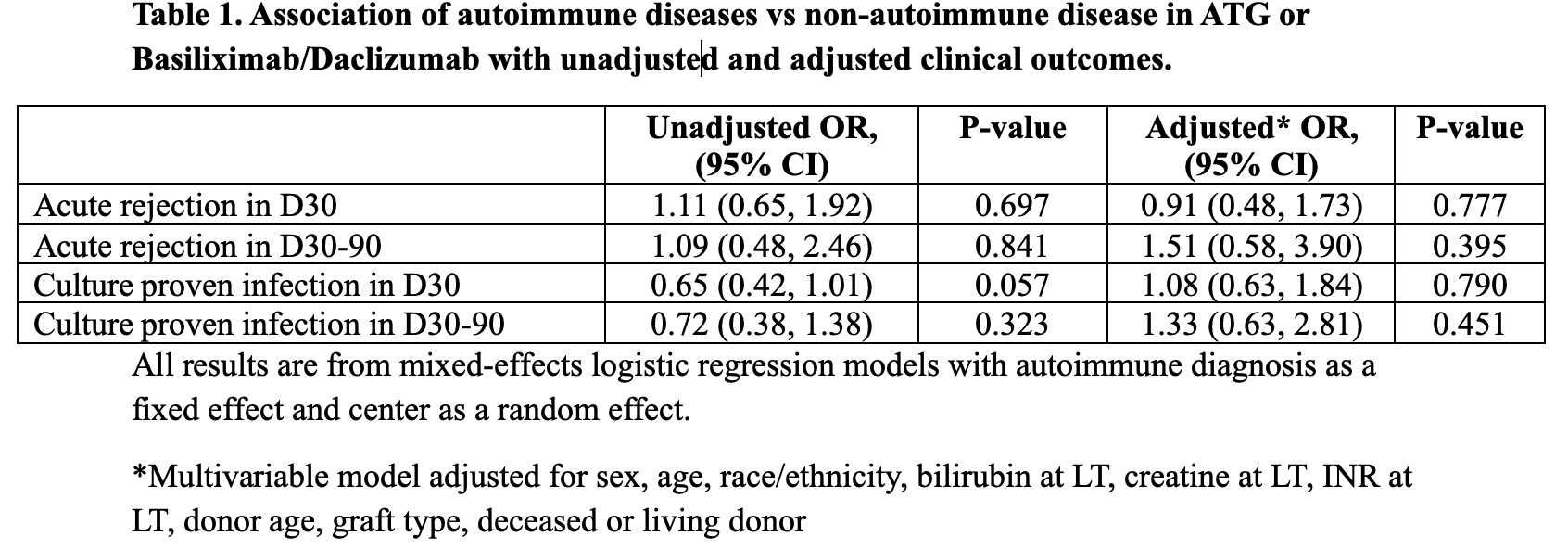
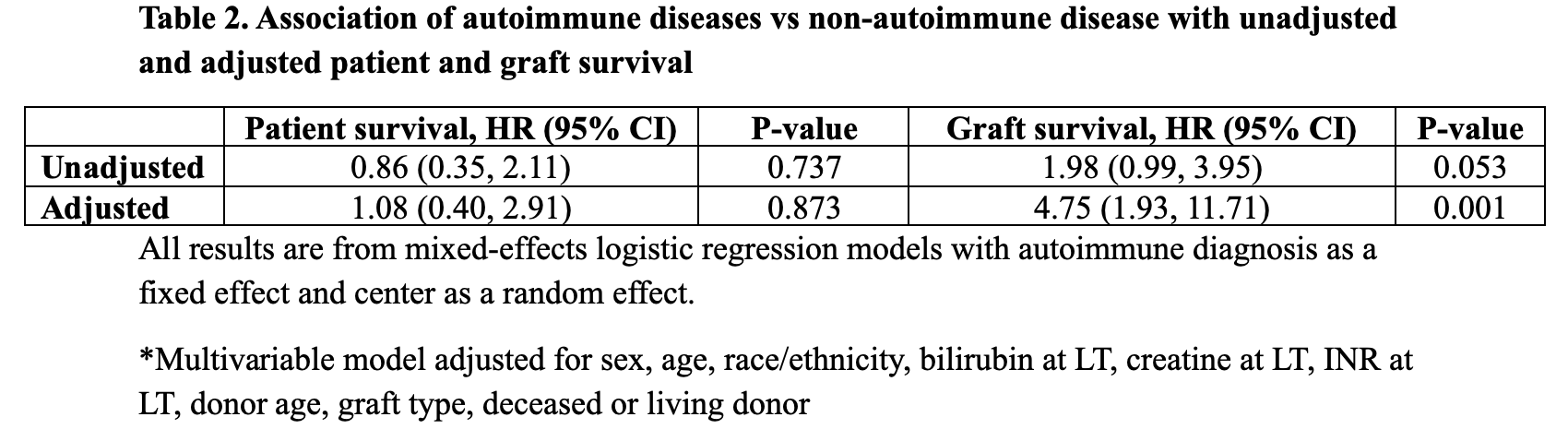
Conclusion: Among pediatric liver transplant recipients under antibody induction therapy, recipients with AILD demonstrate post-transplant patient survival, acute rejection, and infection rates comparable to non-AILD recipients. Importantly AILD recipients had significantly lower long-term graft survival after adjustment even under antibody-induction approaches, highlighting the need for tailored management strategies to improve graft longevity in this cohort.