Evolution of Donor-Derived Cell-Free DNA following acute rejection treatment in pediatric kidney transplant recipients
Authors
Affiliations
Abstract
Introduction: Recently, Donor-derived Cell-free DNA (dd-cfDNA) has emerged as a valuable biomarker to predict allograft rejection. Recent adult and pediatric studies demonstrated that combining standard of care data with dd-dfDNA may decrease the need for surveillance allograft biopsies. However, data on longitudinal assessement of dd-cfDNA both prior and after a rejection episode are lacking, especially in children. The aim is to assess the association between the change in dd-cfDNA levels and the evolution of allograft rejection under treatment.
Methods: We included pediatric patients with a diagnosis of allograft rejection or borderline lesions according to the Banff 2022 classification who had a follow-up biopsy and dd-cfDNA measurement available at the time of both biopsies. Patients were recruited from both centers in France and the US. Additional data included, estimated glomerular filtration rate (eGFR), urine protein-to-creatinine ratio (UPCR), and donor-specific antibodies (DSA). Improvement was defined as a decrease in rejection grade according to the Banff 2022 classification.
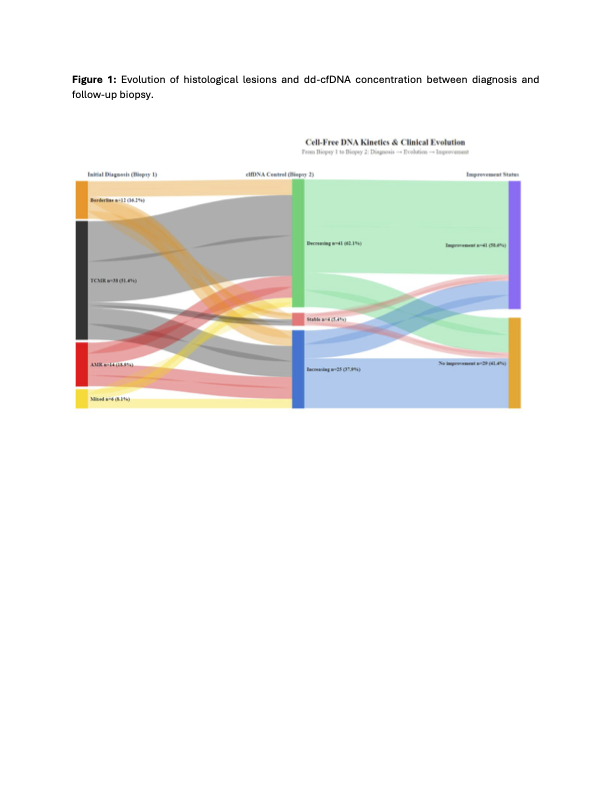
Results: We included 58 patients with a median age of 18 [12 -19] year at time of first rejection. A total of 70 biopsy-proven rejection episodes were studied. At the initial biopsy, median eGFR was 47 [28- 59] mL/min/1.73 m², median UPCR was 0.20 [0.12 - 0.40] g/g, and 41 (58.6%) patients had DSA. Of the 70 biopsies, 22 (31.4%) were surveillance biopsies; 14 episodes were classified as AMR, 38 as TCMR, 6 as mixed rejection, and 12 as borderline lesions. Median dd-cfDNA at rejection diagnosis was 0.88 % [0.33 -2.33]. At follow up biopsy, 41 (58.6%) episodes showed histological improvement and 24 (34.3%) showed resolution of the rejection.
Among 57 episodes of biopsy-proven rejection and elevated dd-cfDNA at baseline, followed by a repeat biopsy within 6 months, dd-cfDNA decreased in 36 (63.2%) episodes. Of these, 27 (75%) showed histological improvement, including 13 with complete resolution of rejection. Among the 19 (33.3%) episodes with an increase in dd-cfDNA, 13 (68.4%) showed no histological improvement. Six (31.6%) episodes showed histological improvement despite an increase in dd-cfDNA; all had an early follow-up biopsy performed within 1–2 months, and 16 of the 19 episodes showed persistent evidence of rejection. Figure1
Among patients with elevated dd-cfDNA at the time of rejection, decreasing dd-cfDNA was associated with histologic improvement (p=0.003). However, the absolute dd-cfDNA level at follow-up biopsy was more predictive of rejection resolution than the change in dd-cfDNA from baseline (AUC 0.75, 95% CI 0.63–0.87 vs. AUC 0.60, 95% CI 0.46–0.72)
Conclusion: Our study suggests that a decrease in dd-cfDNA concentration during rejection treatment is associated with histological improvement. Conversely, dd-cfDNA at the time of follow-up biopsy rather than the change in dd-cfDNA overtime, was associated with the persistence of active rejection on biopsy.