
Impact of Pre-Transplant Desensitization on Time to Transplant in the TACKLE-PRA Cohort: A Study of the Pediatric Nephrology Research Consortium

Authors
Affiliations
Abstract
Introduction: One of the biggest immunologic barriers that precludes transplantation is HLA sensitization when patients have antibodies prior to transplantation, resulting in positive crossmatches with potential donors. Several protocols exist to desensitize patients awaiting transplant; however, this practice is not uniform across transplant centers in the United States. Additionally, it is not known whether desensitization improves time-to-transplant or transplant outcomes in children who already receive priority on the deceased donor waiting list. Timing And Clinical outcomes in Kidney transplants for chiLdrEn with PRA > 30% (TACKLE-PRA) is an ongoing study recruiting pediatric patients with elevated cPRA at the time of listing to evaluate the impact of desensitization.
Methods: This longitudinal retrospective multi-center cohort included patients that were listed for deceased donor transplant between 1/1/2014 – 12/31/2023 and were < 18 years old at the time of listing. They must have received a transplant < 22 years of age and had a cPRA > 30% at the time of transplant listing. Comparison of continuous and categorical variables occurred using Wilcoxon rank-sum or Pearson’s chi-squared tests, respectively. An accelerated failure time model with lognormal distribution, adjusted for cPRA, age at listing, ABO, and inactive waitlist time was utilized to evaluate association with time to transplantation.
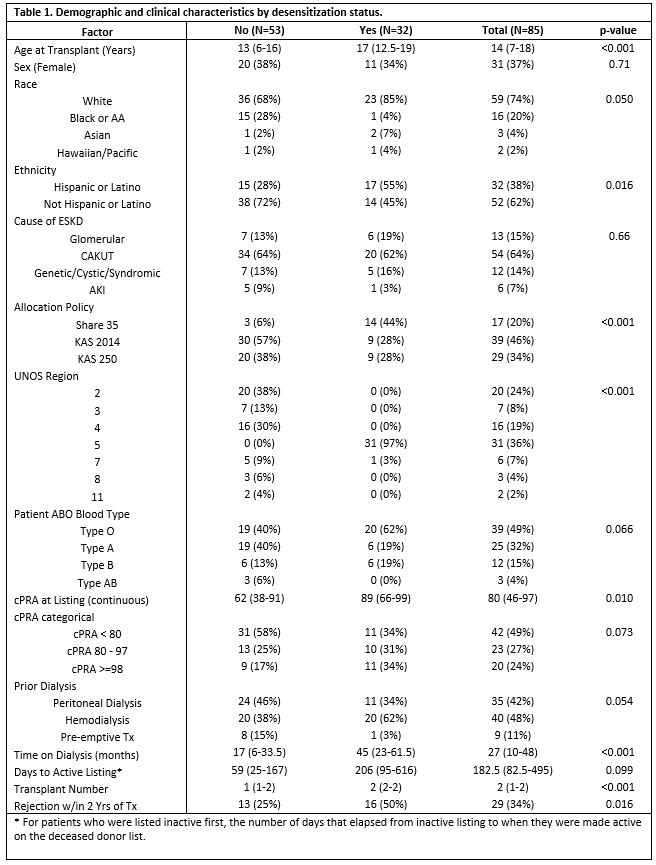
Results: The cohort included 85 patients, of whom 32 (37.6%) had received some form of desensitization. Those who received desensitization were older at time of transplant [17 (IQR 12.5-19) vs 13 (IQR 6-16) years, p <0.001], spent more time on dialysis [45 (IQR 23-61.5) vs 17 (6-33.5) months, p<0.001], were more likely to be receiving a second transplant, and had higher cPRA at listing [62% (IQR 38 – 91) vs 89% (IQR 66 – 99), p-value = 0.010], Table 1. Approaches among the 32 patients who received desensitization included IVIg (100%), Rituximab (87%), plasmapheresis (55%), tocilizumab (19%), and daratumumab (6%).
Desensitization was evaluated as a time-varying covariate from listing and from active waitlist time. In the primary model from active waitlisting and adjusted for allocation era, desensitization was associated with a shorter time to transplant (TR 0.24, 95% CI 0.12 – 0.47, p < 0.001), Figure 1. The associated persisted in all adjusted models. Higher cPRA at listing was associated with a longer time to transplantation (TR 1.02, 95% CI 1.01 – 1.03, p = <0.01) for every percentage point increase.
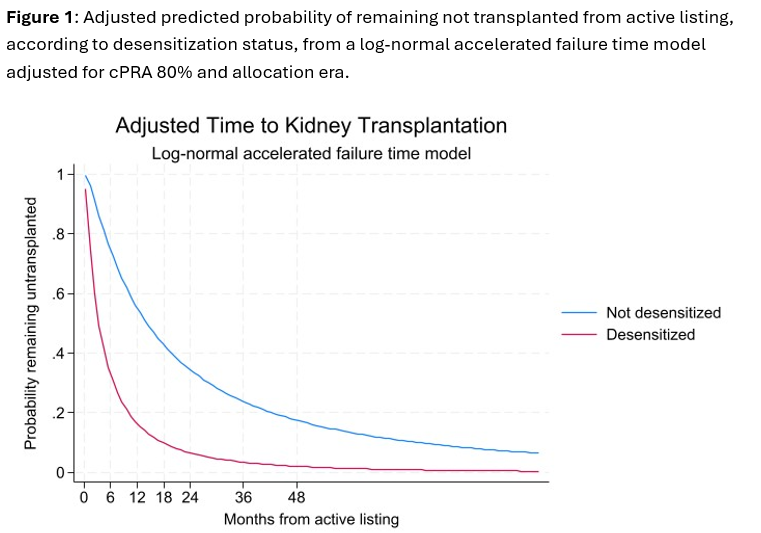
Conclusion: In the TACKLE-PRA cohort, desensitization was associated with decreased time ratio to transplantation from active and inactive waitlisting. Regional variation could not be assessed in this analysis due to small sample size but will be explored when data collection at additional centers is completed. Further analysis will adjust for infectious complications and explore association of desensitization with early post-transplant rejection risk.