Diagnostic Performance of MMDx for Antibody Mediated Rejection in Pediatric Heart Transplant Recipients: A Comparison with Conventional Histopathology
Authors
Affiliations
Abstract
Introduction: Antibody-mediated rejection (AMR) is a major cause of graft dysfunction and mortality after pediatric heart transplantation (HT). The Molecular Microscope Diagnostic System (MMDx), which detects rejection-associated transcriptional changes may address key limitations of histopathology in AMR diagnosis. Adult data suggest MMDx enhances AMR assessment, but pediatric data on interpreting MMDx results remain limited. We evaluated the concordance of MMDx and histopathology for AMR, and the impact of donor specific antibodies (DSA) and donor-fraction cell-free DNA (cfDNA) on AMR detection by each method.
Methods: We conducted a retrospective, single-center cohort study of pediatric HT recipients undergoing for-cause endomyocardial biopsy with concurrent MMDx testing from January 2023 to August 2026. Histopathology was graded by ISHLT criteria. DSA was categorized by class and mean fluorescence intensity (MFI); cfDNA, echocardiographic, and hemodynamic data were collected. Primary outcomes were AMR detection rate by MMDx versus histopathology (overall and stratified by DSA status/strength) as well as diagnostic discrimination cfDNA. Secondary outcomes include MMDx-histopathology concordance (Cohen's kappa). All models used generalized estimating equations (GEE) with cluster-robust variance to account for repeated biopsies per patient.
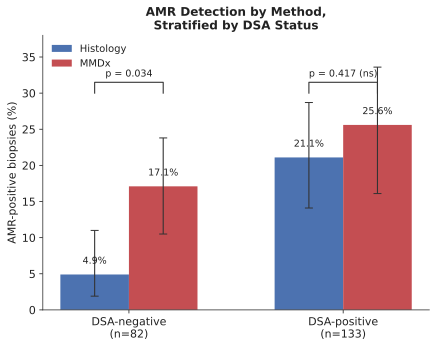
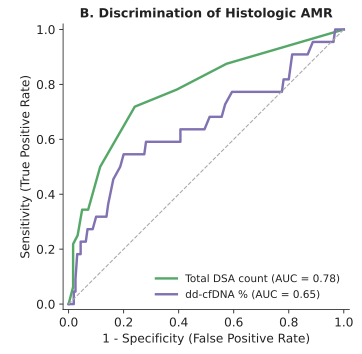
Results: Among 226 endomyocardial biopsies from 85 pediatric heart transplant recipients (median 2, range 1–10 biopsies/patient), AMR was identified in 14.2% of biopsies by histology versus 22.1% by MMDx (OR 1.90, 95% CI 1.11–3.27; p<0.05), with only slight agreement between methods (κ=0.145, 95% CI −0.05–0.34). This gap was concentrated in DSA-negative biopsies (histology 4.9% vs MMDx 17.1%; t test p=0.034), while DSA-positive biopsies showed similar rates by both methods (histology 21.1% vs MMDx 25.6%; t test p=0.417). DSA strength did not affect concordance. Notably, cfDNA positivity was associated with a 3.4-fold higher odds of histology/MMDx disagreement. cfDNA positivity was strongly associated with MMDx-AMR (31.1% vs 6.4%; OR 6.61, 95% CI 1.98–22.05) but not histologic AMR (12.9% vs 10.6%), better discriminating MMDx-AMR than histologic AMR (AUC 0.74 vs 0.65).
Conclusion: This is among the first pediatric evaluations of MMDx-histopathology concordance for AMR. MMDx more frequently detected molecular AMR in the absence of circulating DSA, and cfDNA positivity was associated with AMR not identified on histopathology. DSA and cfDNA both appear to contribute meaningfully to rejection detection, extending recent adult findings to a pediatric population with distinct sensitization biology. Clarifying whether MMDx detects clinically meaningful antibody-mediated injury beyond histology could refine post-transplant surveillance and support earlier, biomarker-guided intervention in pediatric heart transplant recipients.