Lumasiran Treatment and Isolated Kidney Transplantation in Primary Hyperoxaluria Type 1 and Late-Stage Chronic Kidney Disease
Authors
Affiliations
Abstract
INTRODUCTION: Ongoing hepatic oxalate production and systemic oxalate accumulation in patients with primary hyperoxaluria type 1 (PH1) and late-stage chronic kidney disease (CKD) have historically limited the feasibility of isolated kidney transplant (iKT). We reviewed data from the real-world observational BONAPH1DE study (NCT04982393) and Phase 3 ILLUMINATE-C trial (NCT04152200) to assess whether lumasiran could reduce oxalate burden and facilitate iKT in this high-risk population.
METHODS: BONAPH1DE (N=174; all ages; any CKD stage) included 19 lumasiran ever-treated patients on dialysis and 11 not on dialysis with baseline estimated glomerular filtration rate (eGFR) ≤45 mL/min/1.73 m2. ILLUMINATE-C (N=21; all ages; late-stage CKD) included 15 patients on dialysis and 6 not on dialysis with baseline eGFR ≤45 mL/min/1.73 m2; all initiated lumasiran. Post-iKT outcomes were evaluated in a subset of 7 BONAPH1DE patients (lumasiran-treated at iKT; ≥1 year follow-up; ≥1 post-iKT plasma oxalate [POx] and eGFR value) and 6 ILLUMINATE-C patients.
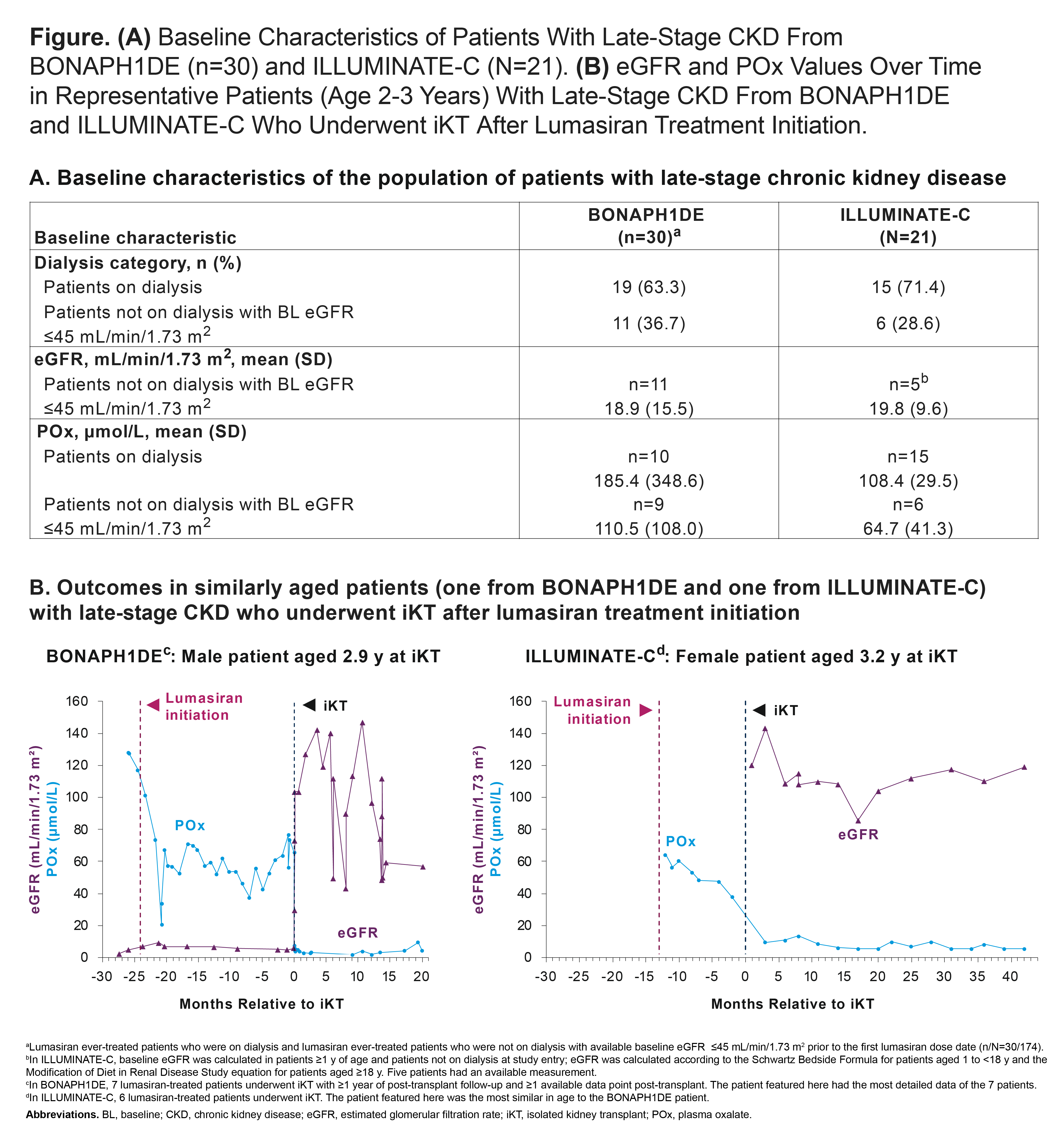
RESULTS: In BONAPH1DE, patients not on dialysis had a mean (SD) baseline eGFR of 18.9 (15.5) mL/min/1.73 m2 and baseline POx of 110.5 (108.0) µmol/L; those on dialysis had a mean (SD) baseline POx of 185.4 (348.6) µmol/L. In ILLUMINATE-C, patients not on dialysis had a mean (SD) baseline eGFR of 19.8 (9.6) mL/min/1.73 m2 and baseline POx of 64.7 (41.3) µmol/L; those on dialysis had a mean (SD) baseline POx of 108.4 (29.5) µmol/L (Figure). Generally, POx declined post-iKT among lumasiran-treated patients in BONAPH1DE and ILLUMINATE-C. In ILLUMINATE-C, following lumasiran, POx was already reduced at the time of iKT (range: 19.2-93.2 µmol/L) and declined further post-iKT.
CONCLUSION: In this group of patients with PH1 and late-stage CKD, lumasiran was associated with reduced POx pre- and post-iKT, with concordant findings across real-world and clinical trial settings. These results suggest that lumasiran can facilitate iKT in PH1 patients by reducing oxalate burden.