Beyond AKI: Urine NGAL as a Signal for UTI in Pediatric Kidney Transplant Recipients
Authors
Affiliations
Abstract
Introduction
Urine neutrophil gelatinase-associated lipocalin (NGAL) is a well-established biomarker of acute kidney injury (AKI). Urine NGAL also identifies urinary tract infection (UTI) with high accuracy in non-transplant pediatric populations, including febrile children and children with neurogenic bladder. However, its utility for detecting UTI in pediatric kidney transplant recipients, a population at high risk for UTI and its complications, has not been evaluated. We examined whether urine NGAL differs between UTI by culture positivity in urine samples from pediatric kidney transplant recipients and assessed its diagnostic performance.
Methods
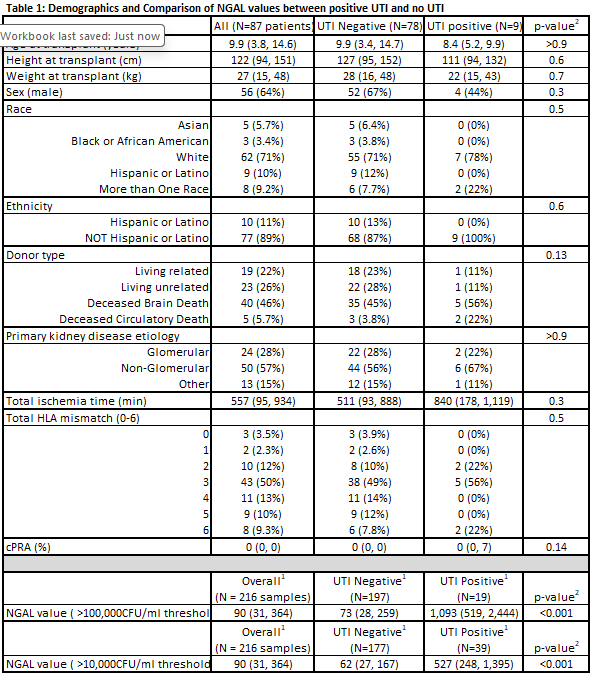
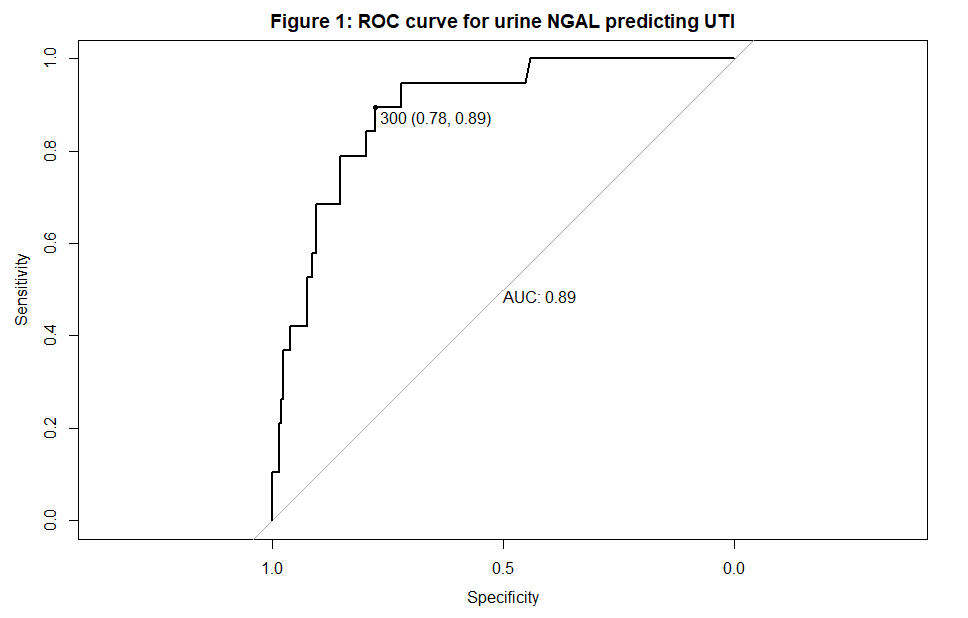
This retrospective, single-center analysis included urine NGAL values obtained ≥7 days post-transplant from pediatric kidney transplant recipients followed at University of Iowa Health Care Stead Family Children’s Hospital between 2019 and 2026. NGAL levels were obtained by clinical indication and performed by clinical laboratory measurement. Each NGAL value was paired with a temporally linked urine culture that was obtained within 72 hours. UTI was defined as growth of any organism at ≥100,000 CFU/mL. When multiple NGAL values were linked to the same culture result, only the highest value was retained. Patients who received two distinct transplants during the study period contributed data as independent transplant episodes. Urine NGAL was compared between UTI-positive and UTI-negative samples using the Wilcoxon rank-sum test, and receiver operating characteristic (ROC) analysis was used to evaluate discrimination and identify the optimal cutoff by the Youden index.
Results
Among 83 patients (87 transplant episodes), 216 paired NGAL–culture samples were analyzed, of which 19 (8.8%) met criteria for UTI. Median urine NGAL was higher in UTI-positive samples (1,093 ng/mL; IQR 519–2,444) than in UTI-negative samples (73 ng/mL; IQR 28–259; p<0.001). The AUC for discriminating UTI was 0.88 (95% CI 0.82–0.95). A Youden-optimal cutoff of 300 ng/mL yielded sensitivity 90% (95% CI 74%-100%), specificity 78% (95% CI 72%-84%), PPV 28% (95% CI 22%-35%), and NPV 99% (95% CI 97%-100.0%). Findings were similar using a ≥10,000 CFU/mL threshold (39 UTI-positive samples; median NGAL 527 vs 62 ng/mL, p<0.001) but yielded a lower AUC for discriminating UTI.
Conclusion
Urine NGAL was markedly elevated in pediatric kidney transplant recipients with culture-confirmed UTI and discriminated UTI status well, extending prior work in non-transplant pediatric populations to this high-risk group. The number of UTI events was small, and the cutoff was derived and evaluated in the same cohort; therefore, prospective validation in larger cohorts, with attention to concurrent allograft injury, is needed before a clinically actionable cutoff can be established.