Medication adherence barriers and tacrolimus variability predict acute rejection in kidney transplant patients: An Improving Renal Outcomes Collaborative study
Authors
Affiliations
Abstract
Background: Adolescent and young adult kidney transplant recipients have the highest risk of allograft loss with half related to poor medication adherence. Medication adherence barriers (MAB) and elevated tacrolimus variability may help identify patients at risk for rejection.
Methods: This retrospective study using the Improving Renal Outcomes Collaborative (IROC) registry identified kidney transplant recipients and/or caregivers who completed a medication adherence barriers assessment tool (BAT). Data from nine participating sites were analyzed to examine relationships between MAB, tacrolimus coefficient of variation (CV%) and T-cell mediated rejection (TCMR) Banff grade IA or higher in the 12 months after BAT. Patients were defined as having 0, 1 or ≥2 MAB. High tacrolimus variability was defined as ≥30%. Nested multivariable logistic regression models examined rejection risk of MAB and CV% controlling for other risk factors.
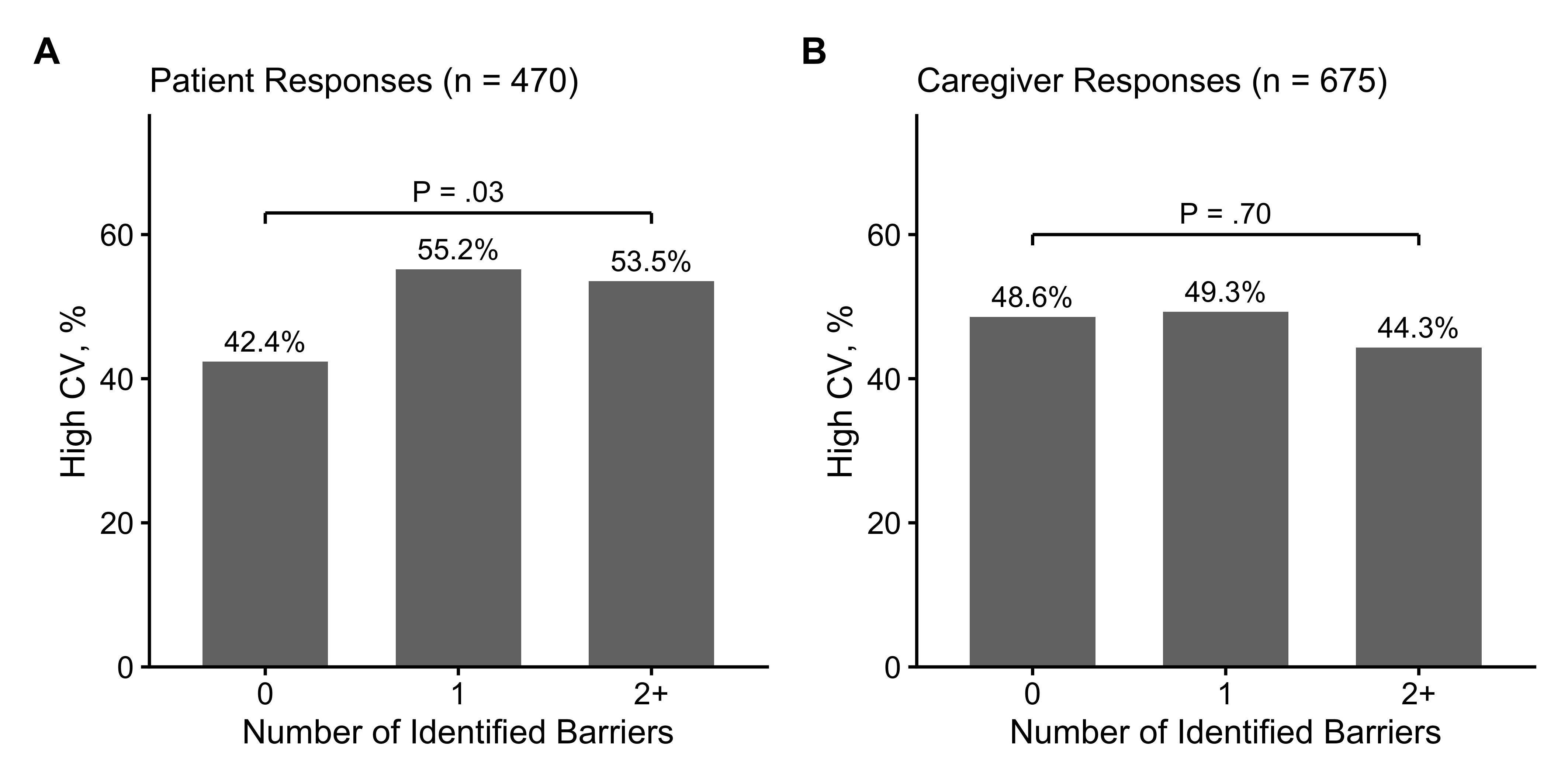
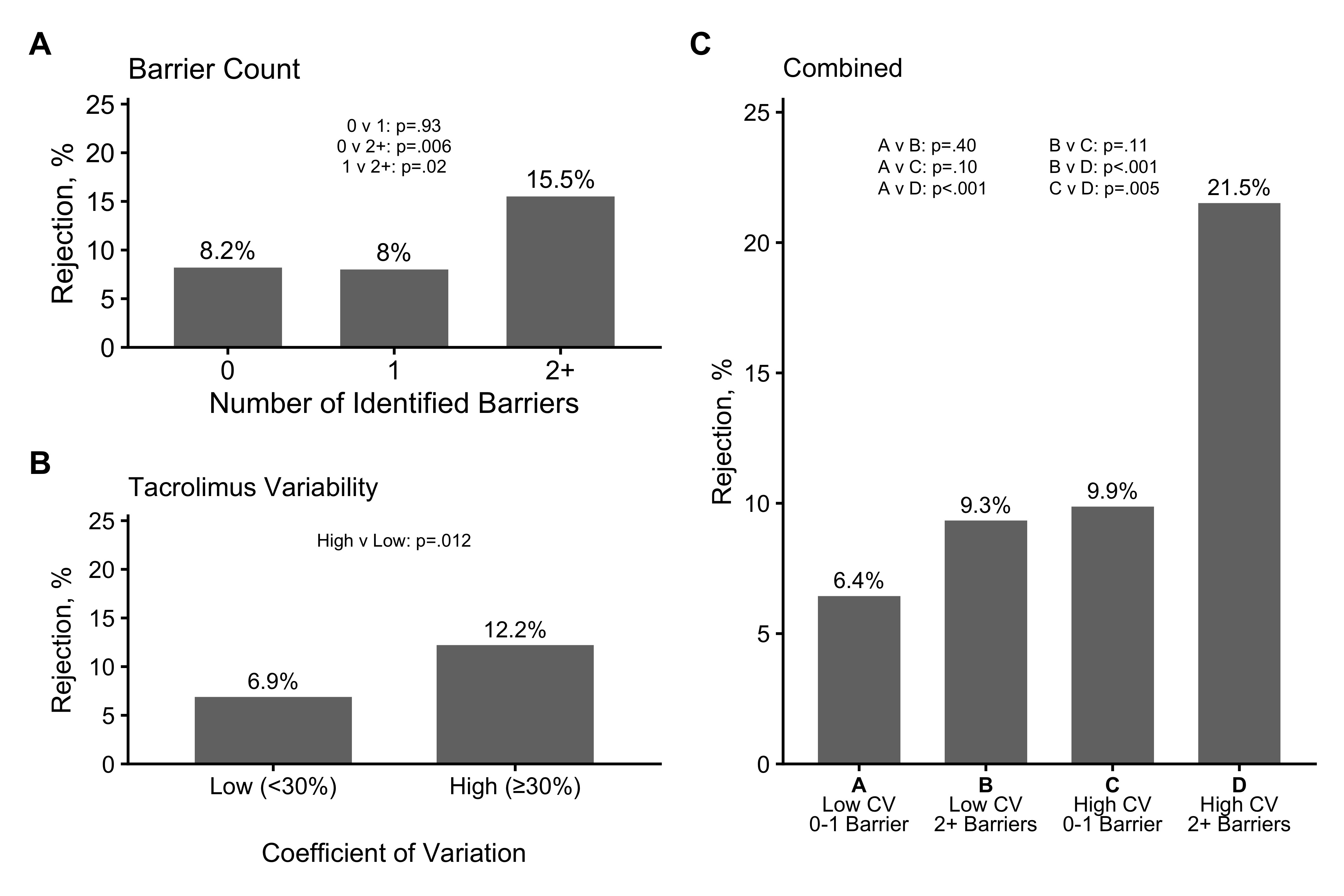
Results: In 892 patients aged 1 to 23 years (median 13.6, IQR 8.3-17.2), 22.4% of BAT respondents reported 1 MAB and 18.7% reported ≥2 MAB. Patients were more likely than caregivers to report barriers (p<0.001). Among 794 patients with CV% data, 49.5% had a CV%≥30. There was no difference in mean CV% by MAB status (32.5, 34.1 & 33.9%, p=0.1). CV%≥30 was associated with higher MAB status only in patient respondents (p=0.03), not caregivers (p=0.7, Figure 1). TCMR ≥1A was seen in 9.5% of patients and occurred more frequently in those with ≥2 MAB (15.5 v 8.2 & 8.0%, p=0.01) and in those with CV%≥30 (12.2 v 6.9%, p=0.01) with the highest observed prevalence in those with both risk factors (21.5%, Figure 2). In the full model, the presence of ≥2 MAB (OR=2.28,95%CI=1.21-4.28), higher CV% (OR=1.12,95%CI=1.04-1.21), prior history of TCMR (OR=2.15,95%CI=1.39-3.31), deceased donor type (OR=0.5,95%CI=0.3-0.82) and shorter time since transplant (OR=0.9996,95%CI=0.9994-0.9999) were significantly associated with higher odds of TCMR. Model performance with immunologic and demographic risk factors was maximally improved when incorporating both MAB status and CV%, rather than either factor alone (p<0.001).
Conclusion: In pediatric kidney transplant recipients, the presence of 2 or more MAB and a higher CV% are independent and significant risk factors for acute TCMR in the following 12 months. The two risk markers are better used in conjunction than separately to identify patients who might benefit from intervention. Given the inconsistent association between reported barriers and high CV% across reporter types, tacrolimus variability is not a reliable surrogate for adherence and should not replace direct assessment of medication-taking barriers.