TIPS in young children awaiting liver transplantation: outcomes in a low-weight cohort
Authors
Affiliations
Abstract
INTRODUCTION
Transjugular intrahepatic portosystemic shunt (TIPS) has become the standard treatment for complications of portal hypertension in adults. In recent years, this approach has also been used in the pediatric population. However, most pediatric series shows relatively high mean ages and body weights, and their findings may therefore not be extrapolated to patients in the first years of life.
Objective: to evaluate the outcomes of TIPS in a pediatric cohort, most of whom weighed less than 10 kg
METHODS
Retrospective study of TIPS placement in patients listed for liver transplantation between 2015-2025. The primary outcome was shunt patency, assessed by Doppler ultrasonography. Technical success and the number of procedures performed per patient were also recorded.
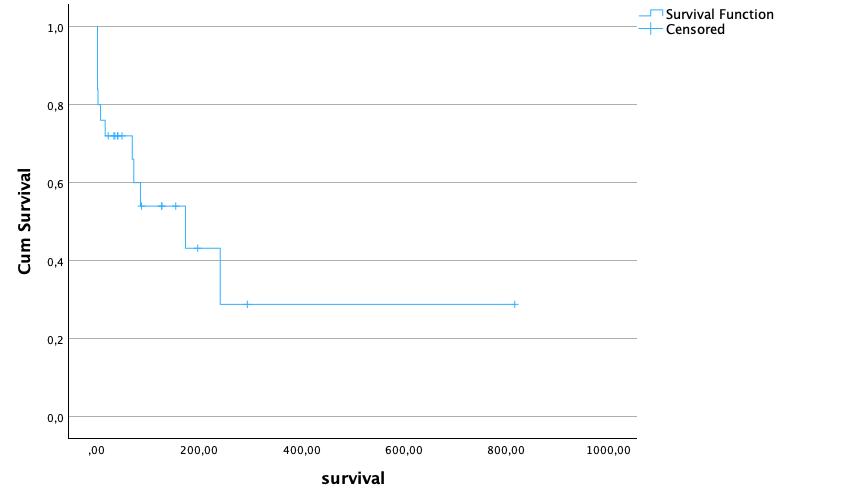
Each technically successful procedure was analyzed as a separate episode. Time to shunt thrombosis was measured from the date of the procedure and estimated using the Kaplan–Meier method. Repeated episodes within the same patient were analyzed as independent observations.
RESULTS
Thirty-one procedures were performed in 16 patients, median body weight 6.7 kg (3.9–18.7 kg), 13 patients (81.3%) weighed < 10 kg. Median age 7.1 months (3.9–79.6 months).
The underlying diagnosis was biliary atresia in 12 patients (75%), familial intrahepatic cholestasis in 2 (12.5%), Alagille syndrome in 1 (6.3%), and autoimmune cirrhosis in 1 (6.3%).
The most frequent indication for TIPS was refractory ascites, in 8 cases (50%), followed by reduction in portal vein caliber in 6 cases (37.5%).
The median number of procedures was 2 per patient. Nine patients (56%) required ≥ 2 sessions: 4 patients (25%) two sessions, 4 (25%) three, and 1 patient (6%) underwent four sessions
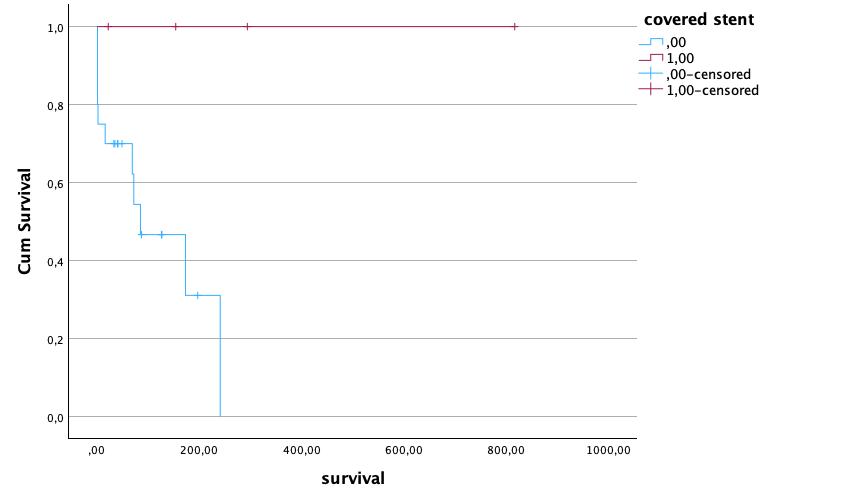
Stent diameters ranged from 3.5 to 8 mm, with 5 mm being the most frequently used (9 cases, 56.3%). Covered stents were used in 4 procedures.
Shunt creation was unsuccessful in 6 procedures (technical success rate of 80.6%). Among successful procedures, 48% (12/25) developed thrombosis during follow-up. Thrombosis-free survival at 1, 3, and 6 months was 72%, 54%, and 43%. The use of covered stents was associated with a lower risk of thrombosis (log-rank test, 4.713; p = 0.03).
Fifteen patients (93.75%) underwent liver transplantation. Of these, 13 (86.6%) had a patent shunt at the time of transplantation. The median interval between TIPS placement and transplantation was 4.2 months (1.1–27 months).
One patient with a thrombosed shunt developed severe TIPSitis, which subsequently complicated the surgical procedure at the time of transplantation.
CONCLUSIONS
TIPS placement was technically feasible, but thrombosis was frequent and repeat interventions were often required in this particularly fragile population. Despite the high incidence of thrombosis, most shunts could be successfully rescued.
The potential need for repeated interventions should be weighed against the patient's clinical condition and the estimated waiting time until transplantation.