Survival, recurrence, and long-term comorbidities following resection versus transplant for pediatric hepatoblastoma an Epic Cosmos study
Authors
Affiliations
Abstract
Background: Advances in medical and surgical management have led to improved overall survival in pediatric patients with hepatoblastoma. However, the rarity of this disease is a limitation in evaluating long term-outcomes. Epic Cosmos, a novel multi-institutional database, offers the scale needed to address this gap.
Methods: All patients < 18 years of age diagnosed with hepatoblastoma who underwent liver resection or liver transplant from 10/1/2015-07/31/2026 in the Epic Cosmos database were included. PRETEXT classification was not available; timing of chemotherapy and surgical management were used to distinguish between low-risk and intermediate-high risk patients. Primary outcomes were (i) all-cause mortality in overall and intermediate-high risk cohorts (ii) incidence of recurrent disease in overall and intermediate-high risk cohorts, and (iii) long-term comorbidities overall.
Results: The overall cohort included 679 pediatric patients: 454 who underwent liver resection, 225 who underwent liver transplant. Unadjusted overall survival was significantly higher after resection than transplant (1-, 3-, and 5-year OS: 95.8% vs 92.6%, 92.9% vs 83.9%, and 91.3% vs 81.7%, respectively; log-rank p = 0.0013). After adjusting for age at diagnosis and chemotherapy category, transplant remained associated with worse survival (HR 1.84, 95% CI 1.08–3.11; p=0.024). In a subgroup analysis restricted to intermediate-high risk patients only (n=285 resection, 187 transplant), unadjusted overall survival remained significantly higher after resection than transplant (1-, 3-, and 5-year OS: 95.5% vs 91.6%, 90.5% vs 81.0%, and 89.0% vs 79.3%, respectively; log-rank p=0.0088). Adjusted overall survival in the intermediate-high risk cohort was not significantly different between transplant and resection (HR 1.75, 95% CI 0.97–3.15; p=0.062, Figure 1). 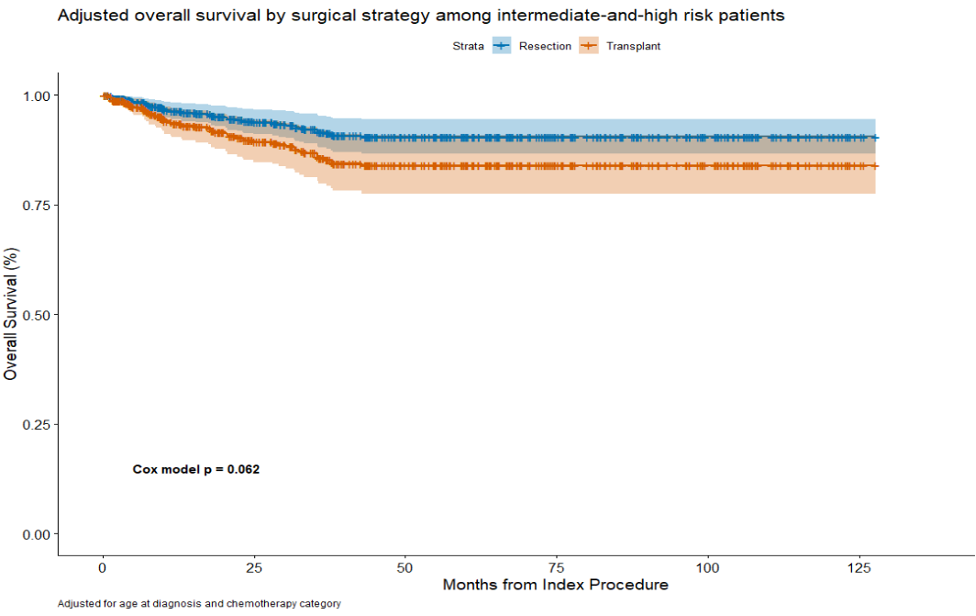
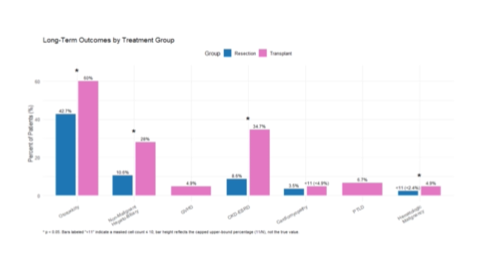
Conclusion: In this Epic Cosmos study, after restricting to intermediate-high risk patients, adjusted overall survival did not differ between liver resection and liver transplant, with transplant patients having higher rates of long-term co-morbid conditions. Epic Cosmos is a novel database for investigating rare diseases and long-term outcomes such as pediatric hepatoblastoma. However, limitations in granular tumor staging data preclude direct comparison of resection and transplant outcomes among patients with equivalent disease extent.