One year or more of pegcetacoplan for pediatric and post-transplant patients with C3 glomerulopathy or primary (idiopathic) immune-complex membranoproliferative glomerulonephritis
Authors
Affiliations
Abstract
Introduction: C3 glomerulopathy (C3G) and primary (idiopathic) immune-complex membranoproliferative glomerulonephritis (IC-MPGN) are rare, chronic kidney diseases often diagnosed in childhood. Both frequently recur after transplantation despite conventional immunosuppression. One year of pegcetacoplan (C3/C3b inhibitor) showed efficacy and favorable tolerability for adults (≥18 years) and adolescents (12–17 years) with native or post-transplant recurrent C3G or primary IC-MPGN in NOBLE (phase 2, NCT04572854; adults with post-transplant recurrent disease) and VALIANT (phase 3, NCT05067127; adults and adolescents with native or post-transplant disease). Patients from VALIANT continued pegcetacoplan in the subsequent open-label extension (VALE; NCT05809531).
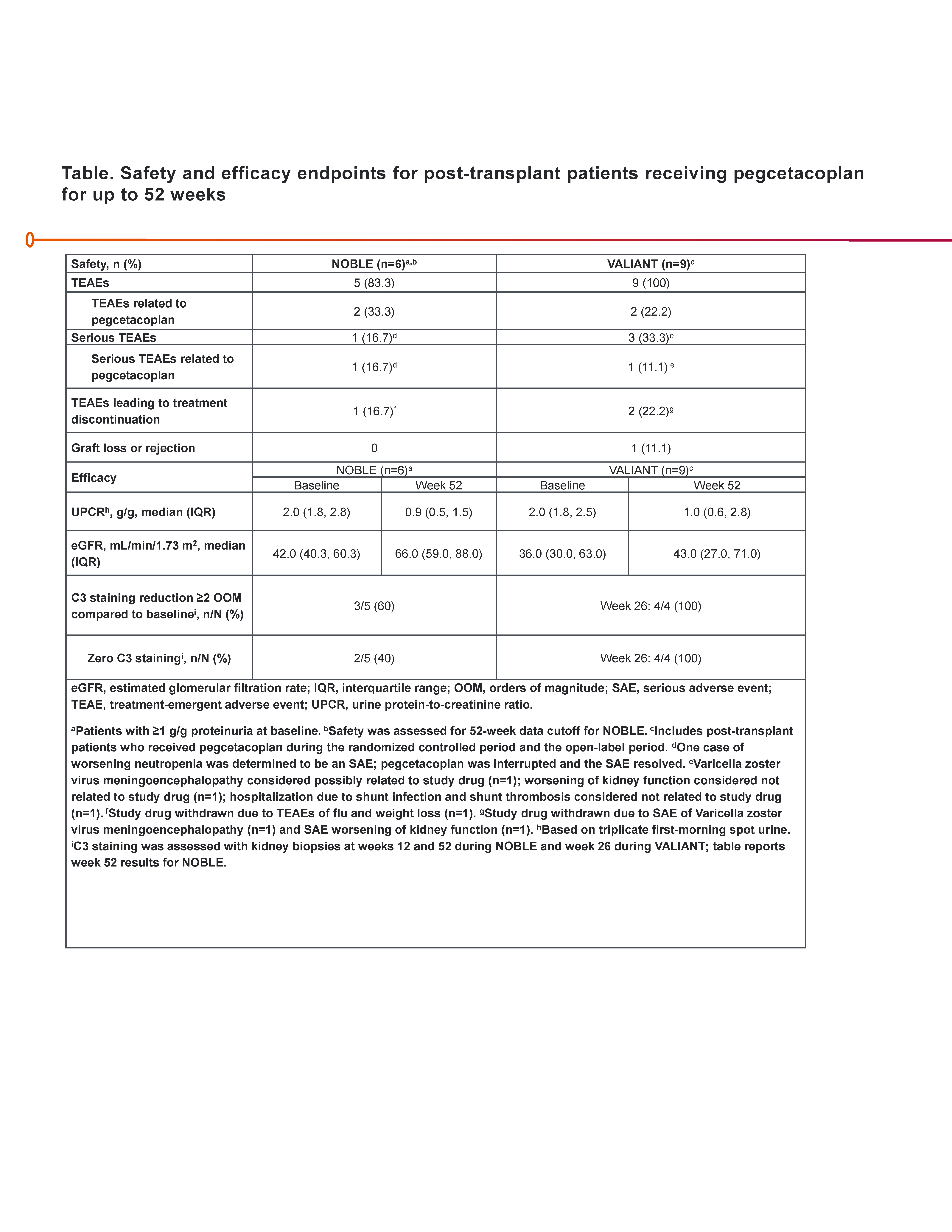
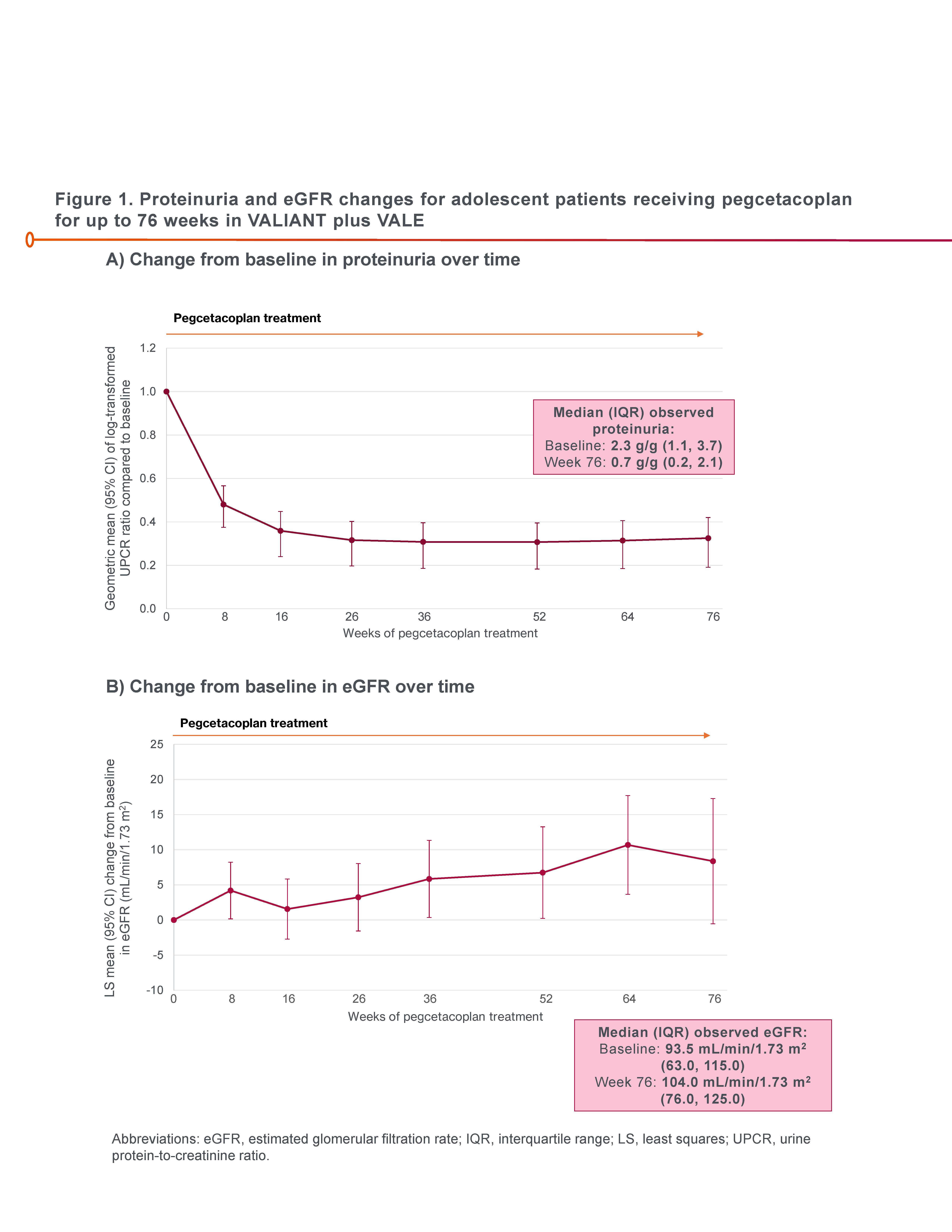
Methods: Fifteen post-transplant patients (including one 17-year-old) with ≥1 g/g proteinuria at baseline received pegcetacoplan (NOBLE, n=6; VALIANT, n=9). Study designs and biopsy schedules differed between studies, but all patients received pegcetacoplan 1080 mg subcutaneously twice weekly for 52 weeks. Efficacy endpoints included change from baseline in proteinuria (measured as urine protein-to-creatinine ratio [UPCR]), estimated glomerular filtration rate (eGFR), and C3 staining on kidney biopsy. Fifty-five adolescents started the VALIANT study. Results from 53 adolescents who received pegcetacoplan for 76 weeks in VALIANT plus VALE were aligned by pegcetacoplan treatment duration. Efficacy endpoints included changes from baseline in C3 staining, UPCR, and eGFR. Treatment-emergent adverse events were noted in NOBLE and VALIANT.
Results: Pegcetacoplan’s safety profile was favorable for post-transplant patients, with no graft loss or rejection reported during 52 weeks of treatment. Pegcetacoplan-treated post-transplant patients demonstrated decreased proteinuria and stable eGFR in both NOBLE and VALIANT (Table). C3 staining reduction was observed at weeks 12 and 52 in NOBLE, and at week 26 in VALIANT, suggesting that pegcetacoplan leads to early and sustained histopathological improvements. Adolescents who received pegcetacoplan for 76 weeks in VALIANT plus VALE had sustained proteinuria decrease (geometric mean change [95% CI] from baseline: –67.5% [–77.0, –54.1]) (Figure 1A). Results were consistent with proteinuria decreases achieved at week 26 (–68.4%) and week 52 (–69.3%) of pegcetacoplan treatment. Adolescents achieved stable eGFR with 76 weeks of pegcetacoplan (least squares mean [SE] change from baseline: +8.4 [4.43] mL/min/1.73 m2) (Figure 1B). No new safety signals were identified.
Conclusion: One year of pegcetacoplan treatment was safe and well tolerated for post-transplant patients with C3G and primary IC-MPGN; patients achieved decreased proteinuria, stable eGFR, and improved C3 staining. The clinical efficacy of 76 weeks of pegcetacoplan treatment for adolescents was consistent with the overall population of VALIANT, confirming its sustained benefit in broad patient populations.