Impact of washed versus unwashed packed red blood cell transfusion on isohemagglutinin titers in pediatric ABO-incompatible heart transplant candidates
Authors
Affiliations
Abstract
Introduction: Passive transfer of isohemagglutinins from packed red blood cell (pRBC) transfusions may increase recipient anti-A and/or anti-B titers, potentially precluding ABOi transplantation based on the Organ Procurement and Transplant Network (OPTN) eligibility criteria for ABO-incompatible (ABOi) heart transplantation because of hyperacute rejection concerns. To preserve ABOi heart transplant eligibility, some pediatric transplant centers use washed pRBCs to reduce donor-unit isohemagglutinin titers and minimize passive antibody transfer. Anticipating the upcoming COBE 2991 sunset, a blood-processing device commonly used for “washing”, we performed a two-phase study to assess the efficacy of pRBC washing in reducing isohemagglutinin titers and to quantify passive isohemagglutinin transfer after unwashed pRBC transfusion in young pediatric patients.
Methods: In phase 1, anti-A and anti-B isohemagglutinin titers were measured using erythrocyte agglutination in segments from 12 group O pRBC units before and after washing, yielding 48 measurements. In phase 2, plasma isohemagglutinin titers were measured from residual complete blood count (CBC) specimens from 25 pediatric patients before and after unwashed pRBC transfusion. Both anti-A and anti-B titers were measured in 4 group O recipients, giving 29 observations. These titers were also measured in the corresponding transfused pRBC units. Patients were excluded if they were older than 2 years, received multiple pRBC transfusions or other blood products between pre- and post-transfusion sample collection, or lacked a post-transfusion CBC. Bayesian logistic regression with leave-one-out sensitivity analysis was used to estimate the probability of post-transfusion titers associated with ABOi heart transplant ineligibility (≥1:32) or an intraoperative plasmapheresis indication (≥1:16).
Results: Washing significantly lowered both anti-A and anti-B isohemagglutinin titers in group O pRBC units (p<0.001, Table 1). After unwashed pRBC transfusion, 13.7% of observations reached the ABOi heart transplant ineligibility titer threshold, and 44.8% reached the intraoperative plasmapheresis threshold (Table 2). Higher pre-transfusion isohemagglutinin titers correlated with increased likelihood of both post-transfusion ABOi heart transplant ineligibility and intraoperative plasmapheresis (p = 0.008). Our model performed significantly better than the no information rate (p = .04437). A pre-transfusion titer of 1:8 coincided with a 50% predicted probability of a post-transfusion titer ≥1:16.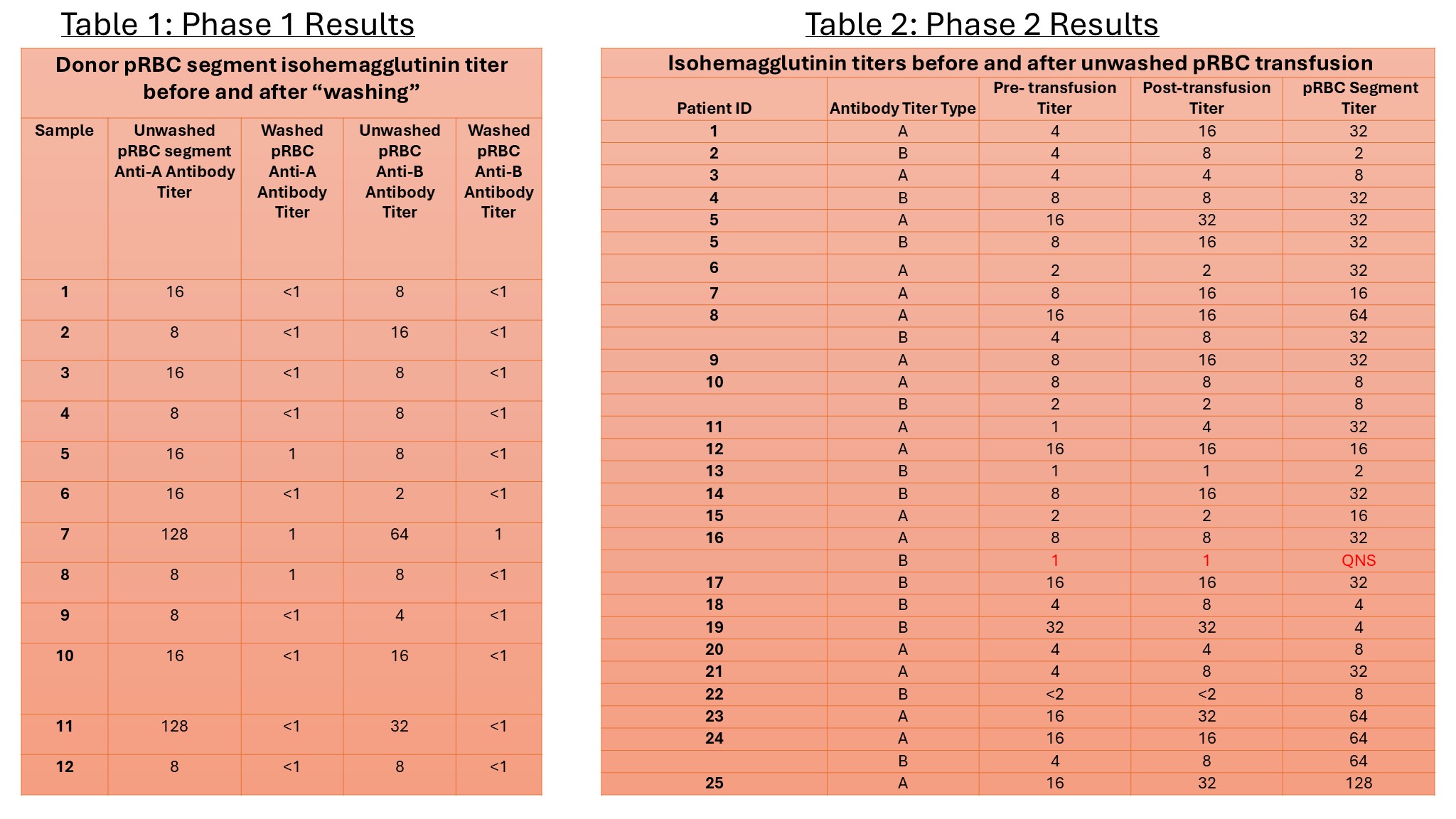
Conclusions: Washing effectively reduces isohemagluttinins. Young pediatric patients with a baseline titer ≤1:8 may be at lower risk for needing intraoperative plasmapheresis or ABOi transplant ineligibility after unwashed pRBC transfusion. Judicious washed pRBCs use in higher risk patients with a baseline titer >1:8 may be an effective way to maintain ABOi heart transplant candidacy while avoiding routine washing.