Beyond Cardiac Output: Myocardial Energetics in Pediatric Heart Transplantation - Exploratory Differences by Diagnosis and Ventricular Physiology
Authors
Affiliations
Abstract
Introduction: Myocardial performance score (MPS), a novel hemodynamic metric incorporating aortic pulsatility index (API) and cardiac power output (CPO), has been applied in adult heart failure and cardiogenic shock to assess physiologic reserve. However, CPO, API, and MPS have not been characterized as longitudinal markers of allograft energetics in pediatric heart transplantation. We evaluated indexed CPO (CPOi), API, and indexed MPS (MPSi) across serial post-transplant catheterizations in pediatric heart transplant recipients, stratified by primary diagnosis and ventricular physiology.
Methods: We performed a single-center retrospective study of pediatric patients transplanted at <18 years of age from July 2015 to August 2026. All available post-transplant hemodynamic catheterizations were reviewed. CPO was calculated as (MAP × CO)/451 and CPOi as (MAP x CI)/451. API was calculated as (SBP−DBP)/PCWP, MPS as (API × CPO)/2, and MPSi as (API x CPOi)/2. CPO and MPS were indexed to account for pediatric size variation. Patients were stratified by primary diagnosis, congenital heart disease (CHD) versus cardiomyopathy (CMY), and by ventricular physiology, single ventricle versus biventricular. Analyses were primarily descriptive; exploratory linear mixed-effects models with patient-level random intercepts were used to account for repeated catheterizations within patients.
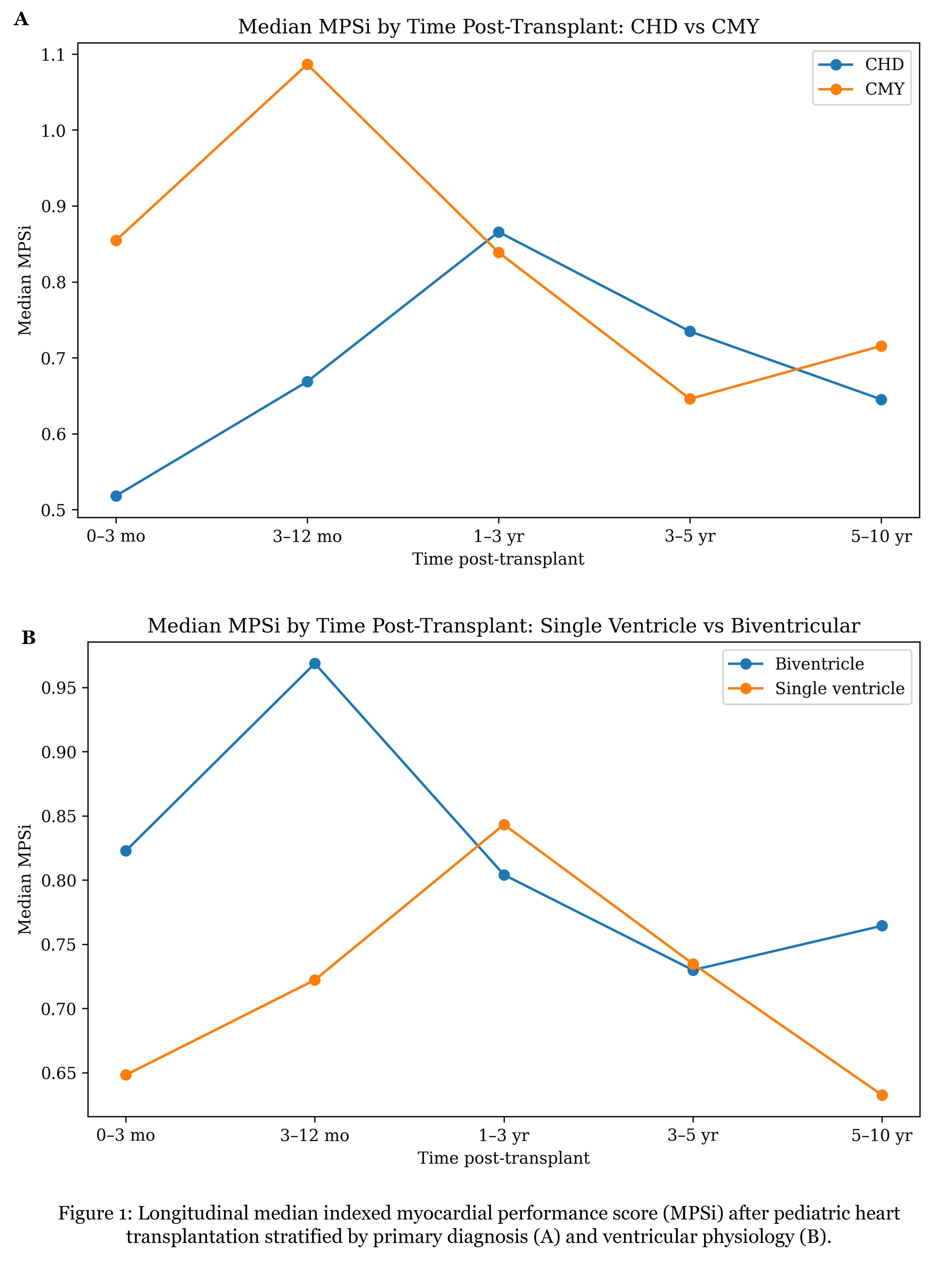
Results: The cohort included 75 patients and 449 catheterization encounters, with a median of 6 catheterizations per patient [IQR 3–8] and maximum follow-up of 9.89 years. Thirty-three patients (44%) had CHD, and 27 (36%) had single-ventricle physiology. Compared with CMY recipients, CHD recipients had similar median CPOi (0.41 vs 0.42; p=0.947), but lower API (3.30 vs 3.80; p=0.013) and MPSi (0.72 vs 0.81; p=0.011). Diagnosis-by-time interactions were significant for API and MPSi (p=0.001 and p=0.003, respectively). Similarly, single-ventricle recipients had comparable CPOi to biventricular recipients (0.42 vs 0.41; p=0.710), but lower API (3.20 vs 3.82; p=0.005) and MPSi (0.71 vs 0.80; p=0.015). The ventricular physiology-by-time interaction was significant for API (p=0.007), but not MPSi. Longitudinal MPSi patterns by diagnosis and ventricular physiology are shown in Figure 1.
Conclusion: This study represents the first descriptive application of CPOi, API, and MPSi to pediatric heart transplant allograft surveillance. CPOi was similar across diagnostic and ventricular physiology subgroups, whereas API and MPSi were modestly lower among CHD and single-ventricle recipients, suggesting that pediatric post-transplant allograft energetics may be influenced by recipient primary diagnosis and pre-transplant ventricular physiology. These exploratory findings establish early benchmark values and support future studies correlating serial MPSi trajectories with rejection, cardiac allograft vasculopathy, graft dysfunction, and survival.