Vital and Mighty: Can Shared Language Change How Children and Families Talk About Organ Donation?
Authors
Affiliations
Abstract
Introduction: Transplantation has precise clinical language for organs, donation and death, but families must make sense of these concepts culturally and emotionally as well as medically. Conversations may therefore begin with unfamiliar terminology at precisely the moment when understanding is most difficult. The Orgamites Mighty Education Programme uses a complementary, non-biomedical classification, namely “Vital and Mighty”, to give children, families, educators and health professionals accessible language for discussing which organs sustain one body and which can help another. Vital and Mighty is a programme-specific communication framework, not an anatomical, physiological, or clinical classification.We describe the rationale, development and application of this vocabulary and propose it as a subject for evaluation by the transplant community.
Methods: Within the educational model, Vital describes organs essential to sustaining life, while Mighty identifies transplantable organs and tissues represented by the Orgamites. Some are both Vital and Mighty; the brain provides an important exception: it is Vital but cannot be donated. Rather than replacing anatomical or clinical terminology, the classification acts as a communication layer through which children can explore organ function, transplantation and neurological determination of death. The concept has been operationalised through two public-education interventions: The Mighty Engine, an interactive museum experience exploring the body, organs and donation, and The Vital Brain, an animated communication tool developed for health-professional and public education.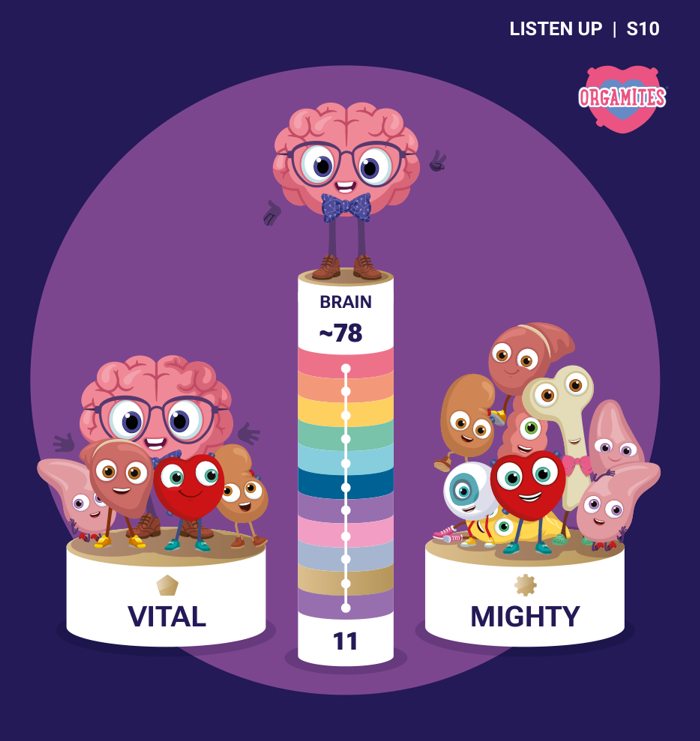
Results: The Mighty Engine has been implemented in Canadian museum settings and has engaged thousands of children, families and educators. Reported observations include sustained engagement with interactive stations and family conversations about organ health and donation. The wider Orgamites programme has directly reached approximately 180,000 students worldwide (annual reach in Greece alone is 50,000 students per school year), with open-access resources estimated to have reached a further 500,000 across more than 6000 schools in eight countries and territories. These findings demonstrate feasibility and reach; whether the Vital/Mighty vocabulary measurably improves understanding, recall, confidence or willingness to discuss donation has not yet been formally evaluated.
Conclusion: Accessible shared vocabulary may reduce barriers to age-appropriate discussion; this hypothesis requires empirical testing across cultural and linguistic settings.. Mighty is offered not as a biomedical reclassification, but as shared cultural vocabulary for something transplantation currently struggles to name simply: the organs and tissues capable of helping another body. We invite the pediatric transplant community to test this proposition with us, across cultures, languages and clinical contexts, and determine whether changing the language can help change the conversation.