Burden and growth among caregivers of heart, liver and kidney transplant recipients over time
Authors
Affiliations
Abstract
Background: Caregiver burden may result in reduction of quality of care provided to the patient and decrease in quality of life. Caring for children and adolescents with solid organ transplant places enormous demands on their caregivers, and the full scope of this is not yet recognized. The Zarit Caregiver Burden Scale (ZBS) is a validated tool used to evaluate burden, while the Post-Traumatic Growth Inventory (PTGI) is a tool to measure positive change in response to an impactful event. Using these tools, we sought to assess burden and post traumatic growth of caregivers of kidney, heart, and liver transplant recipients at 1-year, 3-years, and 5-years post-transplant.
Methods: In this cross-sectional study, caregivers were approached to complete the ZBS and PTGI. Total scores for ZBS (ranging 0 to 48) and PTGI (ranging 0 to 105) were calculated. Sociodemographic and transplant factors were obtained from the medical record (Figure 1). Descriptive statistics and T-tests were performed.
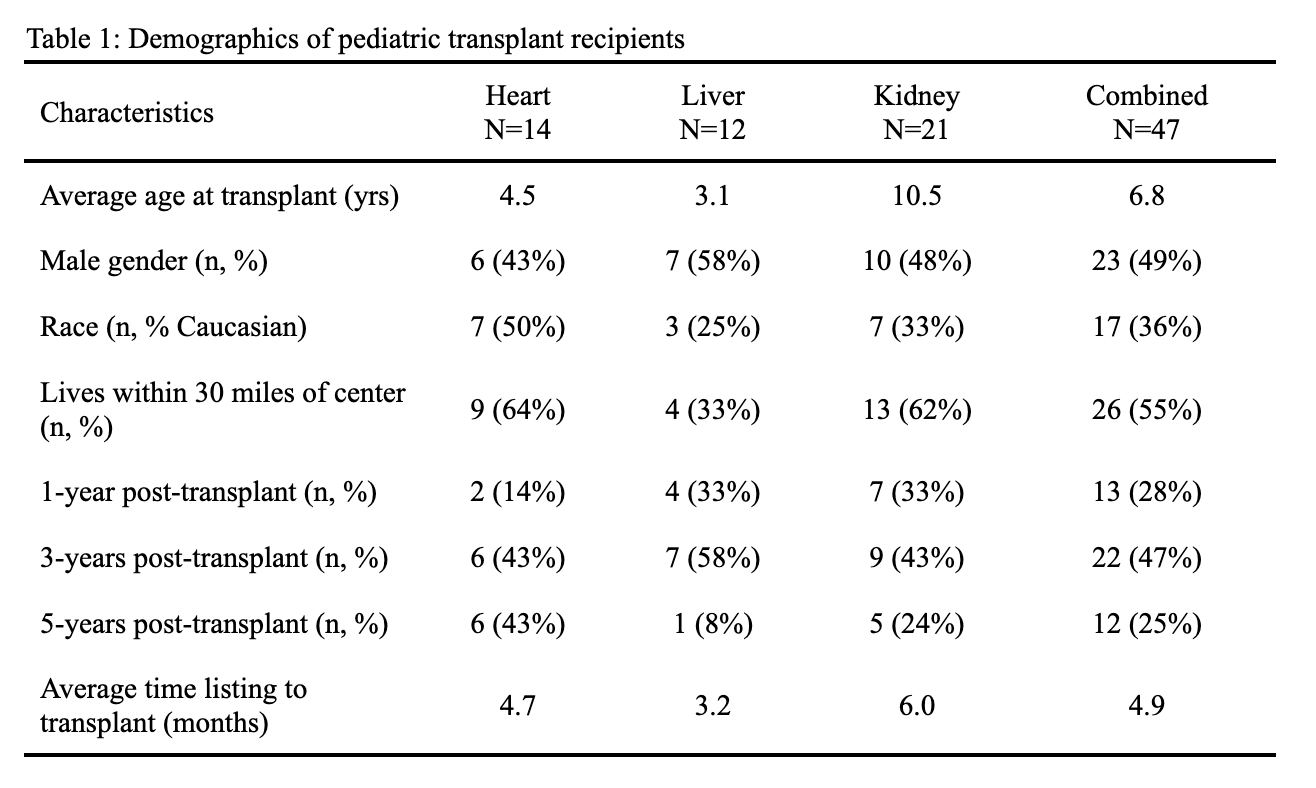
Results: A total of 47 caregivers agreed to participate: 14 of heart transplant recipients, 12 of liver transplant recipients, and 22 of kidney transplant recipients. Survey completion was 100%. ZBS scores were higher for caregivers of children in the 5-year post-transplant group than 1-year post-transplant, but not significantly (12.4 vs 7.5, p=0.06). This trend was noted across each solid organ transplant group (Figure 2). There was no difference in PTGI scores across the three-time points or solid organ transplant groups. The ZBS scores were significantly higher for non-Hispanic white caregivers compared to other races/ethnicities (14.3 vs 8.0, p=0.001), while there was no difference in PTGI scores. The ZBS scores were significantly higher for caregivers of infants/toddlers (0-2yo) and young children (3-11yo) when compared to adolescents (p=0.05 and p=0.04, respectively). The PTGI scores were significantly higher for caregivers of infants/toddlers compared to adolescents (p=0.03).
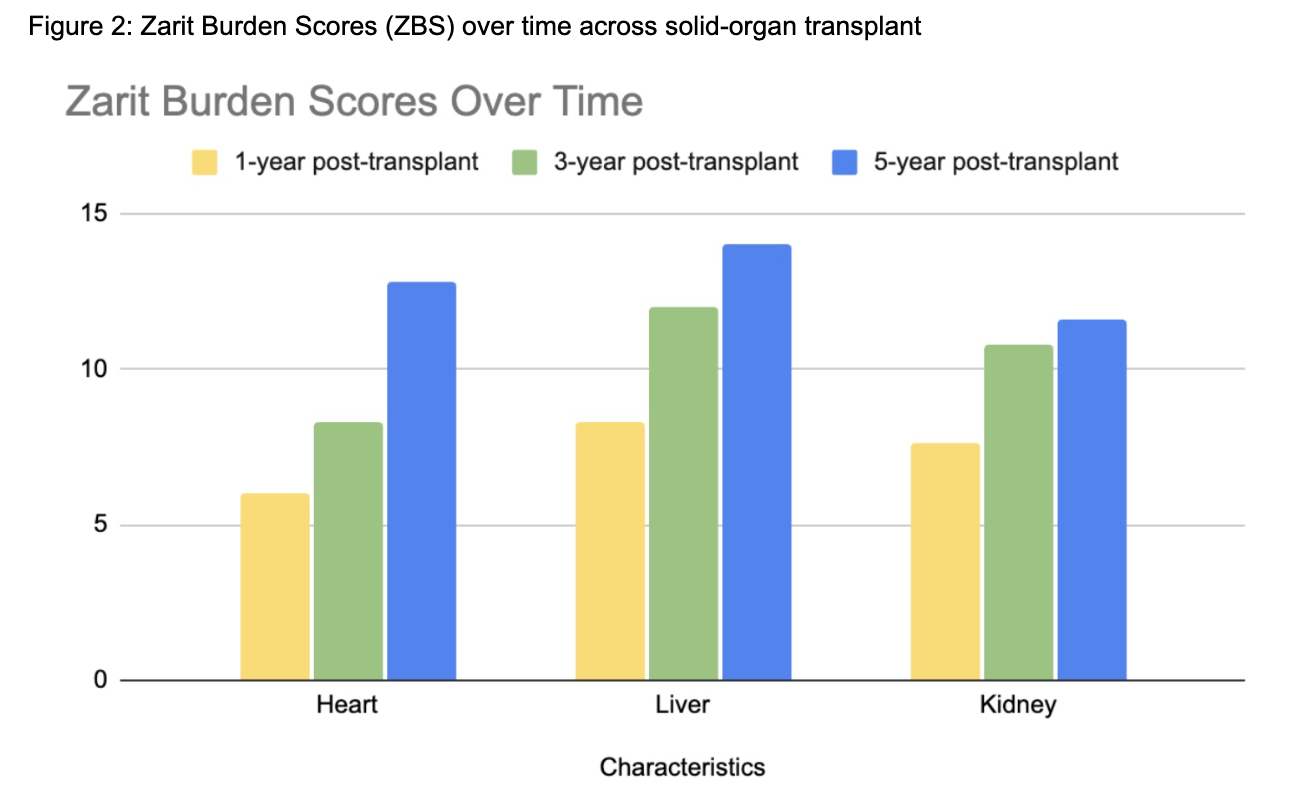
Conclusion: Caregivers of children with solid organ transplants experience significant burden that persists after the immediate transplant period. While sample size limited this study, there was a trend for higher burden scores further out from SOT. Despite increasing caregiver burden, PTGI scores remained stable, suggesting that caregivers may experience ongoing challenges while maintaining positive psychological growth. Additionally, race/ethnicity as well as patient age impact both caregiver burden scores as well as post-traumatic growth. Characterizing caregiver burden and post-traumatic growth may allow transplant teams to identify families who would benefit from targeted support to optimize outcomes for both caregivers and pediatric transplant recipients.