Persistent post-transplant hyperparathyroidism is associated with hypercalcemia, vitamin D deficiency, and inferior long-term graft function in pediatric kidney transplant recipients

Authors
Affiliations
Abstract
Introduction:
Post-transplant hyperparathyroidism (HPT) is common in pediatric kidney transplant recipients despite restored kidney function; yet distinguishing persistent from new-onset HPT and its prognostic relevance has never been studied in this population. We aimed to assess whether HPT phenotype at 1 year post-transplant identifies patients at risk for unfavorable long-term allograft function and disturbed mineral metabolism.
Methods:
Using CERTAIN registry data, 593 pediatric kidney transplant recipients with adequate early graft function (eGFR >30 mL/min/1.73m² at 30 days) were classified by pre-transplant and 1-year PTH-to-upper-limit-of-normal ratio (PTH/ULN) into three groups: no HPT, new-onset HPT, and persistent HPT. In an analysis restricted to recipients with pre-transplant HPT, outcome was compared between resolved and persistent HPT. Longitudinal eGFR, calcium, and 25-hydroxyvitamin D (25(OH)D) status and nutritional and activated vitamin D supplementation were analyzed using adjusted mixed-effects models.
Results:
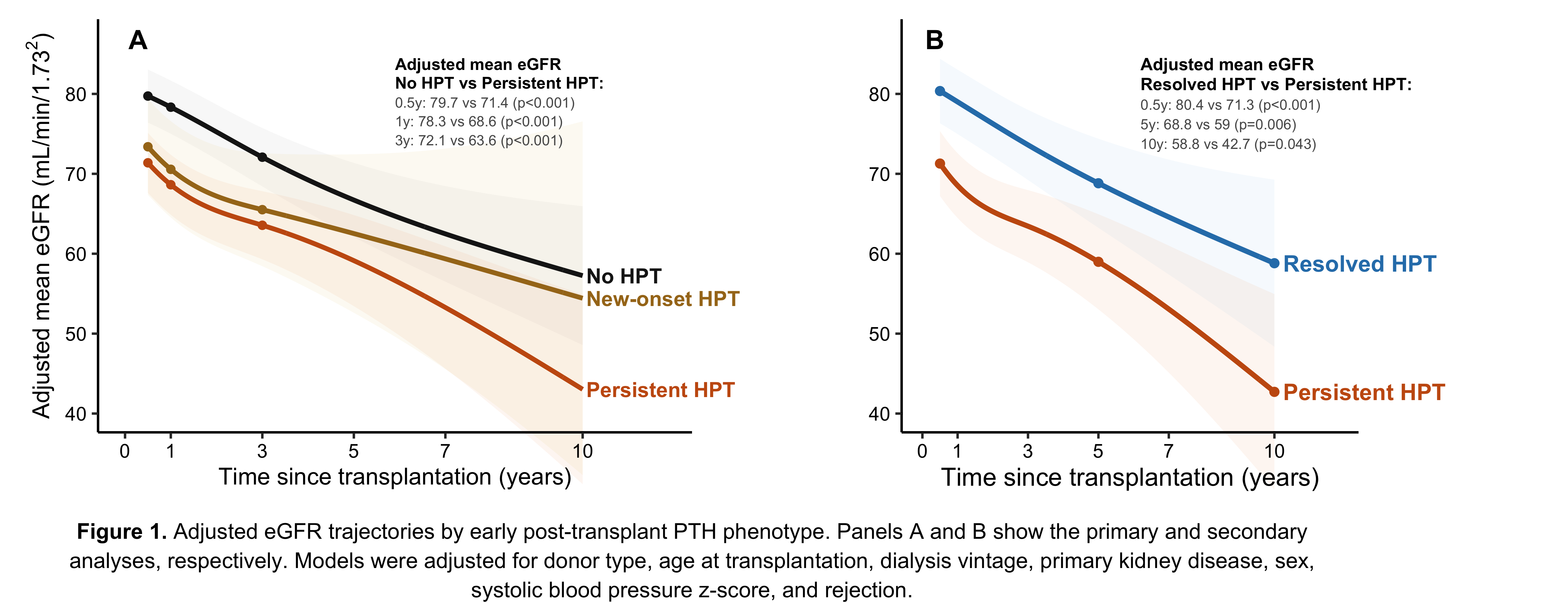
Among 593 recipients, 337 (56.8%) had no HPT at 1 year (including 250 with resolved HPT), 54 (9.1%) new-onset HPT, and 202 (34.1%) persistent HPT. Persistent HPT was associated with the least favorable eGFR trajectory (fig. 1A); resolved HPT maintained consistently higher adjusted eGFR throughout follow-up, with differences of 9.1 mL/min/1.73m² at 0.5 years (80.4 vs 71.3, p<0.001) and 16.1 mL/min/1.73m² at 10 years (58.8 vs 42.7, p=0.043) (fig. 1B). Persistent HPT was further characterized by higher odds of hypercalcemia than no HPT at 1 year (OR 2.01, 95% CI 1.20–3.38, p=0.008) and throughout years 1–5 (OR 2.50, 95% CI 1.51–4.12, p<0.001), and, at 1 year, higher odds of 25(OH)D deficiency (<20 µg/L) than both no HPT (OR 1.90, 95% CI 1.20–3.03, p=0.007) and resolved HPT (OR 1.77, 95% CI 1.08–2.92, p=0.024), alongside more frequent use of active vitamin D treatment than no HPT (OR 2.47, 95% CI 1.40–4.42, p=0.002) and resolved HPT (OR 2.65, 95% CI 1.42–5.11, p=0.003).
Conclusion:
We identify persistent HPT as a clinically relevant high-risk phenotype associated with sustained hypercalcemia, vitamin D deficiency, and inferior long-term graft function, with a 16 mL/min/1.73 m² difference in adjusted eGFR at 10 years post-transplant compared to resolved HPT. More frequent use of active vitamin D to suppress PTH likely contributes to the higher prevalence of hypercalcemia in this group. Given that the greatest decline in PTH occurs during the first post-transplant year, this period may represent a window of opportunity for HPT and mineral metabolism management, with potential benefits for long-term allograft function.