Measles is Back: Taking Action To Prevent it in Pediatric Liver Transplant Recipients
Authors
Affiliations
Abstract
The early 2025 measles outbreak in the United States prompted implementation of a quality initiative (QI) effort focusing on identifying the measles vaccine and serologic status and offering MMR vaccine to eligible pediatric liver transplant (LTx) recipients at our institution.
Methods
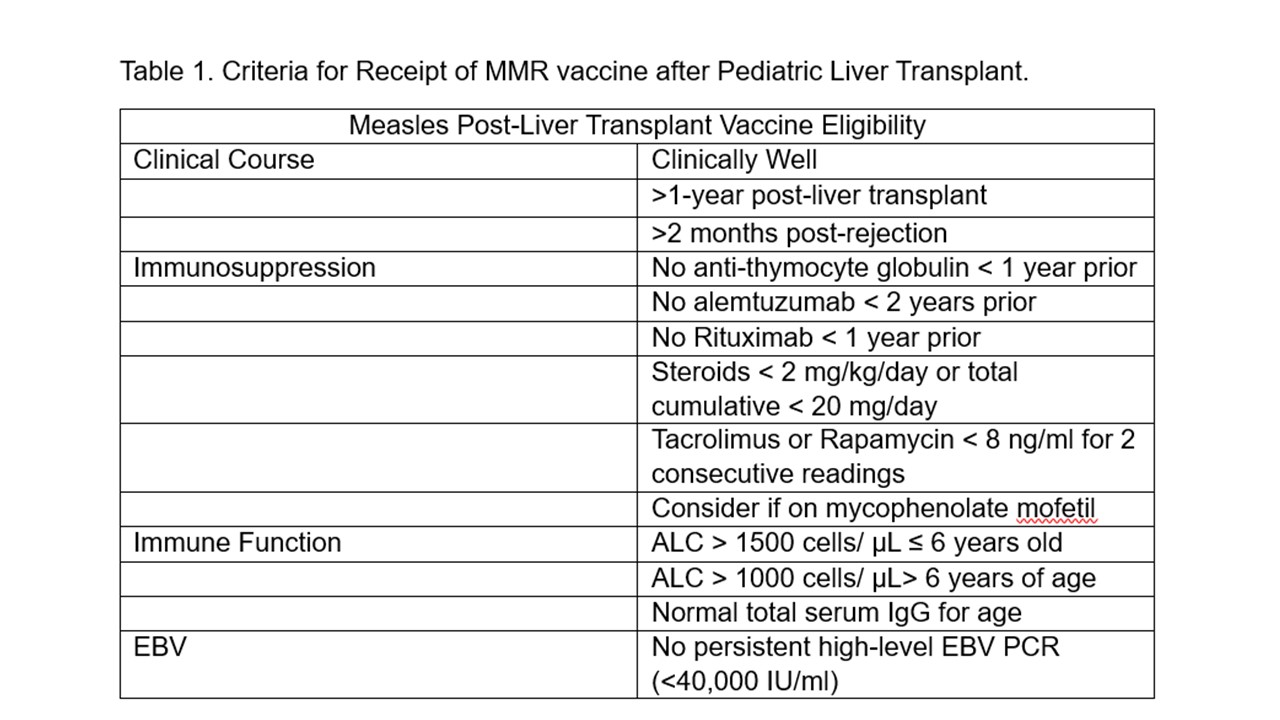
This approved QI project was initiated using the 2018 IPTA Live Viral Vaccine Consensus Conference guidelines as the basis for MMR vaccine recommendations. Patient (Pt) medical records were reviewed to identify vaccine status with confirmation by LTx Coordinators who spoke with families. Available measles titers (pre- and/or post-LTx), current immunosuppression regimen and levels, rejection history, absolute lymphocyte count, and EBV loads were documented. Current measles titers were recommended for any child with a prior history of measles vaccine. Children with no history of prior immunization or with negative measles titer meeting criteria for MMR vaccine per IPTA guidelines were offered immunization. Vaccine eligible patients with no pre-LTx vaccines were recommended 2 doses of MMR. Those with 1 pre-LTx dose of MMR, or 2 doses and negative measles serology, were recommended 1 post-LTx dose of MMR. Pts with 2 pre-LTx doses of MMR and positive measles serology did not require vaccination. Primary Care Providers (PCP) and families received letters explaining the recommendations. Families were called 10-12 days post-vaccination to assess for presence of fever, rash, and immunization site reactions. Measles titers were obtained >4 weeks after final dose of MMR. Provision of additional MMR doses for non-responders was decided on an ad hoc basis.
Results
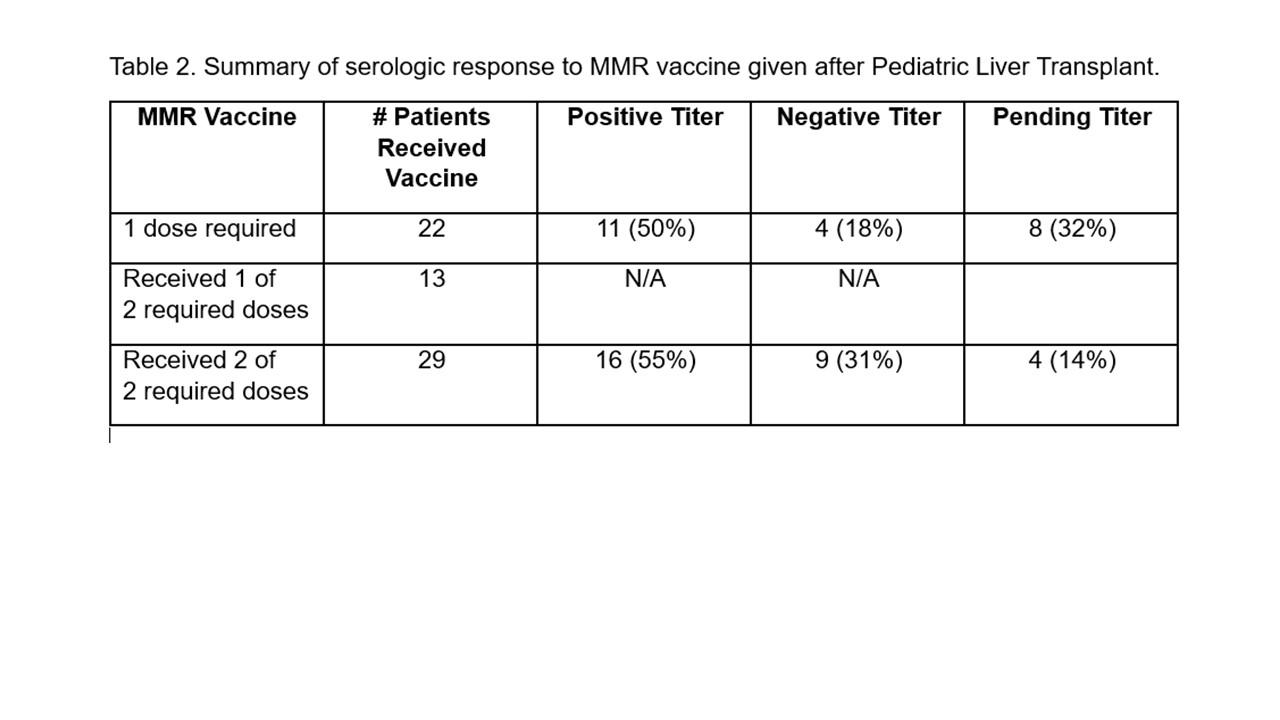
Between 5/2025 & 8/2026, 132/324 reviewed LTx recipients were recommended to receive MMR post-LTx. Those not recommended to receive post-LTx MMR included 93 with protective titers, 11 clinically unwell, 23 not meeting IPTA criteria, 36 transferred, 4 international, and 3 lost to follow up. The 17 remaining Pts include 15 with pending data and 2 whose family refused titers. 98/132 eligible Pts agreed to vaccination; 22 received 1 recommended vaccine; 11, 4 and 8 had positive, negative, or pending post-vaccine titers, respectively (Table 2). 29/42 recommended to receive 2 doses got both doses; 16, 9 and 4 were positive, negative or pending post-vaccine titer, respectively. The 13 remaining Pts received only 1 of 2 recommended doses so far. A single Pt experienced an adverse event consisting of coughing and wheezing which resolved with diphenhydramine IM and steroid treatment.
Conclusion
Eligible children can receive post-LTx measles vaccinations safely following the IPTA Guidelines with more than half the patients demonstrating protective serologic response. Future opportunities include evaluation of cellular immunity for patients with negative titers, consideration of 3rd post-transplant MMR for recipients with negative titers, and communicating with PCP to avoid delay in vaccine administration.