Clinical insights from a prospective multicenter study of Epstein Barr virus (EBV) replication in children after solid organ transplantation (SOT)
Authors
Affiliations
Abstract
Introduction: EBV replication and invasive disease remain a significant challenge of SOT, without proven prophylaxis or treatment. In particular, progression to post transplant lymphoproliferative disorders is a dreaded complication, more frequent in children who are more likely to be EBV naive prior to SOT. Almost all prior studies of EBV replication after SOT have been retrospective, and to date no validated biomarkers to predict EBV clearance have been identified or made clinically available.
Methods: The NIH-funded UNEARTH study is a prospective multicenter study evaluating immune responses to EBV replication in the first year after SOT in children. After informed consent, blood samples are drawn at five time points, including baseline (pre- or peri-transplant), then at 2, 4, 6 and 12 months after SOT. Clinical data collected into a REDCap study database includes demographic data on the donor and recipient (D/R), viral serostatus at SOT, immunosuppression, and results of peripheral blood EBV DNA loads as measured by PCR in the blood at and in-between study visits. Comparisons between clinical data accumulated so far were performed using Kaplan Meier time to event analysis and log-rank test.
Results: Among 238 participants consented, 222 have undergone SOT so far; 194/222 (87%) have at least one post-SOT EBV PCR result available. Demographic characteristics of the 194 children include: median age 10.3 years, 57% male and 79% white with 38%, 30% and 27% receiving a kidney, heart or liver SOT, respectively. Too few lung transplants have been enrolled to include in comparisons at this time. Sixty-six of the 194 (34.0%) developed detectable EBV DNA in blood with similar rates of EBV DNAemia occurring in kidney, heart and liver recipients (40%, 31%, and 32%, respectively). Time to detectable EBV DNAemia was not different between the three major SOT groups (figure 1).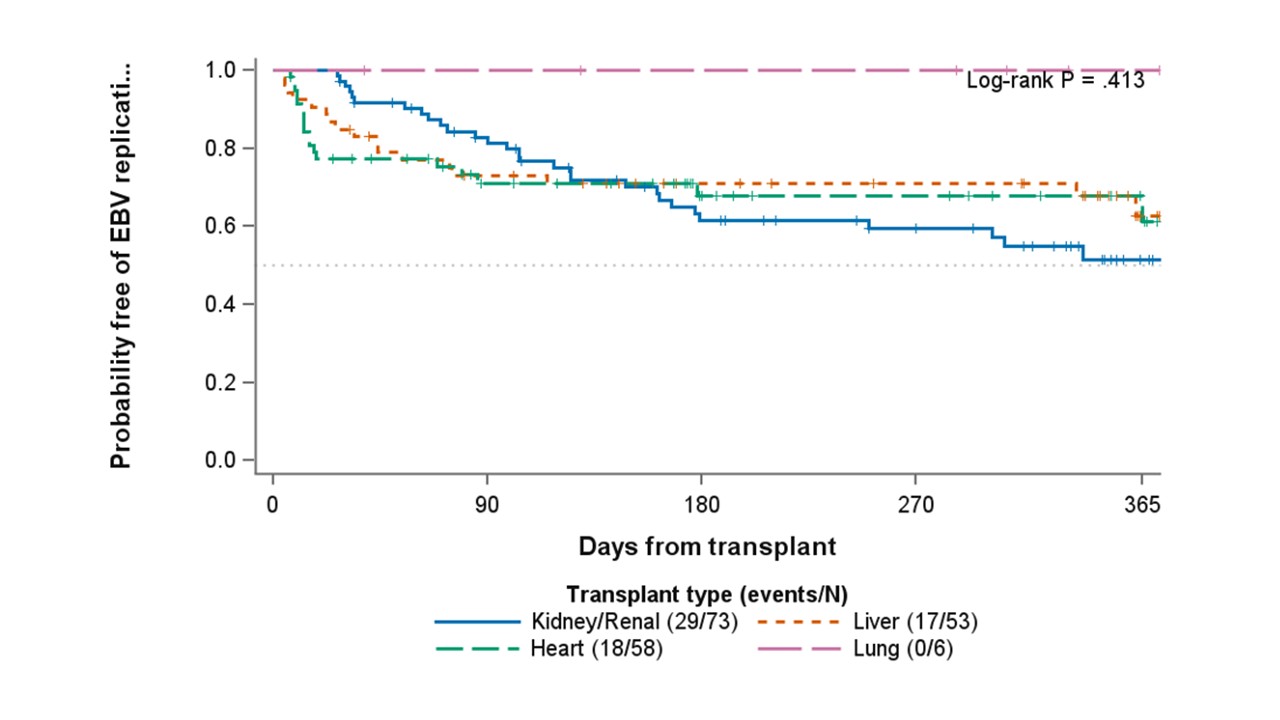
However, time to detectable EBV DNAemia differed significantly by D/R serostatus (log-rank P=.033), with the highest incidence in D+/R− recipients (19/31) and no events observed in D−/R− recipients (0/7; figure 2). 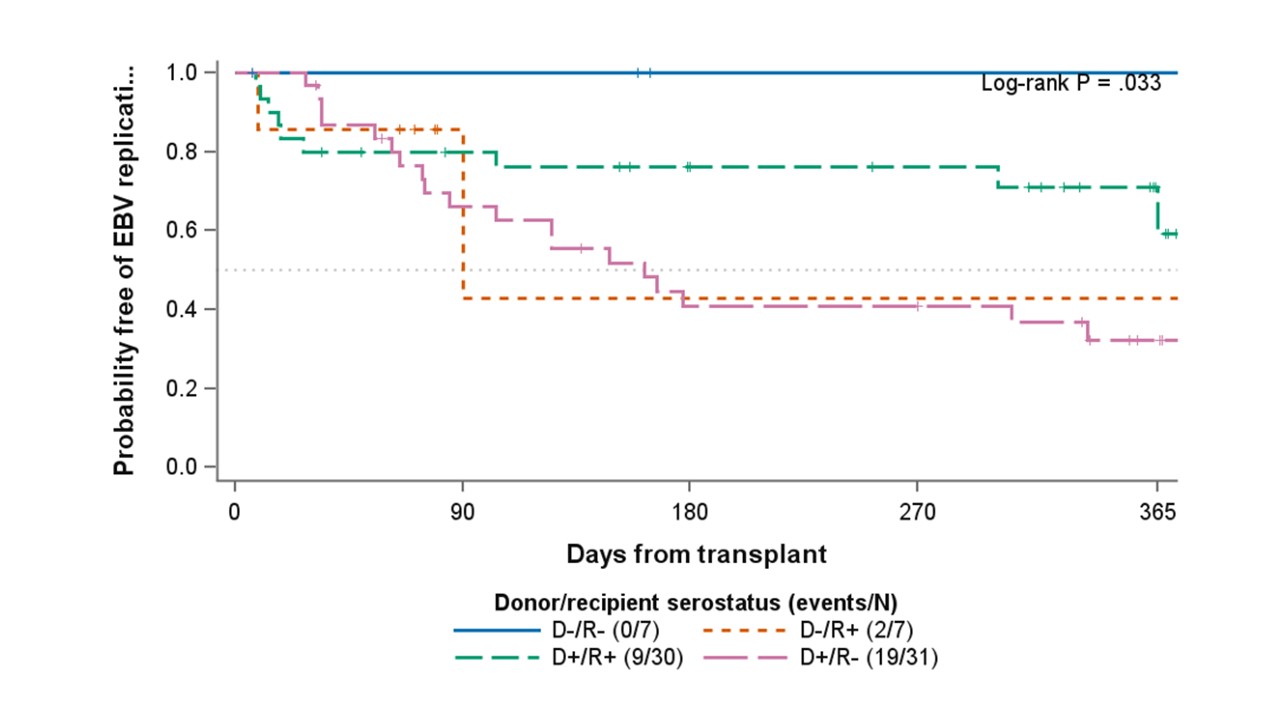
Of the 66 with a positive EBV PCR, 63 had at least one subsequent test; 45/63 (71.4%) achieved clearance (at least one negative PCR result). Time to clearance was not different by organ type or by donor/recipient EBV serostatus.
Conclusions: In this ongoing prospective study evaluating immune responses to EBV replication in the first year after SOT in children, we show a substantial rate of detectable EBV DNAemia, similar amongst 3 major SOT types. Time to first positive EBV PCR was similar between SOT types but differed by D/R serologic strata. Initial clearance of EBV DNAemia occurred frequently regardless of SOT type or D/R status. Ongoing evaluation of this cohort will provide additional information about the outcome of initial and recurrent episodes of EBV DNAemia and the impact of attempted interventions in the setting of contemporary immune suppression.