A Silent Tumor in a Noisy Liver: Recognizing Hepatocellular Carcinoma Risk in Pediatric PFIC before Liver Transplantations.
Authors
Affiliations
Abstract
Background: Progressive Familial Intrahepatic Cholestasis (PFIC) is a rare group of pediatric liver disorders that frequently progress to end-stage liver disease, with subtypes 2, 3, and 4 associated with an increased risk of hepatocellular carcinoma (HCC). The clinical silence of HCC in PFIC, obscured by symptoms like hepatomegaly, elevated liver enzymes, and high alpha- fetoprotein (AFP) levels, often limits early detection, particularly with conventional imaging such as ultrasound. This study aims to quantify the incidence of HCC in pediatric PFIC patients prior to liver transplantation, assess whether HCC was detected preoperatively or incidentally during explant analysis, and evaluate the potential of early liver transplantation to mitigate HCC risk.
Methods: A retrospective cohort study was conducted using a prospectively maintained database at the Pakistan Kidney and Liver Institute and Research Center (PKLI&RC). The study analyzed medical records of 30 pediatric patients with PFIC who underwent liver transplantation between 2020 and 2025. Clinical, surgical, and pathological data were extracted, particularly focusing on patients diagnosed with HCC.
Statistical analysis was performed using IBM SPSS Statistics Version 29 to identify potential risk factors and prognostic indicators. Univariate analyses were carried out to compare outcomes between PFIC patients with and without HCC. For categorical variables, either the Chi-square test or Fisher’s exact test was used, depending on the expected frequencies. For continuous variables, comparisons were made using the independent t-test if the data followed a normal distribution, or the Mann–Whitney U test if the data were non-normally distributed.
.
Results: Of 34 pediatric PFIC patients (median age 6.1 years), 5 (16.7%) developed HCC, with 2
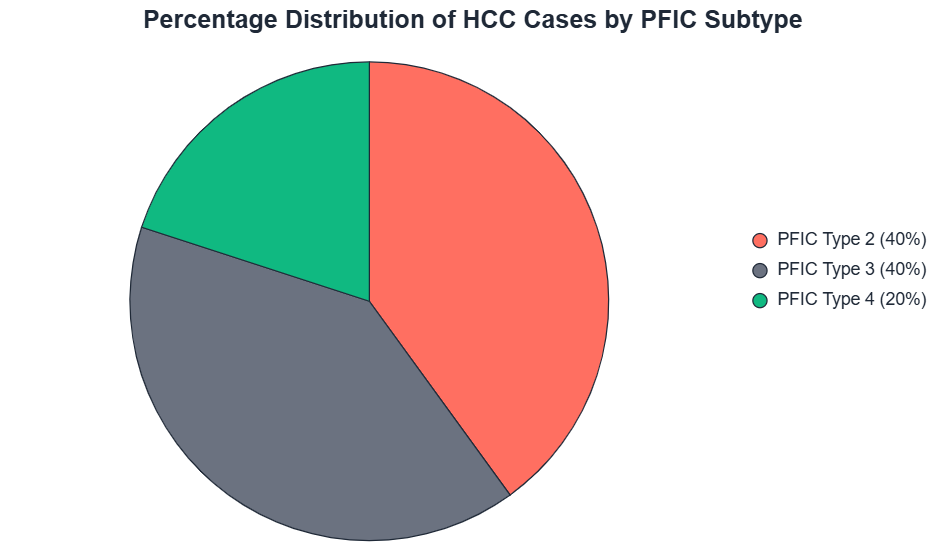
Cases in PFIC type 2 (40%), 2 in type 3 (40%), and 1 in type 4 (20%). HCC was pre-diagnosed in 4 cases via CT imaging and elevated AFP levels (median 981.9 ng/mL, range 2.2–28055 ng/mL), one of the pre-diagnosed case does not have HCC on histopathology. While 2 cases were identified incidentally during explant analysis. Tumors were solitary in 80% of cases, with sizes ranging from 0.8 to 13 cm, and no nodal involvement was reported. Elevated AFP levels were non-specific, observed in 80% of non-HCC patients (median 2.2 ng/mL). Early transplantation may reduce HCC-related mortality. 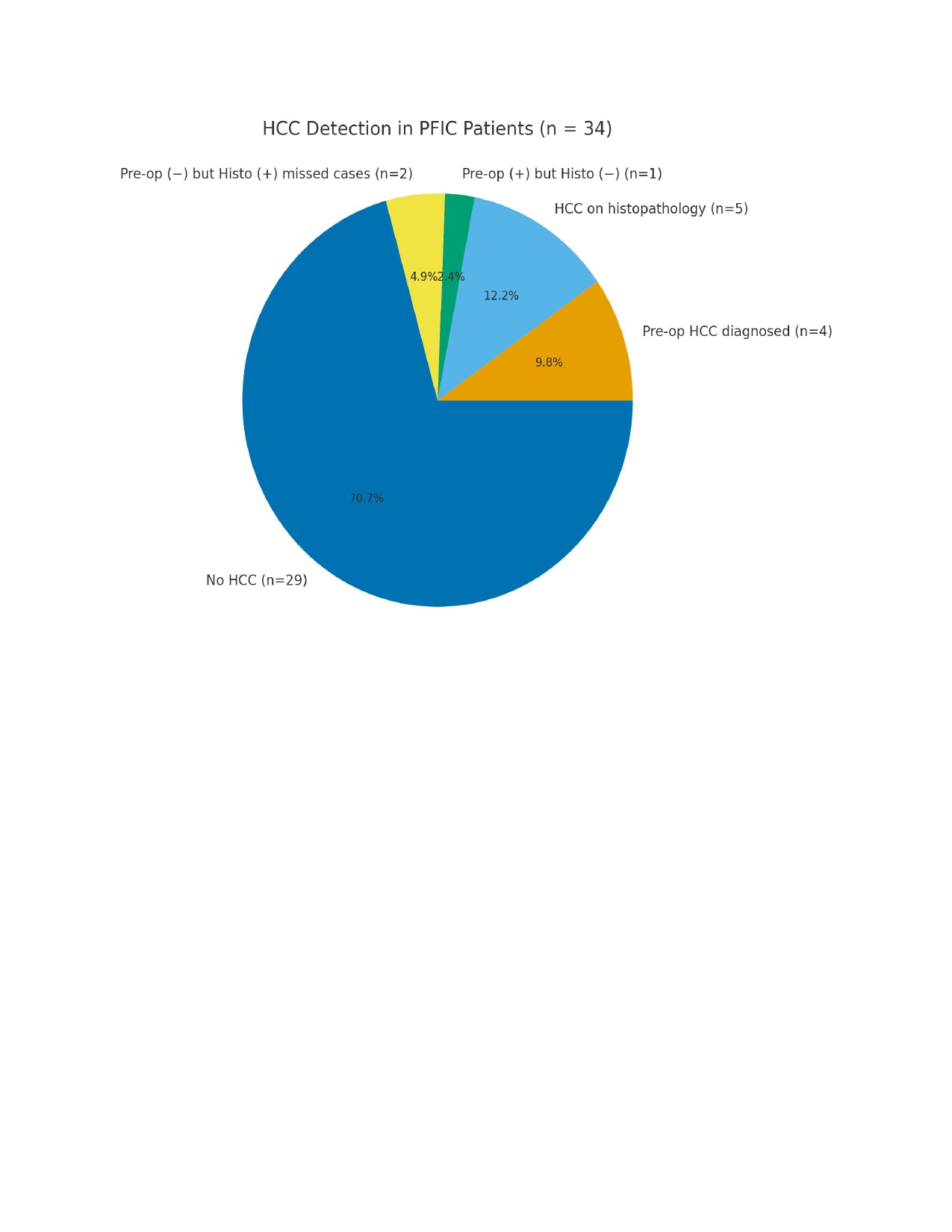
Conclusion: HCC is a significant, often undetected complication in pediatric PFIC, particularly subtypes 2, 3, and 4. Enhanced surveillance protocols, integrating serial AFP monitoring, advanced imaging (e.g. triphasic CT), and clinical evaluation, are essential for early detection and improved outcomes. Early liver transplantation may reduce HCC risk in high-risk population.