Expanding the Pediatric Donor Pool Beyond Conventional Transaminase Criteria
Authors
Affiliations
Abstract
Introduction:
Marked donor transaminase elevation may discourage liver utilization because of concern for donor hepatocellular injury, early allograft dysfunction (EAD), and graft loss. However, aminotransferase magnitude alone may incompletely reflect graft quality, particularly when biochemical injury is improving before procurement. Pediatric recipients face additional constraints in donor availability, yet pediatric-specific evidence regarding transplantation of grafts with extreme donor transaminase elevations remains limited. Better characterization of these grafts may inform appropriate expansion of pediatric donor acceptance.
Methods:
A retrospective single-center cohort of 186 pediatric liver transplants (LTs) performed between 2001 and 2026 was evaluated. Grafts were stratified by maximum donor AST/ALT as <500, 500–999, or ≥1,000 U/L. Donor peak and terminal transaminases and pre-procurement biochemical trajectory were evaluated. Outcomes included EAD, early recipient hepatocellular injury, and graft survival at 90 days and one year.
Results:
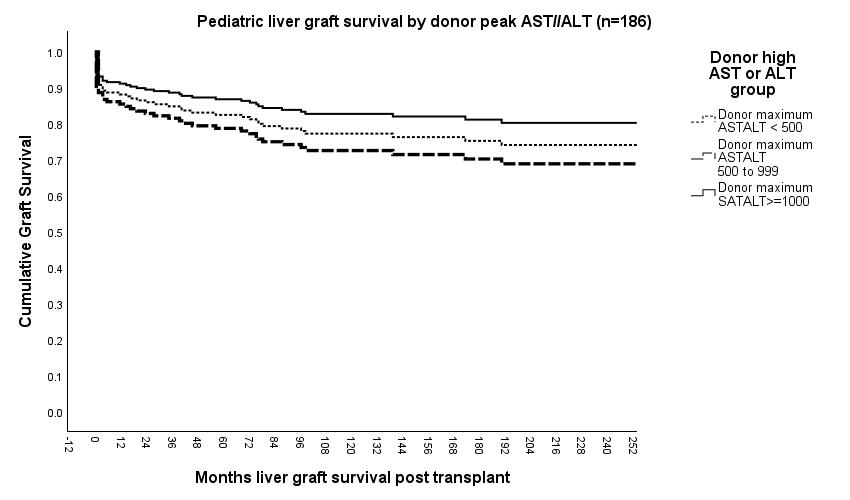
Of 186 transplanted grafts, 141 (76%) had maximum donor AST/ALT <500 U/L, 24 (13%) had 500–999 U/L, and 21 (11%) had ≥1,000 U/L. Despite increasing donor transaminase severity, EAD did not differ significantly across groups (40%, 46%, and 24%, respectively; p=0.28). Ninety-day graft survival was 89%, 92%, and 95% (p=0.61), and one-year graft survival was 87%, 83%, and 95% (p=0.46), respectively (Figure 1). Recipient hepatocellular injury showed no dose-response across increasing donor transaminase categories. Among grafts with peak AST ≥1,000 U/L, donor AST demonstrated substantial biochemical improvement before procurement, with a median decline of approximately 81%. Thus, the highest transaminase group showed no measurable increase in EAD or decrement in short-term graft survival despite extreme peak biochemical injury.
Conclusion:
Among carefully selected grafts used for pediatric LT, extreme donor transaminase elevation was not associated with greater EAD or inferior short-term graft survival. The substantial pre-procurement improvement observed among grafts with AST ≥1,000 U/L further suggests that a single peak aminotransferase value may incompletely characterize donor suitability. These findings support evaluating transaminase magnitude and trajectory within the broader donor context rather than using extreme enzyme elevation as an isolated barrier to pediatric liver utilization. Because this cohort includes only transplanted grafts, these results should inform expanded donor assessment rather than define the safety of declined grafts.
Figure 1. Graft survival after pediatric liver transplantation according to peak donor serum sodium.