National changes in pediatric liver graft selection across allocation eras and center volumes
Authors
Affiliations
Abstract
Introduction: Recent implementation of the Acuity Circle (AC) allocation and the Pediatric End-Stage Liver Disease–creatinine (PELD-Cr) score fundamentally changed pediatric liver allocation in the United States. Whether these policy changes altered pediatric liver graft selection across transplant center volumes while preserving outcomes remains unknown. Changes in graft selection across allocation eras and early graft and patient outcomes were evaluated.
Methods: UNOS data was analyzed for liver-only transplants in recipients <12 years during the pre-AC (January 1, 2016–February 3, 2020), AC/pre-PELD-Cr (February 4, 2020–July 12, 2023), and PELD-Cr (July 13, 2023–December 31, 2025) eras. Grafts were categorized as whole or segmental pediatric deceased donor, whole or segmental adult deceased donor, or living donor. Graft distributions were compared across eras overall and within annualized center-volume strata (low, ≤5/year; medium, 6-10/year; high, >10/year). Kaplan–Meier methods estimated 90-day and 1-year graft and patient survival.
Results: The distribution of graft types differed significantly across allocation eras among 4,057 recipients at 61 centers (pre-AC, n=1,760; AC/pre-PELD-Cr, n=1,293; PELD-Cr, n=1,004; p<0.001). Living donor use increased from 14.7% to 19.0% to 23.5% (pre-AC to PELD-Cr change, +8.85 percentage points (pp); 95% CI, 5.75–11.95). Similarly, segmental pediatric graft use increased from 8.8% to 10.1% to 12.5% (+3.70 pp; 95% CI, 1.27–6.13). Whole pediatric grafts decreased from 57.6% to 55.7% to 46.4% (−11.14 pp; 95% CI, −15.00 to −7.29) (Figure 1A). From the pre-AC to the PELD-Cr era, living donor use increased by 11.8, 8.6, and 8.9 pp across low-, medium-, and high-volume centers, respectively. Segmental pediatric graft use increased by 2.8, 4.7, and 3.2 pp, respectively, whereas whole pediatric graft use decreased by 9.1, 5.2, and 14.3 pp, respectively (Figure 1B).
Death-censored graft survival remained comparable across eras at both 90 days (p=0.445) and 1 year (p=0.645), as did patient survival (90-day, p=0.729; 1-year, p=0.829). Within each era, graft and patient survival did not differ significantly among the five donor graft groups.
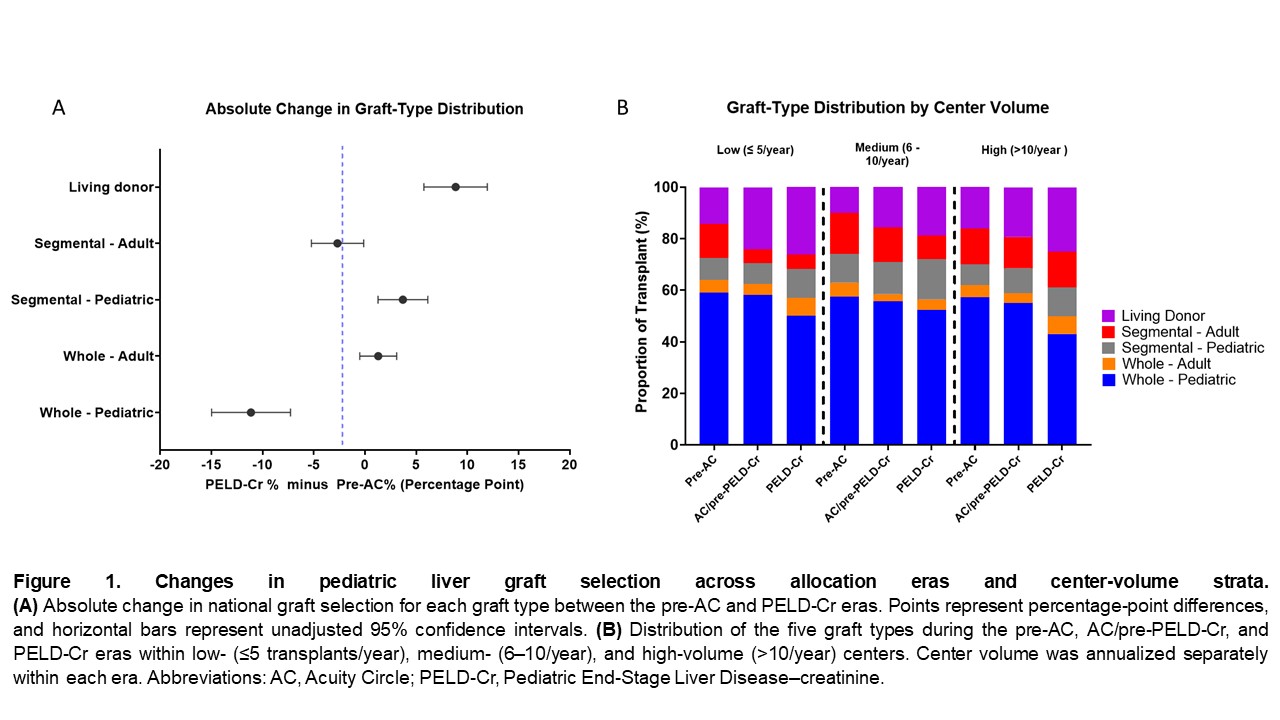
Conclusions: National pediatric liver graft selection shifted toward living donor and segmental pediatric donor grafts and away from whole pediatric donor grafts across all center-volume strata, while 90-day and 1-year graft and patient survival remained stable. These findings demonstrate national adaptation to evolving allocation policy through increased use of living donor and segmental grafts without compromising early graft or patient survival.